
Martin Midstream Partnering Gulf Coast Energy Flows as Q1 Updates Reinforce Stability
Q1 2026 results affirm Martin Midstream’s stable, diversified midstream model anchored in the U.S. Gulf Coast with durable contracts.
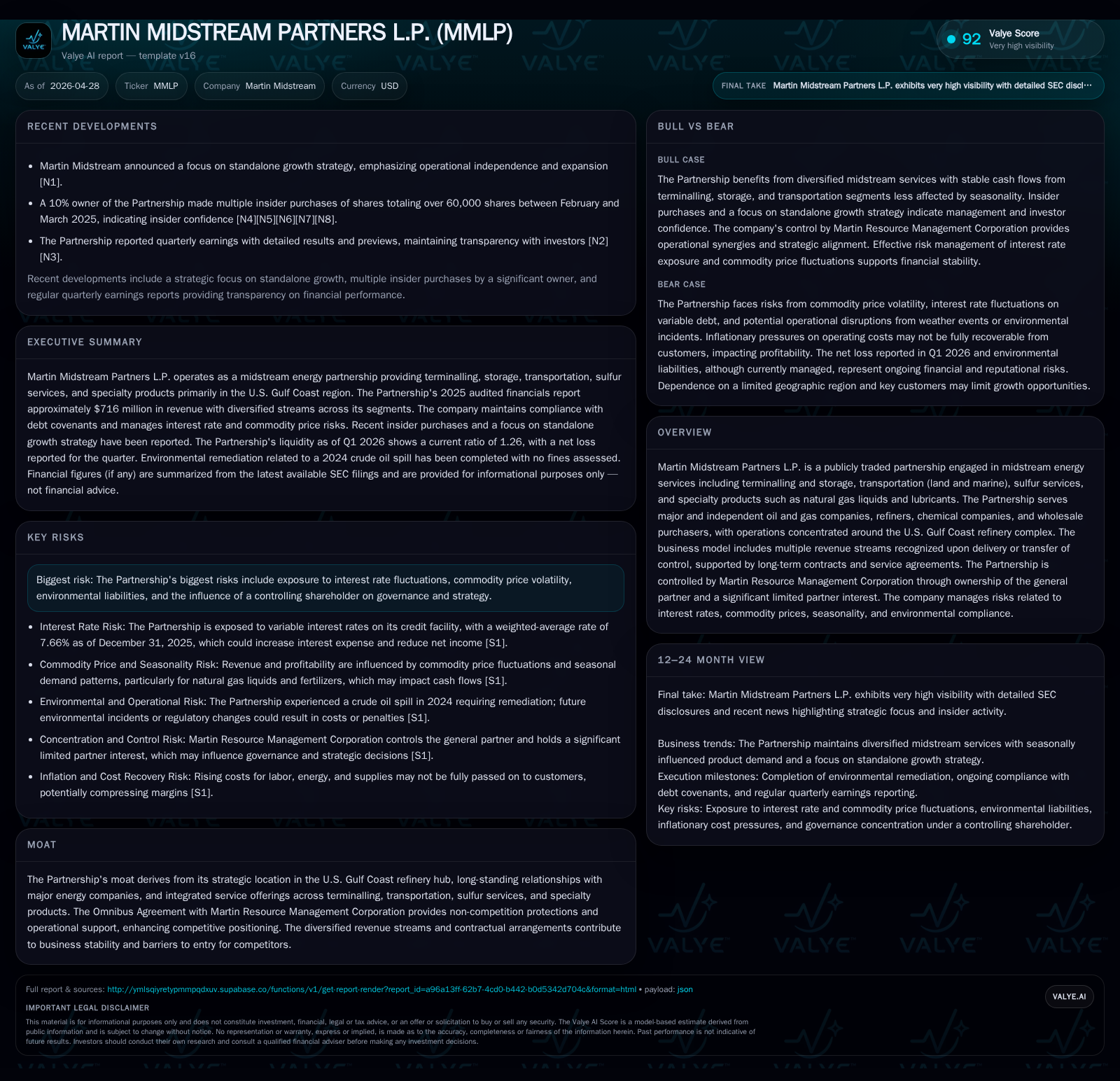
Martin Midstream Partners L.P.'s first quarter 2026 operating report highlights steadiness in its multi-segment energy infrastructure business centered on terminalling, transportation, sulfur services, and specialty products. The company continues to benefit from long-term contracts and its strategic Gulf Coast location, which together underpin resilient cash flow amid commodity price and interest rate risks. Environmental remediation efforts have stabilized with no new material liabilities. Going forward, growth hinges on expanding petrochemical demand and contract renewals against inflationary pressures and regulatory oversight.
Q1 2026 Operational Update: What Has Shifted?
Martin Midstream Partners L.P.'s latest quarterly report (10-Q filed April 27, 2026) reveals no significant changes in its risk profile since the annual filing earlier this year [S2]. Management disclosed no amendments to insider trading arrangements during the first quarter, underscoring steady governance practices. An earlier April 22 event filing (8-K) confirmed issuance of the Q1 earnings summary alongside supplemental information [S3], reflecting transparency in communications.
Critically, the Partnership reported consistent operating conditions with no emergent risks flagged. The absence of material shifts in factors such as interest rate exposure, environmental matters, or counterparty credit risk signals continuity. This stability anchors confidence in Martin Midstream’s ongoing operational discipline and contractual strength.
Multi-Stream Business Model Anchored in the Gulf Coast Hub
Martin Midstream derives revenue from four main segments: terminalling and storage; transportation (both land based and marine); sulfur services; and specialty products including natural gas liquids (NGLs) and lubricants [S1]. These operations cluster primarily around the strategically crucial U.S. Gulf Coast refinery complex—a nexus for hydrocarbon processing and distribution that forms a durable geographic moat.
Customers range across major oil producers, independent operators, refiners, chemical manufacturers, and wholesale purchasers who rely on Martin’s integrated infrastructure offering. Revenue recognition typically occurs upon transfer of control under long-term contracts or service agreements that provide predictable cash flows insulated from spot commodity swings [S1]. Integration across service lines enhances customer retention by bundling complementary midstream functions.
Sector Positioning: Industry Dynamics and Competitive Advantages
The midstream sector benefits from persistent demand for energy product transportation and storage driven by refining throughput and petrochemical manufacturing activity—especially robust on the Gulf Coast corridor where Martin is focused. Competition includes regional logistics providers operating pipelines, terminals, or marine fleets; however, Martin’s service breadth combined with proximity to complex refinery clusters affords it competitive differentiation.
The Partnership’s Omnibus Agreement with controlling shareholder Martin Resource Management Corporation provides operational support plus non-compete protections that erect barriers to entry for rivals. Environmental compliance is a salient industry factor given recent regulatory intensification related to pipeline spills or emissions reporting. Martin has demonstrated responsiveness here—mitigating reputational damage while limiting incremental costs.
Contract Structures and Revenue Durability
Long-term contracts form the backbone of revenue durability at Martin Midstream [S1]. Many agreements incorporate pass-through provisions shielding margin erosion by allowing recovery of commodity price movements or input cost increases in certain segments such as fertilizer supply chains.
Seasonality moderately affects specialty product sales tied to winter heating demand for NGLs and spring planting cycles for fertilizers. However, core income drivers—terminalling/storage fees plus sulfur services—are relatively immune to seasonal volatility. This mix balances cyclicality inherent in energy markets.
Growth Catalysts and Constraints in the Midstream Landscape
Expansion of petrochemical capacity along the Gulf Coast represents a tangible growth lever due to heightened feedstock demands requiring increased throughput and logistics services. Similarly, rising marine transport volumes for refined products offer incremental vessel utilization upside.
Conversely, inflationary pressures could increase replacement capex costs alongside operating expenses linked to diesel fuel consumption or labor shortages—a notable concern within midstream labor markets nationally. Fluctuating interest rates expose Martin’s credit facility under variable terms to elevated funding costs absent swap hedges.
Environmental remediation obligations add complexity despite no recent material expenses reported; regulatory scrutiny remains a constant constraint on operational flexibility. Market competition may also pressure pricing in commoditized service lines absent further contractual insulation.
Environmental, Regulatory, and Financial Risk Factors
The Partnership has faced historically notable environmental liabilities stemming from a June 2024 crude oil pipeline spill near its Arkansas terminal. Prompt coordination with EPA and state agencies transitioned cleanup operations successfully from emergency response to full remediation completion with no fines levied as of early 2026. Insurance policies covered most associated costs beyond a $0.5 million deductible recorded as an operating expense.
Financially, Martin continues to manage interest rate exposure via derivatives strategies aligned with its hedging policy. Credit facility covenants necessitate adherence to leverage ratios restricting debt issuance capacity but remain presently compliant [S2]. Commodity price risks are mitigated partly through contract structures yet remain an intrinsic operational challenge given cyclical upstream market dynamics.
Upcoming Milestones and What Investors Should Watch
Near-term catalysts include key contract renegotiations that may recalibrate fee structures reflective of inflation or volume changes [S2][S3]. Planned capital expenditures primarily focus on sustaining asset reliability plus incremental expansions aligned with petrochemical customer growth trajectories.
Management commentary during upcoming earnings calls should be monitored closely for updates on throughput trends impacted by refining margin swings or weather events such as hurricanes which intermittently disrupt logistics chains regionally.
Energy commodity pricing shifts will indirectly influence demand levels given their effect on production economics across Martin’s customer base. Regulatory developments—especially new environmental mandates—also merit attention as potential cost headwinds emerging over medium term horizons.
Compact Financial Snapshot Supporting Operating Insights
As of March 31, 2026, the Partnership held current assets around $148.8 million against current liabilities near $118.2 million, resulting in a current ratio approximately 1.26 evidencing sufficient near-term liquidity [F1]. Net debt approximated $378 million based on last available gross debt minus cash holdings [F1], consistent with prior leverage profiles reported.
Importantly, all debt covenants were met as per December-end disclosures with expectations maintained for twelve-month covenant compliance going forward [S2][S4]. This financial posture underscores operational resilience even amidst low-margin specialty products where scale economies are critical.
This analysis is based solely on publicly filed documents including SEC filings through April 27, 2026. It neither constitutes investment advice nor endorsement but aims to provide an informed industry perspective grounded in verified disclosures relevant to Martin Midstream Partners L.P.’s business model sustainability, competitive stance, risk exposures, and growth outlook.
Disclaimer: This is research-only, informational analysis and not investment advice. It may include AI-generated interpretation and general industry context. Always verify important details using primary sources.

Comments