
Metals Royalty Co Inc. Launches Nasdaq Listing to Capitalize on Critical Metals Demand
TMCR’s Nasdaq debut marks its transition to a public royalty-focused vehicle positioned to benefit from rising critical metals demand.
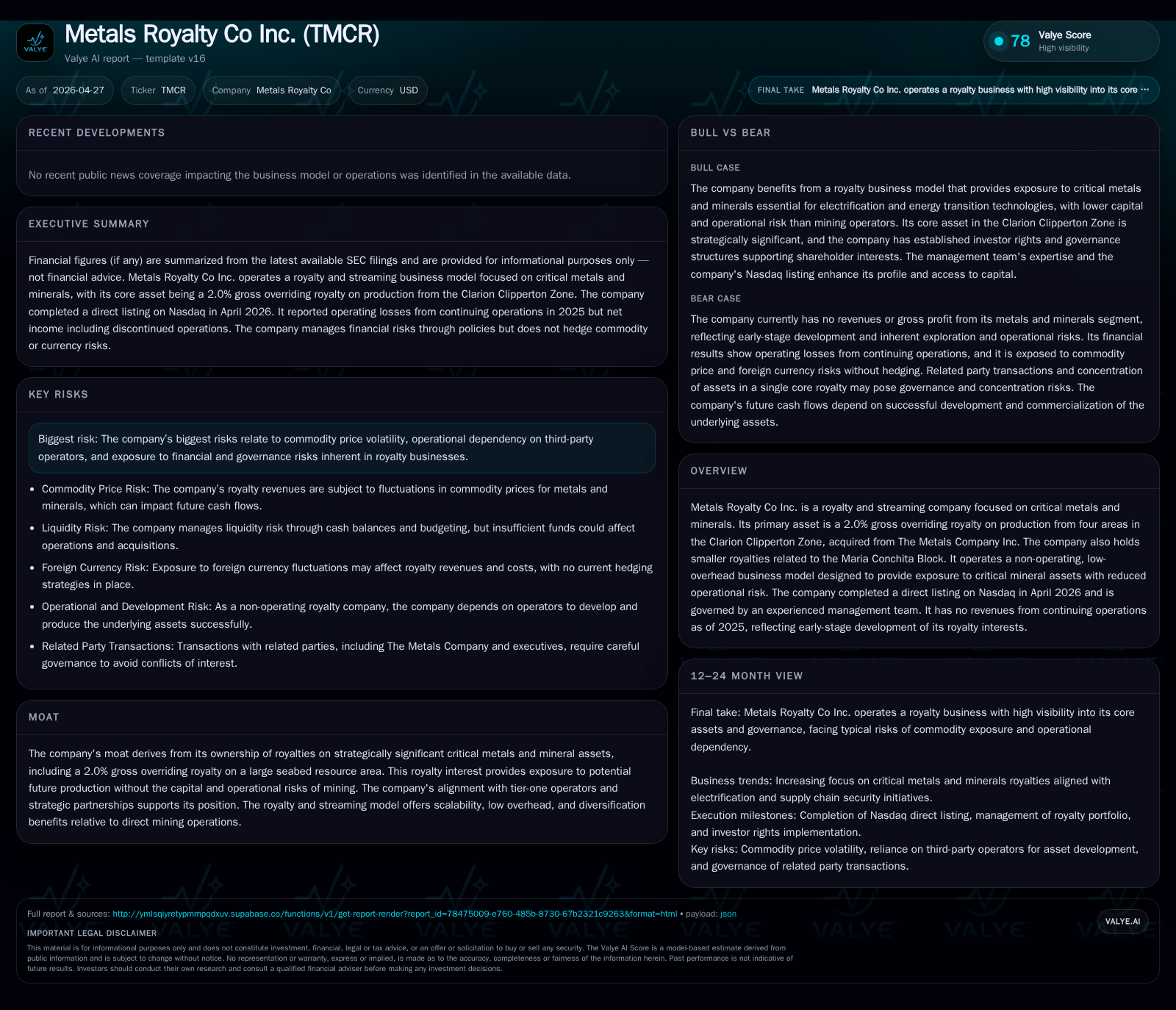
Metals Royalty Co Inc. (TMCR) completed its Nasdaq listing in April 2026, unlocking liquidity and capital access for the royalty company specializing in strategic critical minerals. Its business model delivers non-operating exposure to critical metals via royalties on seabed polymetallic nodules and other assets, mitigating operational risk while aligning with growth themes around electrification and energy transition. TMCR’s core portfolio includes a 2.0% gross overriding royalty on Clarion Clipperton Zone resources, positioning it uniquely amidst an expanding global emphasis on battery and specialty metals security. Key near-term value depends on operator progress toward production and market appreciation of critical minerals.
Nasdaq Debut Marks New Chapter for TMCR
On April 1, 2026, Metals Royalty Co Inc. announced that its registration statement on Form F-1 was declared effective by the U.S. Securities and Exchange Commission, with its common shares expected to commence trading on the Nasdaq Stock Market under the symbol "TMCR" on April 8, 2026 [S2]. This milestone transitions TMCR from a private entity developing its royalty portfolio into a publicly traded vehicle offering investors direct exposure to critical metals royalties. The listing enhances liquidity for shareholders and positions TMCR to raise capital efficiently to pursue growth opportunities within the burgeoning critical minerals sector.
Royalty Business Model: Low Risk with Strategic Upside
TMCR’s business foundation relies on a royalty and streaming structure that provides exposure to commodity price appreciation without incurring direct mining operational or capital expenditure risks [S1]. Unlike mine operators who must fund exploration, development, equipment maintenance, environmental compliance, and bear commodity price downturn burdens directly, TMCR earns income through agreed percentages of production revenue from underlying operators extracting minerals. Revenue recognition occurs when commodities are processed by project operators at properties where royalties are held [S1]. This non-operating stance creates scalability potential with minimal overhead and diversification benefits as additional royalties or streams are added across various assets or operators.
Asset Portfolio Anchored in Critical Metals and Minerals
The company’s primary asset is a 2.0% gross overriding royalty granted over four contiguous areas within the Clarion Clipperton Zone (CCZ), a seabed region estimated to contain vast polymetallic nodules rich in copper, nickel, cobalt, and manganese [S1]. These metals play essential roles in batteries and high-tech manufacturing. In addition to this marquee seabed asset acquired from The Metals Company Inc., TMCR holds smaller royalties related to the Maria Conchita Block through multiple gross production royalties totaling approximately 1.56% [S1]. As of December 31, 2025, no revenues from continuing operations were recognized reflecting the early-stage development status of these assets [S1]. These royalties represent potential long-term revenue streams pending successful regulatory approvals and commercial mining operations by third-party developers.
Industry Context: Critical Metals Demand and Policy Tailwinds
TMCR’s opportunity is set against accelerating global demand for critical metals driven by electrification across transport (notably electric vehicles), grid-scale storage, renewable energy infrastructure, AI data centers, and U.S. re-industrialization efforts [S1]. The International Energy Agency's World Energy Investment Report 2025 projects clean technology investments at $2.2 trillion annually — underscoring multi-decade growth in material intensity targeting copper, nickel, cobalt, and manganese [S1]. Defense technologies also depend heavily on these minerals for superalloys, magnets, electronics, and propulsion components. Given China’s dominance in processing many defense-critical minerals globally, U.S. policy supports domestic critical minerals production for national security reasons [S1]. TMCR’s position via low-risk royalties on strategically vital mineral reserves off conventional landmasses like seabeds enables indirect benefit from these policy-driven demand surges.
Competitive Position: Leveraging Partnerships and Scalability
TMCR’s competitive advantage stems from its royalty agreements with tier-one operators managing the CCZ resource without requiring TMCR to engage directly in extraction or capital-intensive operations [S1]. This structure facilitates scalability as new royalty interests can be added while maintaining lean administrative costs. Governance aligns management with shareholders; approximately 29.48% of common shares are held by management and directors as of late April 2026 alongside substantial holdings (25.15%) by The Metals Company — an integral partner since asset acquisition — ensuring shared long-term incentives [S1]. Investor rights agreements provide nomination rights supporting transparency and strategic oversight aligned with shareholder interests.
Growth Drivers: Energy Transition and National Security Themes
Growth drivers propelling demand for TMCR’s royalty metals stem from broadening adoption of clean technologies requiring intensified material inputs. Polymetallic nodules yield essential battery precursors such as nickel sulfate, cobalt sulfate, manganese sulfate alongside copper cathode crucial for electrical wiring — all indispensable components in EVs, stationary batteries, electronics manufacturing, turbines, specialty steel alloys, catalysts used industrially and agriculturally [S1]. These sectors are expected not only to expand volumetrically but also deepen their metal content per unit output driven by decarbonization goals. National security imperatives amplify interest in domestically accessible or allied-controlled mineral sources given geopolitical supply chain vulnerabilities linked to Chinese processing dominance [S1]. TMCR aims to capitalize on these structural trends rather than cyclical commodity pricing fluctuations.
Risks and Challenges: Commodity Volatility and Operational Dependency
Material risks include volatility in critical metal prices which can impact royalty income unpredictably due to price-sensitive revenue recognition [S1]. Dependence on third-party operators for commencing mineral extraction means project delays or failures directly constrain earnings potential. Additionally, ongoing remediation efforts address material weaknesses identified in internal controls over financial reporting related to inadequate accounting staffing and supervisory frameworks during early post-IPO phases—a factor that may heighten operational risks if unresolved promptly [S1]. The company continues mitigation measures including engagement of external consultants.
What Investors Should Watch Next
Key near-term milestones include progress updates from project operators toward commercial production triggering royalty payments beyond discontinued oil & gas operations reported through end-2025 [S1]. Expansion of portfolio deals adding new royalties or streaming agreements would indicate growth consistent with management’s strategy [S1]. Resolution status of internal control deficiencies will remain important given investor focus on transparent financial governance post-listing [S1]. Market reaction following Nasdaq debut coupled with evolving commodity markets will provide directional cues ahead.
This analysis synthesizes publicly filed SEC documents through April 2026 without reflecting any investment advice or projection about future stock performance or financial outcomes related to Metals Royalty Co Inc.
Disclaimer: This is research-only, informational analysis and not investment advice. It may include AI-generated interpretation and general industry context. Always verify important details using primary sources.

Comments