
Performance Shipping Inc. Secures Long-Term Charters to Strengthen Fleet Outlook
New Suezmax time charters and recent vessel sale reflect active fleet and financial management amid volatile tanker markets.
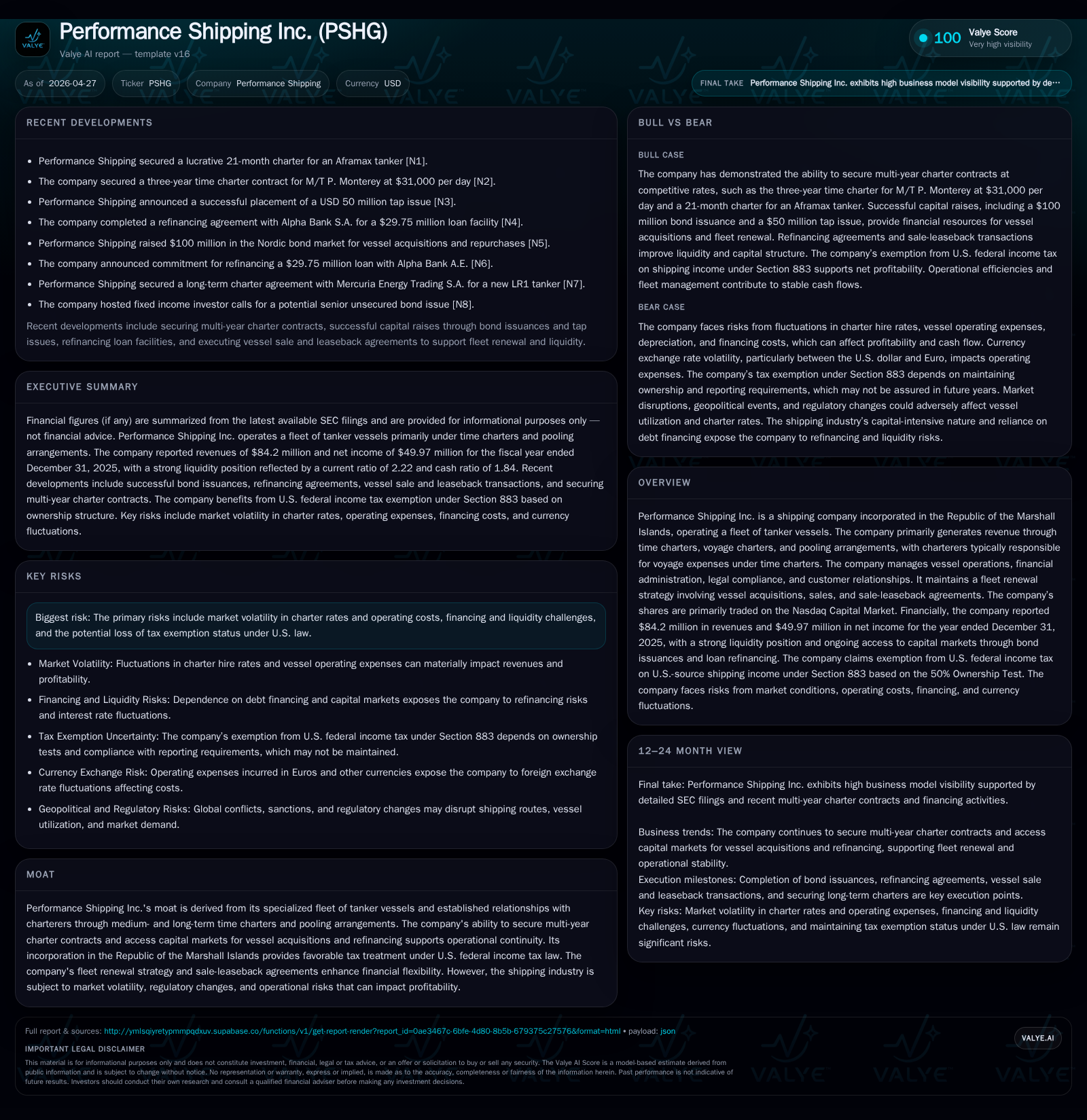
Performance Shipping recently secured long-term time charters for two Suezmax newbuilding tankers delivering in 2028 and 2029 and sold a 2010-built Aframax vessel for $42.65 million, reflecting its strategy to optimize fleet composition and revenue stability. Operating primarily through fixed-rate time charters, the company benefits from predictable cash flows while managing fleet renewal via disposals and sale-leaseback financing. Despite a challenging market environment marked by geopolitical tensions and modest demand growth with projected fleet expansion, Performance Shipping maintains solid liquidity with cash balances of approximately $48.2 million against total debt near $228.7 million at year-end 2025, supporting capital investments and operational resilience.
Recent Operating Developments Highlight Strategic Fleet Positioning
Performance Shipping Inc.’s latest quarterly filings reveal crucial developments shaping its fleet deployment strategy amid ongoing tanker market volatility [S2][S3]. In April 2026, the company announced long-term fixed-rate time charters for two Suezmax vessels currently under construction, with expected deliveries in October 2028 and May 2029 respectively [S2]. These contracts secure future revenue streams well before the vessels commence operations.
Simultaneously, Performance Shipping divested its older Aframax tanker M/T P. Aliki built in 2010 for $42.65 million, aligning with its asset renewal approach focused on optimizing fleet efficiency and liquidity [S3]. This combination of pre-leasing newbuilds while disposing of aging tonnage underscores proactive management to mitigate near-term market uncertainties.
Asset Lifecycle Management and Financial Flexibility
The company undertakes an active asset lifecycle strategy involving acquisitions, disposals, and innovative financing structures such as sale-leaseback arrangements that enhance balance sheet flexibility [S1][F1]. Newbuild vessels are equipped with modern environmental compliance features like ballast water treatment systems to meet regulatory standards while reducing operating costs.
Sale-leaseback agreements for newly delivered vessels including P. Massport, P. Tokyo, and P. Marseille enable monetization of assets while chartering back on bareboat terms under multi-year contracts at predictable rates [S13][S18]. This approach preserves liquidity to fund future acquisitions or refinance debt without compromising operational control.
Incorporation in the Republic of the Marshall Islands provides favorable tax treatment by exempting the company from U.S. corporate income taxation on shipping revenues, enhancing net returns relative to competitors domiciled elsewhere [S1].
Revenue Streams and Operational Metrics
Performance Shipping’s revenue model predominantly relies on time charters where customers pay fixed daily hire rates covering voyage expenses such as fuel and port fees, thus insulating the company from fuel price volatility but requiring high utilization rates to maximize earnings [S1].
Voyage (spot) charters expose the company to voyage-specific expenses but offer premium rates that compensate risk exposure; pooling arrangements allocate net revenues among pool participants smoothing income variability but introducing dependency on partners’ operational outcomes [S1].
Key performance indicators include ownership days (fleet size), available days (excluding scheduled off-hire), operating days (revenue-generating days), fleet utilization (operating over available days), daily operating expenses per ownership day, and Time Charter Equivalent (TCE) rates which measure average daily earnings net of voyage expenses.
Despite market fluctuations, Performance Shipping maintained a high fleet utilization rate of approximately 98.6% in 2025 with average TCE rates around $31,246 per day; daily operating expenses increased moderately due to compliance-related expenditures [S1].
Industry Context: Competitive Positioning Amid Supply-Demand Shifts
Operating primarily within the Aframax and Suezmax crude tanker segments positions Performance Shipping alongside established peers facing supply-side growth exceeding demand forecasts for 2026 [S1][N1]. The crude tanker deadweight tonnage is projected to grow about +3.7%, while crude tanker demand is expected to decline marginally by -0.2%.
Geopolitical tensions stemming from Middle East conflicts have disrupted traffic through key chokepoints like the Strait of Hormuz leading to longer-haul routes that tighten effective tanker availability temporarily despite nominal supply increases [S1].
The company’s strategy of securing multi-year fixed-rate charters on large-capacity vessels combined with flexible financing structures helps insulate it from spot market volatility typical in cyclical shipping freight markets.
Market Drivers and Constraints: Geopolitical Risks and Regulatory Pressures
Global oil demand grew modestly by +0.7% in 2025 but faces heightened uncertainty in 2026 due to disruptions in critical export routes impacting seaborne volumes [S1]. These dynamics have caused re-routing that temporarily absorbs excess tanker capacity but also contribute to freight rate volatility.
Structural challenges include escalating costs from environmental regulations such as emissions controls and ballast water treatment requirements driving increased vessel operating expenses partially offset by efficiencies from newer ship designs under the renewal program.
Financial Position and Capital Structure Overview
At December 31, 2025, Performance Shipping reported cash and cash equivalents near $48.2 million against total debt approximating $228.7 million—resulting in a current ratio above 2.2—reflecting solid short-term liquidity coverage [F1].
The company's debt profile includes bank loans tied to SOFR plus margins ranging between approximately 0.50% to 2.60%, alongside significant bond issuances such as a $100 million Nordic bond issued July 2025 at a fixed coupon of roughly 9.875% per annum plus a January 2026 tap issuance raising an additional $50 million at similar terms [S10][S11][S13].
These financings support capital expenditures related to newbuild deliveries while sale-leaseback transactions provide additional funding flexibility without compromising operational control [S11][S14].
Outlook: Milestones and Risks Ahead
Key upcoming milestones include scheduled deliveries of contracted Suezmax vessels expected in late 2028 and mid-2029 which will expand earning capacity once fully integrated into the fleet under secured long-term charters [S24]. Monitoring compliance with loan covenants remains critical given variable earnings environments influenced by geopolitical developments.
Market pricing trends post-resolution of Middle East conflicts will be pivotal for charter rate trajectories alongside global crude shipment volumes shaped by macroeconomic conditions [N1][S1]. Operational efficiency improvements measured via daily operating expenses relative to ownership days and sustained high utilization will remain focal points for sustaining profitability.
Performance Shipping’s ability to maintain stable long-duration time charter contracts on modern tonnage alongside flexible financing mechanisms positions it competitively within an industry characterized by cyclicality but also structural consolidation pressures.
This analysis strictly relies on publicly available regulatory filings cited herein; it does not constitute investment advice but aims to provide rigorous operational insight into Performance Shipping Inc.'s business dynamics as of early-to-mid 2026.
Disclaimer: This is research-only, informational analysis and not investment advice. It may include AI-generated interpretation and general industry context. Always verify important details using primary sources.

Comments