
XCHG Ltd Advances EV Charging Solutions with Strategic Global Deployments
XCHG Ltd’s April 2026 quarter highlights demonstrate growth momentum through commercial scale deployment of NZS and GridLink solutions alongside strategic partnerships.
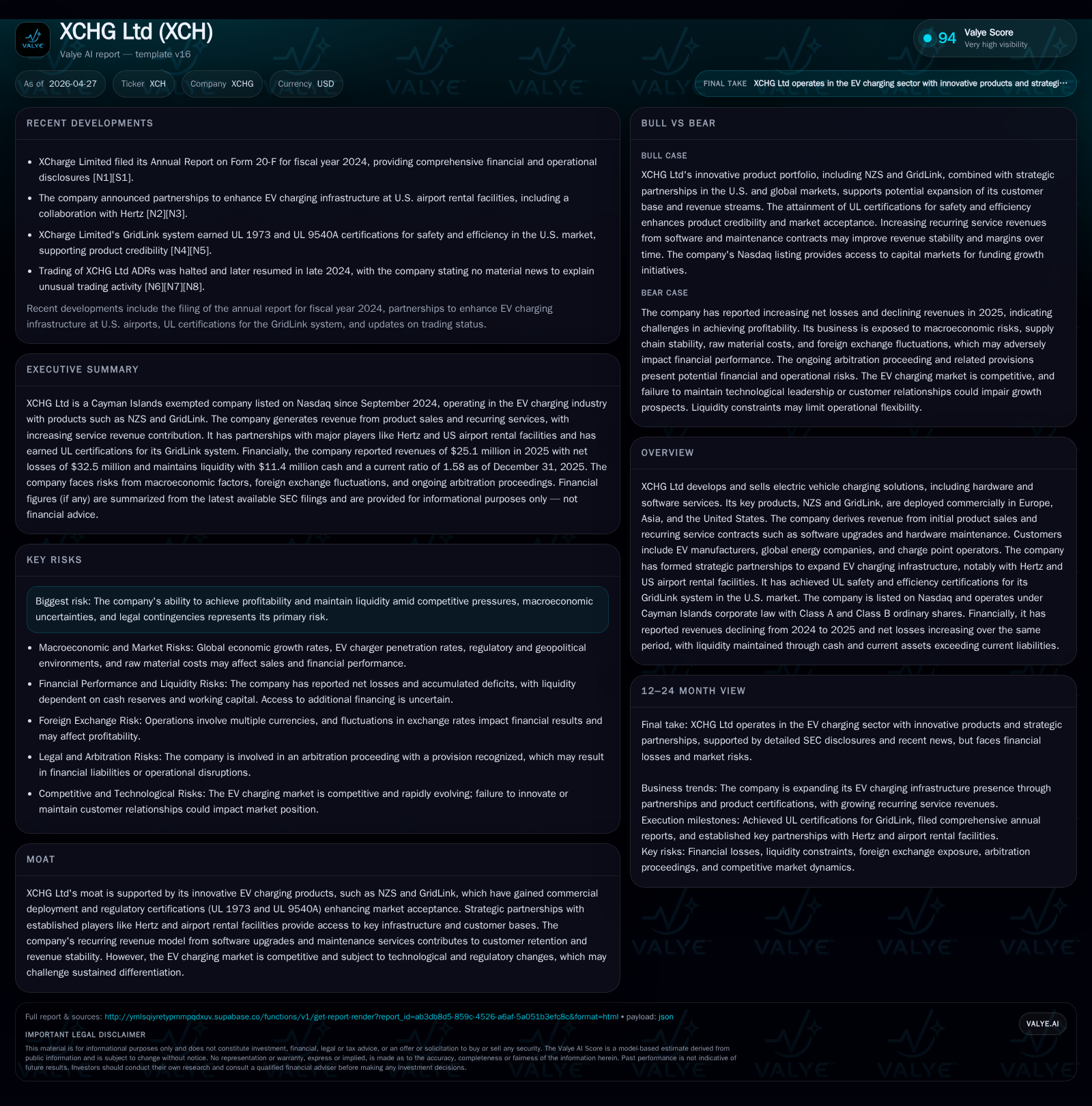
In its latest quarterly filing, XCHG Ltd reported ongoing commercial deployments of its NZS and GridLink electric vehicle charging solutions across Europe, Asia, and the United States. The company has solidified key strategic partnerships with Hertz and US airport rental facilities, expanding its market footprint and recurring revenue base. Its integrated hardware-software model, underscored by UL certifications, provides differentiation in a competitive and evolving EV infrastructure market. However, persistent net losses and competitive pressures temper near-term earnings prospects. Going forward, commercial scaling and product innovation remain critical milestones to watch.
Latest Quarterly Operating Highlights and Developments
The April 2026 Form 6-K filing reveals that XCHG Ltd has advanced its commercial rollout of the NZS charging solution in Europe and Asia while simultaneously deploying its GridLink platform in the United States and Europe [S2][S1]. This geographical spread reflects a deliberate strategy to target key global EV markets. A notable development is the establishment of strategic partnerships with Hertz as well as US airport car rental facilities that broaden channel access to end-users and institutional customers [S2]. These partnerships not only help secure prime installation sites but also embed XCHG’s solutions within existing mobility ecosystems.
This quarter's operational progress signals momentum building behind XCHG’s flagship products amid an increasingly competitive sector. The company is leveraging its dual-hardware lines—NZS with B2G functionalities and GridLink—to cater to distinct regional requirements while capitalizing on scale economies. The company’s filings indicate no newly material adverse events since year-end, supporting steady operational continuity [S1].
Business Model: Integrated Hardware-Software Approach with Recurring Revenue Streams
XCHG Ltd generates revenue primarily via initial sales of electric vehicle charging hardware—NZS and GridLink—augmented by recurring income streams from software system upgrades and hardware maintenance services [S1]. This integrated hardware-software business model is designed to create durable customer relationships by embedding service contracts that extend beyond the initial product sale.
Key customers span OEM EV manufacturers who integrate charging tech into their offerings, global energy companies seeking grid-edge solutions, and charge point operators managing public infrastructure. The company’s ability to secure multi-year service agreements provides some insulation against price-based competition prevalent in hardware commoditization. Additionally, the inclusion of B2G features in NZS creates differentiated value through managed demand response capabilities.
This revenue mix fosters predictable cash flows from a growing installed base while enabling cross-selling opportunities for new product iterations or expanded service coverage. However, maintaining cost-effective operation amid scaling demands remains paramount given the company's current net loss position [S1].
Product Overview: NZS and GridLink Solutions’ Quality and Certification Advantages
XCHG’s primary products—NZS and GridLink—are positioned as technologically innovative EV chargers tailored for commercial-scale deployment. Both products have secured critical UL safety certifications: UL 1973 for battery pack safety compliance and UL 9540A validating fire test performance standards relevant for energy storage systems [S1]. These certifications are fundamental market entry requirements in regions like the US where regulatory scrutiny intensifies amid rapid EV infrastructure adoption.
These regulatory endorsements bolster customer confidence by assuring product reliability and integration safety with broader electrical grid systems. Furthermore, technical differentiation includes embedded software capabilities such as firmware updates over-the-air, remote diagnostics, and compatibility with diverse EV protocols which help meet varied client needs across geographies.
The dual-certification status serves as a moat element by raising switching costs; competitors must match or exceed these regulatory benchmarks to compete effectively. It also underpins partnership efforts that rely on safe standardized installations within complex site environments like airports or rental fleets.
Competitive Environment and Industry Headwinds
The electric vehicle charging equipment industry is characterized by intense competition among both legacy energy equipment manufacturers and emerging EV-focused tech companies. Large incumbent peers control significant portions of the market with extensive distribution networks while startups race to innovate feature sets.
Pricing pressure remains pronounced given commoditization trends in basic charger hardware; thus sustaining margin requires technology-driven differentiation or securing contractual lock-ins via service agreements. Regulatory uncertainty adds complexity—as evolving safety standards or grid interconnection rules can alter product certification scopes or installation feasibility.
Supply chain constraints for key components such as power electronics or semiconductors persist as a limiting factor for rapid capacity expansion. Customer adoption cycles vary across regions depending on incentives or EV penetration levels, imparting some cyclicality into demand patterns [S1].
Growth Catalysts: Market Expansion, Partnerships, and Recurring Service Opportunities
XCHG’s path to growth rides on expanding penetration across established markets (Europe, US, Asia) where accelerating EV adoption drives demand for reliable chargers. The recent partnership wins with Hertz in car rental networks offer embedded infrastructure contracts that could generate high-volume installations coupled with recurring management fees [S2].
Growth is also propelled by rising installed base effects—the more units deployed, the larger the pool of chargers needing software updates or maintenance services. Such recurring revenues improve revenue visibility compared with purely transactional hardware sales.
Additionally, advancing product innovation through iterative enhancements to NZS/GridLink platforms leverages intangible assets (software/IP), facilitating higher-margin opportunities in managed charging services or grid integration solutions [S1][S2]. Geographic diversification reduces dependence on any single regulatory regime or economic cycle.
Risks and Growth Constraints: Profitability Challenges and Market Pressure
Despite operational advances, XCHG continues to face substantial profitability challenges as losses widen alongside investment in R&D, marketing, and global expansion initiatives [S1]. Macroeconomic volatility affecting component costs or supply chains could further elevate operating expenses.
Competitive dynamics present risks of aggressive pricing tactics eroding margins especially if rivals can subsidize growth via stronger balance sheets. Legal contingencies noted in filings add complexity around potential liabilities that may emerge unexpectedly.
Regulatory shifts imposing stricter certification requirements or installation authorizations might delay go-to-market timelines adding to execution risk. Achievement of sustained positive net earnings hinges on balancing growth acceleration with disciplined cost control over upcoming quarters.
Key Milestones to Monitor: Commercial Scaling, Client Acquisition, and Product Innovation
Near-term markers include quarterly additions to commercial clients especially large-scale partnerships that can accelerate charger installations meaningfully. Monitoring backlog levels for new hardware orders will shed light on demand trends tied to contract ramp-ups.[S2]
Tracking progress under the newly adopted 2026 Share Incentive Plan may provide insight into talent retention success critical for scaling operations sustainably [S3]. Moreover, updates regarding certification expansions or new product features expanding functional scope could serve as innovation catalysts enhancing competitive positioning.
Revenue trajectory shifts reflecting rising contribution from recurring software-related fees versus one-time hardware sales will be a key KPI signaling maturation of business model stickiness [S1]. Maintaining operational efficiencies while scaling will be another focal point impacting future profitability outlook.
Disclaimer: This analysis is based solely on information contained in public SEC filings as of April 27, 2026 ([S1], [S2], [S3]) without incorporating any non-public data or forward-looking statements beyond what was expressly disclosed therein. No investment advice or recommendation is provided.
Disclaimer: This is research-only, informational analysis and not investment advice. It may include AI-generated interpretation and general industry context. Always verify important details using primary sources.

Comments