
Credicorp Strengthens Dividend Policy Amid Digital Expansion and Risk Improvements
Q1 2026 highlights significant dividend growth, reinforced credit risk management, and ongoing digital strategy execution at Credicorp.
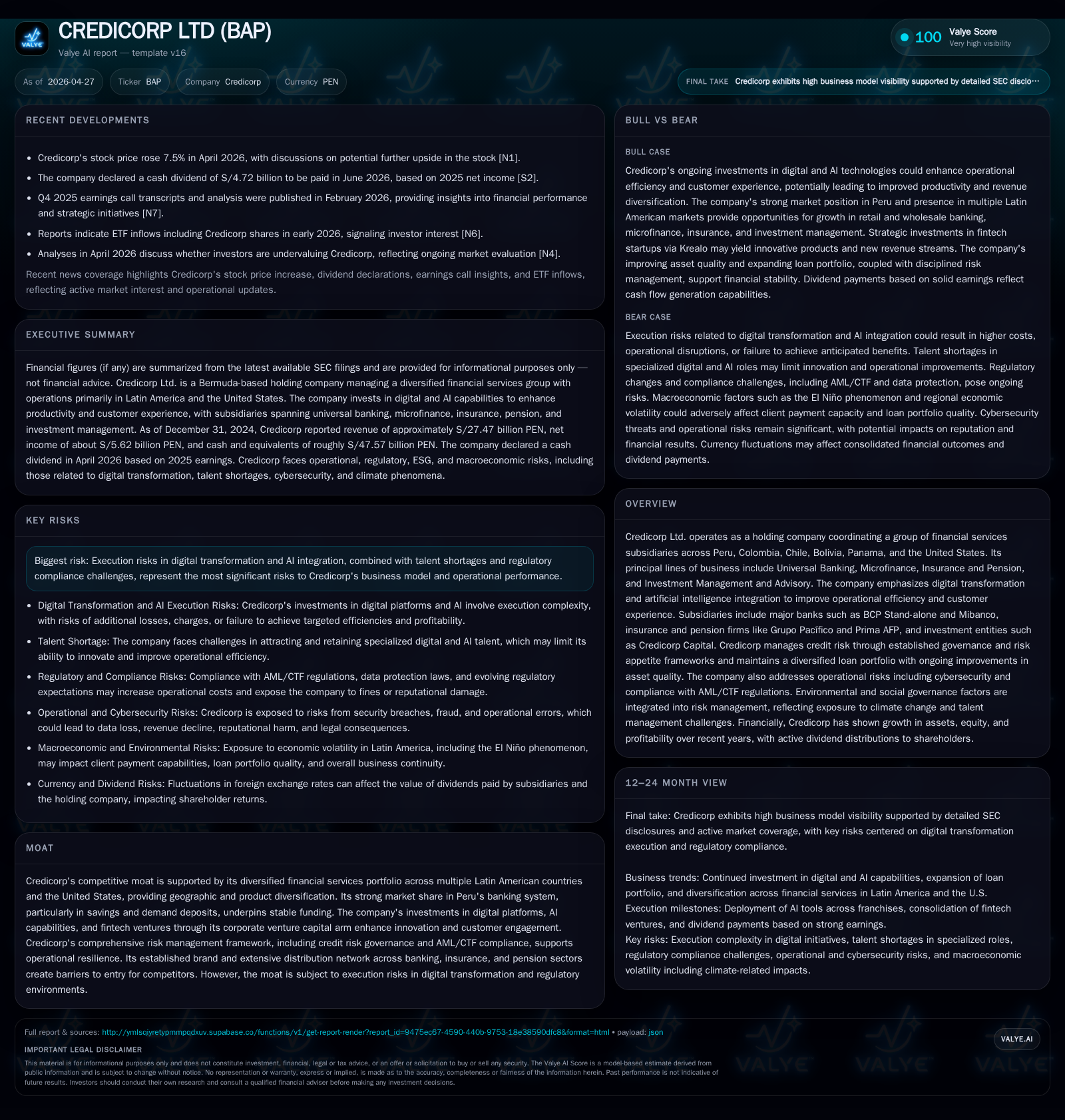
Credicorp’s Board approved a sizable cash dividend reflecting confidence in its robust earnings and operational cash flow from 2025. The firm continues to leverage product and geographic diversification through its universal banking, microfinance, insurance, pension, and investment services across Latin America and the US. Digital transformation remains a double-edged sword: it drives innovation and customer engagement but entails execution risks. Meanwhile, credit quality trends improved with a reduced loan loss allowance and cost of risk amid growing loan portfolios. Key near-term milestones include dividend payment execution, tracking digital adoption progress, and monitoring regulatory landscape shifts.
Dividend Uptick as Early Signal of Confidence in Earnings and Cash Flow
In April 2026, Credicorp's Board of Directors authorized a significant cash dividend totaling approximately S/4.72 billion—equivalent to S/50 per share—highlighting management's confidence following solid financial performance during fiscal year 2025 [S2]. This dividend will be distributed on June 12, 2026 in US Dollars using the Peruvian Superintendency's weighted exchange rate without withholding tax at source; shareholders as of May 18 qualify for payment.
This sizable distribution not only rewards shareholders but also signals robust underlying earnings quality and cash generation capacity after applying over S/6.88 billion of net income to voluntary reserves earlier in the year [S2]. Absence of withholding tax enhances appeal particularly for foreign investors.
Business Model Overview: Diversified Financial Services Backbone Across Latin America
Credicorp functions as a holding company overseeing an extensive network of financial service subsidiaries concentrated primarily in Peru but extending regionally to Colombia, Chile, Bolivia, Panama, as well as operations in the United States [S1]. Its core business lines encompass:
- Universal Banking: Led by Banco de Crédito del Perú (BCP Stand-alone), a dominant force in Peru's banking system with strong savings/demand deposit franchises underpinning low-cost funding.
- Microfinance: Primarily through Mibanco targeting SMEs with higher-yield loan offerings augmenting overall portfolio diversification.
- Insurance & Pension: Notably Grupo Pacífico insurance operations and Prima AFP pension fund management providing steady fee income streams.
- Investment Management & Advisory Services: Executed via Credicorp Capital expanding client offerings across wealth management and brokerage.
This multi-product, multi-geographic coverage provides revenue stability through product cycle diversity and mitigating country-specific economic volatility [S1,F1]. Funding structure benefits from approximately 83.8% low-cost deposits aiding margin preservation during evolving interest rate environments [S8].
Digital Transformation and AI Integration: Innovation Challenges and Opportunities
Credicorp prioritizes digital transformation with ongoing technology investments encompassing cloud-based data management platforms, AI-enabled productivity tools for employees across franchises, and new consumer-facing digital ventures such as the Yape mobile application [S1].
Its corporate venture capital arm Krealo actively supports fintech startups like Tyba (investment tech) and Tenpo (digital payments), aiming to capture under-penetrated markets and broaden distribution channels [S1].
However, technological complexity introduces several challenges:
- Need for enhanced dialogue protection against prompt injection or data poisoning threats impacting AI system integrity.
- Risk of hallucinations where AI-generated content diverges from factual accuracy potentially undermining customer trust.
- Varied user acceptance with some clients preferring human interaction over AI engagement creating segmentation dynamics.
Execution risks are compounded by talent shortages in critical AI/data analytics roles amidst fierce competition regionally [S1,S23]. Given evolving regulatory scrutiny over digital financial services across Latin American jurisdictions, compliance demands inject additional layers of complexity.
Competitive Positioning within Latin America's Financial Ecosystem
Credicorp enjoys a defensible competitive moat due to its entrenched status as Peru’s largest deposit holder—including commanding shares north of 40% in savings deposits—and broad presence across neighboring countries providing geographical diversification [S8,S1]. The universal banking franchise commands >70% share of group revenues while insurance/pension lines add complementary steady-fee contributions enhancing overall profitability resilience.
Regulatory regimes vary by country but generally maintain high capital adequacy standards that elevate barriers to entry for new competitors. Meanwhile, strategic fintech investments serve dual roles: hedging disruption threats from pure-play digital challengers while bolstering client engagement through innovative product bundling [S1].
Risks remain from potential tightening regulation surrounding financial technology companies or cross-border capital controls which require vigilant management oversight.
Credit Risk Management Enhancements Driving Improved Asset Quality
Key credit metrics evidence notable improvement during calendar year 2025:
- Total allowance for loan losses declined by approximately 4% to S/8.04 billion driven by better borrower payment performance particularly within SME segments due to strengthened portfolio monitoring frameworks [S1].
- Cost of risk dropped sharply by nearly 80 basis points from prior year to around 1.63%, benefiting from portfolio mix shifts toward smaller-ticket microloans yielding higher risk-adjusted returns [S4,S21].
- Internal overdue loans ratio improved sequentially to about 3.21%, reflecting effective collections management alongside write-offs facilitated through board-approved provisions [S9,S13].
Breaking down provisions reveals decreases primarily within commercial and microbusiness portfolios offset slightly by modest upticks within select wholesale exposures tied to construction sector clients indicating ongoing risk calibration efforts [S19]. Credicorp adheres rigorously to IFRS 9 impairment methodologies factoring PDs (probability of default), LGD (loss given default), and EAD (exposure at default) maintaining dynamic forward-looking provisioning aligned with macroeconomic assessments [S16].
Overall stable non-performing loan coverage ratios above 110% provide buffers against cyclical volatility while allowing for measured growth ambitions.
Growth Catalysts: Loan Portfolio Expansion, Fintech Ventures, and Market Penetration
Total loan book advanced approximately 2.9% year-over-year (8.5% adjusted for neutral exchange rates), propelled mainly by retail segments at BCP Stand-alone focusing on individuals plus steady double-digit microloan disbursements at Mibanco including Colombian operations contributing incremental scale effects [S4,S12].
The shift towards smaller ticket but higher yield loans within microfinance notably enhances return profiles compensating for slightly elevated provisioning costs compared to traditional commercial book segments.
Fee income continues upward trend through investment management growth under Credicorp Capital plus transactional banking fees underpinned by expanded adoption of digital payments via Yape ecosystem enhancing the recurring revenue base beyond interest margins alone [S19]. These drivers collectively support an improved overall net interest margin stable near ~6.27% despite lower interest rate environments balanced against rising low-cost deposit inflows reducing funding expense costs below ~2.31% levels last reported [S5,S12,S18].
Operational Risks: Execution Complexity and Regulatory Headwinds
The ambitious digital transformation agenda introduces various operational risks including but not limited to cybersecurity breaches intensified by greater technology reliance; technology deployment delays or cost overruns impacting innovation ROI; potential reputational damage from AI inaccuracies or unsatisfactory user experiences; combined with challenges navigating heterogenous regulatory frameworks spanning AML/CTF enforcement obligations across multiple countries all require robust risk governance architecture [S1,S23].
Talent retention remains critical amid competitive global demand for data scientists and AI engineers framing capacity constraints for rapid scaling.
What Investors Should Monitor Next: Dividend Dates, Margin Trends, and Digital Milestones
Key forthcoming milestones investors will track include:
- Dividend record date May 18 followed by June 12 payment confirming management’s commitment to shareholder distributions aligned with sustainable earnings generation [S2];
- Quarterly updates on asset quality indicators such as internal overdue loans ratio changes or cost of risk trajectory revealing persistence or deterioration;
- Progress reports on AI implementation milestones including user adoption rates on platforms like Yape along with early monetization outcomes from fintech venture investments;
- Evolution of net interest margin stability particularly if shifting macroeconomic conditions impact funding costs or loan yields materially;
- Regulatory developments that could impose new capital requirements or restrict existing operational modalities affecting regional franchise economics.
Close analytical attention will be required given fast-moving digital transition coupled with inherent macro-financial uncertainties affecting emerging market lenders like Credicorp.
Financial Snapshot: Profitability, Capital Allocation, and Liquidity
The latest full-year financials underscore marked profitability improvements driven by both revenue growth and disciplined cost management:
- Net profit after non-controlling interests surged nearly +26% YoY reaching S/6.93 billion in fiscal year ended December 31, 2025,
- Return on average equity climbed substantively to ~19%, while return on average assets advanced to ~2.65%, spawning healthy shareholder value creation metrics consistent with investment-grade emerging market peers [F1,S4];
- Net interest income rose about +4.3% fueled predominantly by reduced interest expenses stemming from funding mix transforming towards greater low-cost deposit share;
- Total operating expenses increased moderately (+8.6%) primarily due to strategic hiring initiatives related to commerce technology capabilities supporting innovation programs;
- Cash and equivalents stood at approximately S/47.6 billion as of December 31, 2024, providing a strong liquidity buffer for loan growth or unforeseen stress scenarios [F1];
Collectively these fundamentals reflect an organization balancing growth acceleration alongside measured risk control deploying capital efficiently whilst investing for future competitiveness amidst evolving regional financial landscapes.
This analysis is intended solely for informational purposes based on publicly available SEC filings as of April 2026; it does not constitute investment advice or recommendations.
Disclaimer: This is research-only, informational analysis and not investment advice. It may include AI-generated interpretation and general industry context. Always verify important details using primary sources.

Comments