
Cuprina Holdings Strengthens Global Footprint with New Regulatory Approvals and Product Expansion
Cuprina's latest quarterly update highlights regulatory progress in Saudi Arabia and strategic initiatives supporting its growth in niche bioactive wound care.
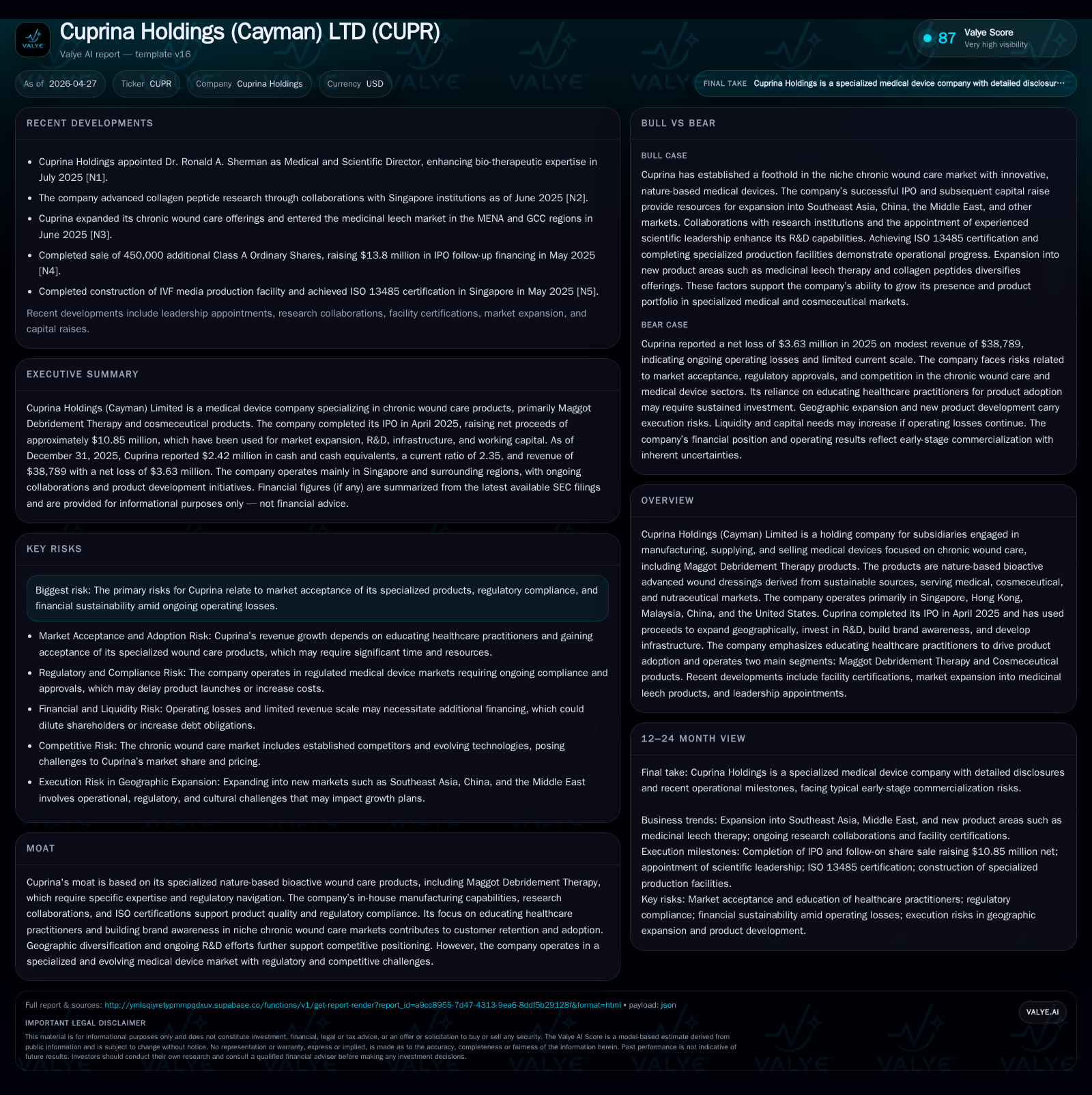
Cuprina Holdings recently announced a key regulatory milestone in Saudi Arabia, bolstering its expansion in the Middle East and reinforcing its presence in specialized chronic wound care. The company’s focus on nature-based medical devices like Maggot Debridement Therapy products, along with developing novel collagen and medicinal leech therapies, positions it uniquely within a niche but evolving market. Despite ongoing operating losses, Cuprina maintains adequate liquidity to fund near-term growth initiatives, supported by recent IPO proceeds and a robust current ratio. Critical execution factors include advancing regulatory approvals across new regions, expanding practitioner education, and pipeline commercialization toward 2027-28.
Latest Quarterly Update: Regulatory Advances and Strategic Initiatives
Cuprina Holdings' most recent Form 6-K filing dated April 21, 2026, signals important operational progress primarily led by its regulatory breakthrough in Saudi Arabia. This milestone authorizes commercial distribution of Cuprina's flagship MEDIFLY Maggot Debridement Therapy (MDT) products across the Kingdom's healthcare network—a strategic gateway into the broader Middle East & North Africa (MENA) markets [S2][S3]. Complementing this approval, the company announced fortification of its global Scientific Advisory Board through the appointment of Dr. Enming Yong, a noted endocrinology consultant with deep clinical expertise relevant to chronic wound management [S3][S16]. These moves collectively indicate Cuprina’s dual-pronged momentum: expanding geographic reach while strengthening scientific endorsement vital for practitioner adoption in a field that demands both regulatory scrutiny and clinical credibility.
In addition to these developments, the upcoming shareholder Annual General Meeting scheduled for May 14, 2026 will review proposals including an 8-for-1 share consolidation, increasing authorized share capital, institution of an employee incentive plan, and authorization for potential future share issuances—actions designed to bolster capital structure flexibility as Cuprina pursues accelerated growth initiatives beyond its initial public offering completed in April 2025 [S2][S16].
Business Model and Bioactive Product Portfolio Overview
Cuprina operates fundamentally as a biomedical manufacturer specializing in nature-based bioactive medical devices tailored to chronic wound care management, chiefly through its proprietary MEDIFLY product line utilized in Maggot Debridement Therapy (MDT). MDT is an established alternative to surgical debridement whereby sterilized fly larvae selectively remove necrotic tissue from chronic wounds, promoting healing with lower infection risks than conventional methods.
Beyond MEDIFLY, revenue generation also includes cosmeceutical product sales targeting health-conscious consumers via online retail platforms and physical channels such as gyms across Singapore, Malaysia, and Australia [S1]. The cosmeceuticals encompass muscle creams and hydrating balms produced under OEM arrangements while research advances focus heavily on leveraging sustainable collagen sources derived from American bullfrog abattoir waste streams—a notable example of circular bioeconomy application—and novel medicinal leech therapies aimed at vascular wound healing treatments.
The company's sales model relies substantially on physician prescriptions distributed primarily through public and private hospitals in Singapore with efforts underway to extend into other geographies such as Hong Kong, mainland China, and GCC nations [S1]. Education programs for healthcare practitioners are critical given MDT’s niche status requiring awareness of clinical efficacy and safety benefits—a high-touch approach that fosters gradual but sustainable adoption.
Competitive Positioning and Industry Dynamics in Chronic Wound Care
Cuprina inhabits a narrowly specialized segment of the medical device industry characterized by intricate regulatory pathways dominating product market entry. Its competitive moat stems from proprietary biologically active therapies that necessitate both manufacturing expertise—such as maintaining sterilization standards for live maggots—and navigating complex medical device classifications globally.
This specialization curtails broad competitive pressure; few companies can match Cuprina’s integrated capabilities spanning from R&D collaborations with academic institutions to having ISO-certified production facilities supporting international approvals. However, uptake remains sensitive to cautious physician prescribing patterns common in chronic wound care where medical conservatism impedes rapid penetration despite recognized therapeutic advantages.
Moreover, reimbursement dynamics heavily influence demand velocity: inclusion of products within government healthcare frameworks notably expands accessibility given patients’ increased ability to afford treatment under public insurance schemes which are growing across Asia-Pacific and GCC regions [S1]. Conversely, continued vigilance is necessary around evolving FDA or regional health authority guidelines as regulator attitudes toward novel bioactive treatments evolve.
Expansion Drivers: Geographic Growth and Pipeline Commercialization
The newly secured Saudi Arabia approval marks a pivotal geographical expansion accelerating Cuprina’s access within the GCC—a logical next step following prior commercialization in Singapore and Hong Kong. Plans are detailed for establishing physical operations to support sales infrastructure across strategically chosen regions including mainland China where rising chronic disease prevalence underpins demand fundamentals [S1][S3].
Pipeline development remains a core growth vector: collagen-based dressings utilizing bullfrog collagen aim for commercial launch over 2026-27 while medicinal leech products targeting vascular complications anticipate clearance through similar timelines subject to successful trials and regulatory nods [S1][S3]. The timing specificity indicates Cuprina’s intent not only on diversifying product mix but reinforcing its leadership within nature-derived bioactive therapies beyond maggot therapy alone.
Given the challenges inherent to practitioner acceptance within these nascent markets, Cuprina’s ongoing investments into educational outreach are instrumental. These programs enhance familiarity among clinicians about distinctive product characteristics helping convert skepticism into standard practice—a vital dynamic when competing against conventional synthetic dressings or purely surgical interventions.
Key Risks: Regulatory, Market Acceptance, and Financial Sustainability
Despite progress, significant risks persist. The unconventional nature of therapies like MDT means patient enrollment depends largely on continuous physician persuasion—a process inherently lengthy due to conservative clinical cultures around wound care management [S1]. The necessity for multiple simultaneous geographic regulatory approvals introduces operational complexity with variable timeframes.
Financially, sustaining operations amid increasing annual net losses—surpassing S$4.67 million (US$3.63 million) in 2025 driven by R&D expenses—exerts pressure on liquidity despite cash reserves secured through IPO funding rounds [F1][S1]. Though debt is minimal (~US$128K), vendor credit constraints requiring prepaid inventory purchases pose working capital challenges requiring prudent cash management strategies moving forward [S5]. Failure to raise additional capital or achieve profitable scale could impair growth momentum.
Financial Snapshot: Liquidity, Losses, and Funding Outlook
As of December 31, 2025, Cuprina held approximately US$2.42 million in cash equivalents with total debt standing near US$128K resulting in a favorable current ratio of about 2.35 evidencing sound short-term liquidity positioning supportive of operational needs over the coming year horizon [F1][S4]. The net debt position is effectively negative reflecting excess cash versus liabilities.
Nonetheless, operating losses have widened significantly (net loss more than US$3.6 million for fiscal 2025), consistent with an early-stage biomedical company prioritizing heavy investment in R&D pipeline advancement alongside geographic expansion efforts [F1][S11]. Cash burn mainly relates to prepayments for professional services (including IPO-related costs), industry research collaborations, insurance premiums post-IPO listing compliance, alongside increasing salaries aligned with headcount growth albeit still modest at ten full-time employees [S21].
Management acknowledges dependence on future financings potentially dilutive but necessary to catalyze commercialization milestones—shareholder approvals on equity plans signify preparatory steps toward scalable funding frameworks ahead of upcoming pipeline launches or acquisitions [S2][S16].
Outlook: Upcoming Milestones and Monitoring Points
Key near-term catalysts include monitoring progressive pipeline data disclosures relating to collagen dressing trials planned for commercial availability starting late 2026 through 2027 alongside medicinal leech therapy development reaching late-stage validation by 2028 [S1][S3]. Progress reports around Gulf Cooperation Council market penetration following the Saudi Arabia approval will offer tangible visibility into international scaling effectiveness.
Additionally critical will be assessing the impact of practitioner education expansion programs aiming at improving prescription rates which directly correlate with revenue ramp potential given supplier concentration risk tied predominantly to institutional hospital purchase dynamics [S1]. Shareholder votes on proposed corporate governance optimizations such as share consolidations aim at streamlining capital structure potentially facilitating efficient future equity raises needed for sustaining long-term innovation endeavors.
Finally, evolving reimbursement schemes within targeted jurisdictions remain a pivotal influence often dictating market traction velocity alongside any shifts in regulatory frameworks impacting biological medical devices broadly.
This analysis is based solely on publicly filed documents including SEC submissions up to April 27, 2026. It does not constitute investment advice or recommendations.
Disclaimer: This is research-only, informational analysis and not investment advice. It may include AI-generated interpretation and general industry context. Always verify important details using primary sources.

Comments