
EON Resources Faces Listing Compliance Hurdles While Leveraging Permian Basin Assets
Recent NYSE noncompliance notice heightens governance risk as EON focuses on production growth within its concentrated Permian Basin portfolio.
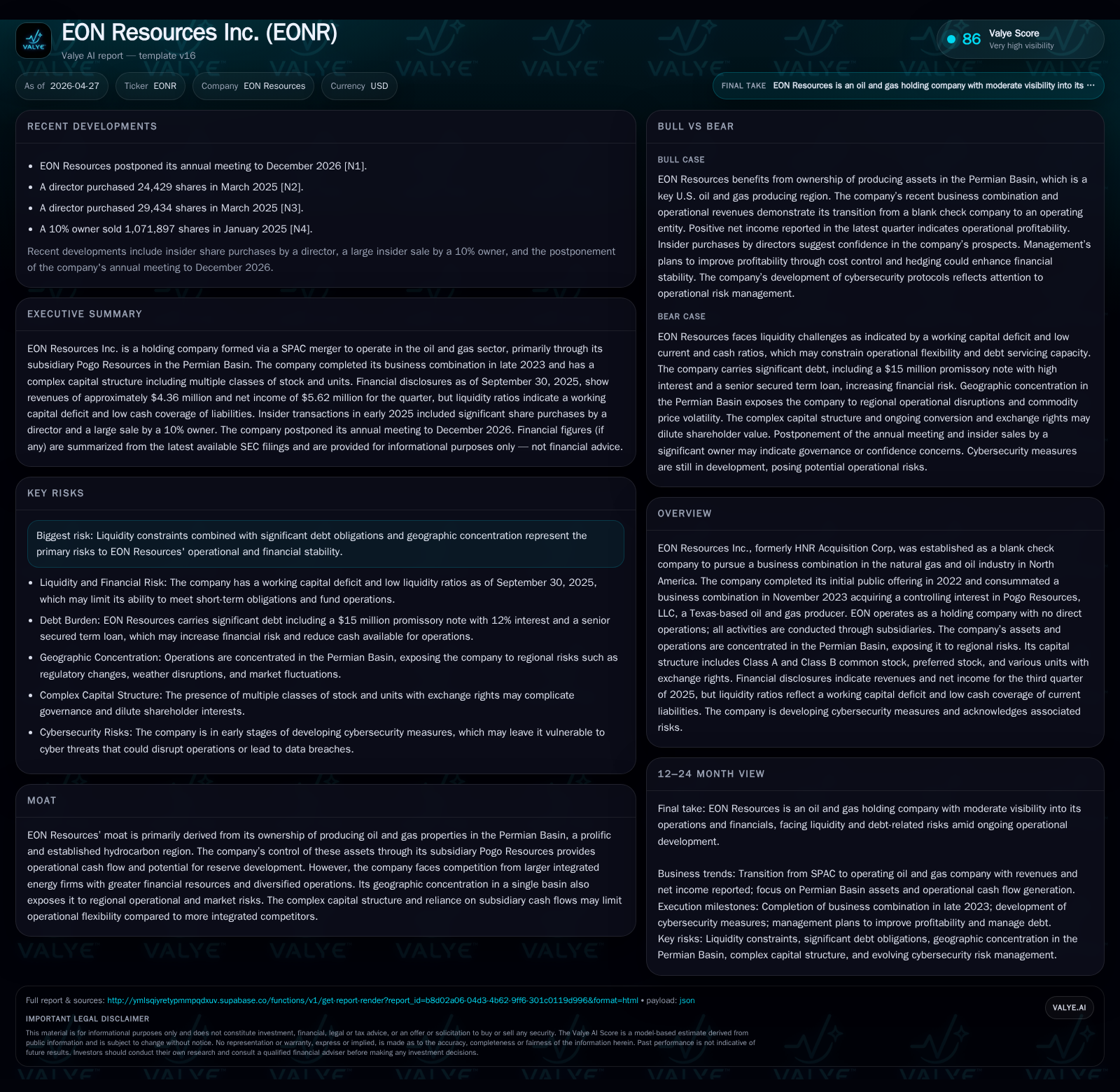
EON Resources recently received a formal notice from NYSE American for failing to timely file its 2025 annual report, initiating a cure period to regain compliance. The company operates as a holding entity controlling Pogo Resources LLC, which owns producing oil and gas assets solely in the Permian Basin, thereby exposing it to regional and operational risks. Its strategic approach relies on cost-effective reserve development through work-overs rather than new drilling to drive midterm production growth. However, EON’s complex capital structure, significant debt load, and poor liquidity underscore substantial refinancing and operational flexibility challenges that may constrain growth prospects in an increasingly regulated environment.
Regulatory Compliance Update and Immediate Implications
In April 2026, EON Resources received an official notice of noncompliance from NYSE American due to the company's failure to file its Form 10-K annual report for the fiscal year ended December 31, 2025, by the April 15 deadline [S3][S21]. Although this notification does not immediately affect the listing status of its securities, it initiates an Initial Cure Period until October 15, 2026 within which EON must complete the filing to regain compliance. If unmet during this window, NYSE American may grant an additional six-month grace period; however, neither assurances exist regarding meeting these deadlines nor maintaining ongoing listing standards compliance.
This regulatory development marks a governance risk flare-up that casts short-term uncertainty over investor perceptions and underscores internal operational or administrative challenges within EON’s reporting framework. The protracted delay necessitates focused resource allocation toward closing outstanding financial reporting requirements amid broader execution priorities.
Holding Company Structure Anchored in Pogo Resources’ Permian Basin Assets
EON originated as HNR Acquisition Corp., a special-purpose acquisition company (SPAC) focused on natural gas and oil industry targets in North America. Following its IPO in early 2022, it consummated a business combination in November 2023 acquiring controlling stakes in Pogo Resources LLC—a Texas-based upstream operator managing producing oil and natural gas properties primarily in the Permian Basin [S1].
Operating effectively as a pure holding entity without direct operational activities or assets, EON depends entirely on its subsidiaries for cash flow generation necessary to fund debt service obligations and administrative expenses [S19]. This structure concentrates both operational dependency and risk syllabically into Pogo’s management effectiveness and the performance of its underlying basin assets.
The Permian Basin constitutes one of the most prolific hydrocarbon regions globally, offering abundant reserves but also concentrating geographic risk factors such as local infrastructure constraints, regulatory shifts at state levels, or basin-specific demand volatility. The integrated approach with Pogo exposes EON to these regional effects while limiting diversification benefits available to larger peers.
Competitive Positioning: Advantages and Constraints in the North American Oil Patch
Within the competitive landscape of North American upstream oil and gas producers, EON occupies a secondary tier defined by its narrow asset scope and relative financial scale. Larger integrated players benefit from diversified geographical footprints across multiple basins alongside vertically integrated downstream capabilities which provide cushioning against commodity price swings and operational disruptions [S1].
Pricing power hinges on prevailing regional supply-demand balances but is tempered by global macroeconomic trends impacting crude benchmarks.
Its reliance on subsidiary cash flows creates inherent inflexibilities restricting quick capital deployment or operational scale-ups absent incremental financing or equity raises. The company’s bespoke capital structure further complicates negotiation dynamics with lenders or partners.
Drivers of Production Growth and Operational Efficiency in the 7R Reservoir
Pogo Resources’ development strategy prioritizes economical enhancement of proved developed non-producing (PDNP) reserves through perforation work-over projects rather than costly new well drilling activity tied to proved undeveloped (PUD) reserves [S1]. This method leverages existing wellbores with incremental perforations to unlock production at significantly lower capital intensity compared to greenfield drilling—offering improved unit economics critical under constrained liquidity.
Targeting development across approximately 115 well patterns within the core 7R reservoir facilitates scalable uplift opportunities aimed at increasing production volumes gradually while managing investment outlays prudently.
Efficient conversion from PDNP reserves evidences a strategic response to balance midterm growth ambitions against prevailing capital market accessibility limitations—addressing pressure points endemic among mid-sized independent producers.
Capital Structure Complexity and Liquidity Pressure Points
EON exhibits a multifaceted equity base comprising Class A and Class B common stocks alongside preferred shares and warrant instruments with exchange rights [S1]. Complementing this equity complexity is substantial financial indebtedness measured at approximately $44.7 million total debt as of mid-2024 quarter-end [F1], aligned with minimal cash resources amounting to roughly $0.9 million by end-September 2025 [F1].
These metrics result in a stark current ratio near 0.35—indicative of significant working capital shortfalls against current liabilities exceeding $15 million [F1]. Such liquidity tightness amplifies refinancing risks amid rising interest rates linked to floating benchmark adjustments (SOFR-based term loans) alongside restrictive covenants limiting incurrence of new debt or alteration of organizational documents without lender consent [S22][S28].
The necessity to allocate discretionary free cash flow toward principal and interest payments further narrows available funding for operational investments or shareholder returns, constraining strategic agility during periods demanding active resource deployment or opportunistic acquisitions.
Regulatory Risk Landscape and Environmental Considerations
Increasingly stringent federal, state, and international regulatory initiatives targeting greenhouse gas (GHG) emissions from the oil and gas sector introduce an evolving compliance backdrop that may escalate operating costs or restrict permissible production domains for companies like EON engaged solely in upstream exploration and development activities [S1].
Potential tightening emissions standards could impose additional monitoring burdens or necessitate capital expenditure for emissions reduction technology deployment—incrementally squeezing margins in an environment already pressured by liquidity concerns. Furthermore, evolving policy risks potentially dampen long-term demand forecasts for hydrocarbons influencing reserve valuations indirectly.
Regulatory uncertainties compound challenges presented by financial constraints highlighting an imperative need for adaptive corporate governance frameworks aligned with environmental sustainability trends.
Key Upcoming Milestones to Monitor for Execution Clarity
Several pivotal events warrant attentive monitoring as signals of execution progress or emerging risks: completion of the delayed annual report filing remains foremost given ongoing NYSE compliance considerations with cure periods extending into late 2026 [S3][N1]; tracking quarterly updates regarding progress on reserve development projects within Pogo’s well patterns will reveal if projected production uplifts materialize reflecting successful work-over completions [S1]; likewise, indicators around liquidity improvements through refinancing deals or enhanced cash flow metrics can illuminate shifts in financial flexibility.
Investor focus will likely sharpen on announcements related to governance restructuring prompted by listing scrutiny alongside operational updates demarcating recovery trajectories amid market volatility.
Summarized Financial Health Snapshot: Liquidity, Debt, and Cash Flows
Latest publicly reported figures depict constrained financial health characterized by cash & equivalents totaling approximately $0.9 million juxtaposed against current liabilities surpassing $15 million as of third quarter-end September 30, 2025—the resulting current ratio stands at an acute low near 0.35 underscoring immediate liquidity strain [F1]. Total outstanding debt amounted close to $44.7 million as reported mid-2024 half-year metrics suggest leverage remains elevated relative to liquid resources creating substantial net debt exposure around $43.8 million after cash offsets [F1].
Operating income records illustrate losses correlating with tighter margins influenced by pricing environment softness paired with elevated general administrative expenses coinciding with public company compliance costs [F1][S2]. These financial stressors manifest tangible refinancing risks magnified by floating rate loan structures susceptible to Fed rate hikes compounding interest burden forecasts further pressing discretionary cash availability for core business operations or expansion ventures.
This analysis is based solely on disclosed public filings up to April 27, 2026, including SEC reports and company data sets cited herein. It reflects non-investment qualitative assessment emphasizing company fundamentals juxtaposed with evolving regulatory environments.
Disclaimer: This is research-only, informational analysis and not investment advice. It may include AI-generated interpretation and general industry context. Always verify important details using primary sources.

Comments