
Syra Health Strengthens Government Contracts as New Leadership Drives Population Health Expansion
Syra Health’s latest filings reveal a strategic thrust on government contract renewals and leadership-driven growth within Medicare Advantage and Medicaid markets.
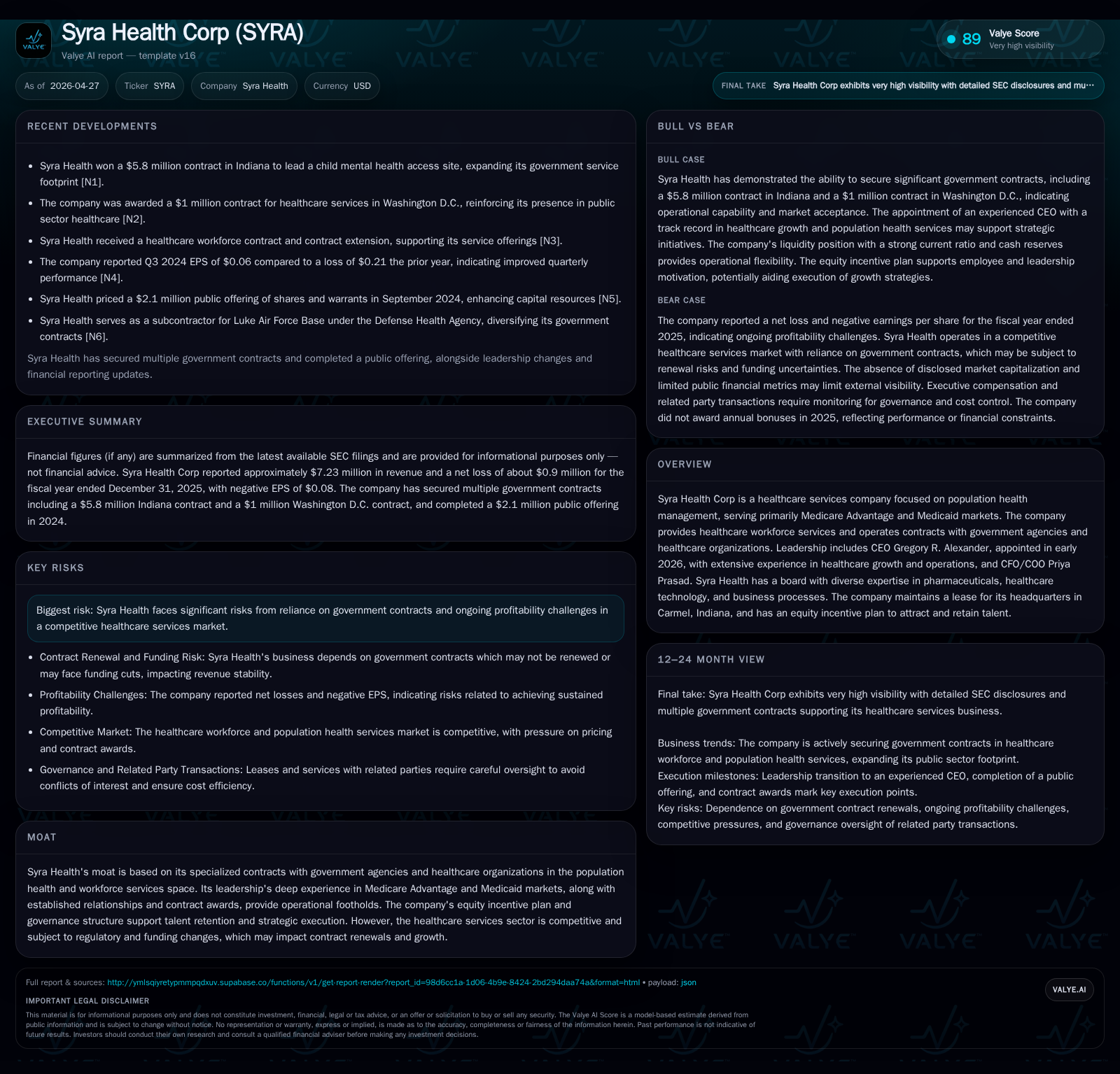
Syra Health Corp’s recent SEC filings spotlight a pivotal phase with CEO Gregory Alexander stepping in early 2026, underscoring operational momentum centered on government contract executions in population health management. The company’s business model leverages specialized healthcare workforce services primarily contracted by Medicare Advantage and Medicaid programs, positioning Syra within a highly competitive and regulatory-sensitive landscape. Growth prospects hinge on leveraging government relationships and operational scale but remain constrained by sector-specific reimbursement pressures and contract renewal risks. Syra’s financial position exhibits solid liquidity with manageable debt, enabling continued investment under new leadership focused on scaling footprint and improving execution.
Recent Operational Developments: 10-Q Insights and Event Updates
Syra Health’s most recent quarterly disclosure dated November 12, 2025 ([S2]) anchors the current analysis by confirming ongoing operations primarily driven through contracts with government agencies focusing on Medicare Advantage and Medicaid populations. The Q3 2025 filing maintains consistency regarding risk factors emphasizing the challenging competitive environment but does not indicate material disruptions. Importantly, the March 12, 2026 event filing ([S3]) serves as a strategic inflection point detailing the formal announcement of financial results for the full year ending December 31, 2025 alongside the appointment of Gregory R. Alexander as Chief Executive Officer starting January 5, 2026 ([S19]). This leadership change positions Syra Health to leverage Alexander’s deep expertise in scaling population health companies.
The timing of Alexander’s onboarding shortly after year-end results suggests a deliberate strategy to accelerate growth initiatives informed by fresh executive insights. These filings collectively reinforce a trajectory focused on expanding contract footprints underpinned by established government relationships while navigating industry challenges.
Business Model Architecture: Population Health Focus and Contract-Centric Revenue Streams
Syra Health's revenue generation is intrinsically tied to securing and executing government contracts that emphasize population health workforce services targeted at Medicare Advantage beneficiaries and Medicaid recipients ([S1]). The company operates specialized service agreements with state agencies such as Indiana's Family and Social Services Administration, delivering rehabilitative and healthcare staffing solutions essential for managing complex care populations.
This contract-centric approach creates an opportunity to develop stable revenue streams derived from long-term engagements; however, it also embeds customer concentration risk since changes in policy or funding can materially impact revenues. Additionally, unit economics depend heavily on efficient workforce management balancing quality patient outcomes against stringent cost controls.
The company uses an equity incentive plan including restricted stock units and performance stock units to attract/retain talent crucial for maintaining operational excellence across multiple contracts ([S19], [S1]).
Competitive Dynamics and Industry Structure in Medicaid and Medicare Advantage Services
The healthcare workforce services industry serving government programs is fragmented yet intensely competitive due to regulatory oversight, reimbursement volatility, and complex bidding processes ([S1]). Syra Health’s niche in providing rehabilitative workforce augmentation positions it against larger managed care organizations and specialized contractors that benefit from scale efficiencies.
Winning government contracts requires navigating multi-layered procurement processes where track record, compliance history, and localized market knowledge create barriers to entry. However, pricing power remains constrained by reimbursement schedules governed by federal/state rules which can compress margins during policy shifts. Additionally, client switching costs exist but are moderated by periodic contract rebidding often leading to churn or reallocation.
Regulatory changes in Medicaid expansion or Medicare Advantage plan design present ongoing uncertainty contributing to cyclicality in contract renewals. This structural environment necessitates continuous investment in systems compliance and operational agility ([S1]).
Leadership Impact and Growth Strategy Execution
Gregory R. Alexander’s appointment as CEO marks a significant inflection rooted in his prior accomplishments scaling Medicare Advantage membership substantially at Lumeris (20% CAGR over four years) alongside commercial strategy roles enhancing sales growth at pharmacy benefits managers ([S1], [S19]). His background signals an intent to sharpen Syra Health’s competitive positioning through targeted market expansions and disciplined budget management.
Alexander’s compensation package tied to annual bonuses (30% target) plus substantial equity awards (restricted stock units vesting over four years plus performance stock units) indicates alignment incentives crafted to drive long-term value through both organic growth and margin improvement ([S19]). Complementing the CEO is CFO/COO Priya Prasad who has held key operational roles previously ensuring continuity during leadership transitions.
The board composition leverages diverse healthcare tech, pharmaceutical research expertise supporting governance tailored toward innovation adoption while maintaining compliance fidelity ([S1]).
Key Growth Enablers Alongside Potential Constraints
Growth catalysts revolve around expanding Syra’s contracting footprint within existing Medicaid/Medicare markets while pursuing new geography or service verticals enabled by Alexander’s network ([S2], [S1]). Contract renewal cadence regularly influences near-term revenue visibility given the semi-annual rebid cycles typical in government procurements.
Operational efficiencies driven by technology integration into workforce management may reduce costs or improve employee retention — both vital for managing tight margins characteristic of public sector health services ([S1]).
Conversely, primary constraints include potential adverse policy changes such as reimbursement rate cuts or tightening eligibility criteria impacting demand levels for contracted services ([S2]). Intensifying competition among providers could force price concessions eroding profitability unless offset by scale or differentiation.
Contract concentration heightens vulnerability if major clients choose alternative vendors or shift program priorities abruptly. Careful portfolio diversification balanced against core competency focus remains a delicate strategic tradeoff.
Performance Metrics to Monitor: Guidance, Contract Renewals, and Market Penetration
While explicit forward guidance disclosures appear limited within the filings examined ([S2], [S3]), investors should closely monitor metrics including:
- Success rate of contract renewals representing revenue continuity.
- Backlog or pipeline disclosures indicating new business prospects.
- Enrollment figures within covered Medicare Advantage/Medicaid populations impacted directly by government program changes.
- Operating margin trends reflecting efficiency gains amid scaling efforts. These KPIs will collectively reveal execution quality of the new leadership team’s strategy and provide clarity on how well Syra adapts to sector headwinds.
Current Financial Position and Liquidity Context
As of December 31, 2025 ([F1]), Syra Health holds $1.61 million in cash & equivalents against total debt of approximately $116 thousand resulting in a net cash position indicative of conservative leverage practices.
Revenue for fiscal 2025 registers just over $7.2 million while operating income remains a loss of about $0.9 million reflective of ongoing investments in restructuring initiatives under new leadership ([F1]). The net loss also aligns with elevated spend levels associated with growth phase companies serving complex government healthcare sectors where upfront investment precedes scale economics realization.
Overall balance sheet health provides flexibility enabling Syra Health to pursue strategic priorities without immediate refinancing pressure while navigating sector cyclicality linked to contract awards.
Disclaimer: This analysis is based solely on publicly available regulatory filings up to April 27, 2026, combined with sector-specific expertise. It does not constitute investment advice nor endorsement of any securities mentioned herein.
Disclaimer: This is research-only, informational analysis and not investment advice. It may include AI-generated interpretation and general industry context. Always verify important details using primary sources.

Comments