
West Bancorporation Strengthens Loan Quality and Deposit Stability in Q1 2026
The Q1 2026 report highlights West Bancorporation’s disciplined credit approach, deposit insurance expansion, and hedging tactics underpinning its regional banking resilience.
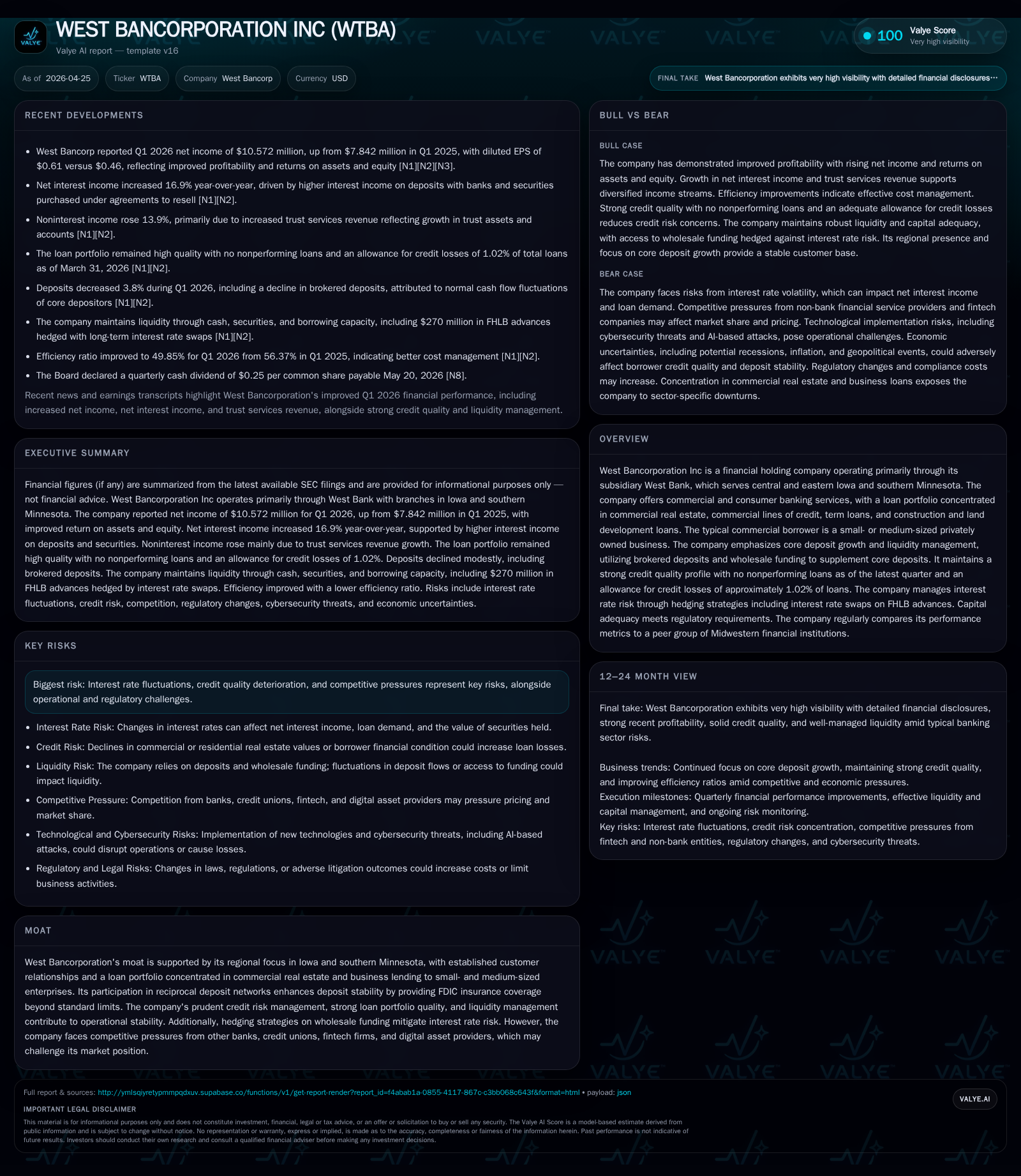
West Bancorporation reported a slight contraction in total assets during Q1 2026, influenced by declines in loans and deposits offset partially by growth in securities under resale agreements. The company’s use of a reciprocal deposit network significantly lowers uninsured deposit risk, enhancing funding stability. Credit quality remains robust with no nonperforming loans reported, supported by conservative underwriting and a 1.02% allowance for loan losses. Its regional focus on small- to medium-sized commercial borrowers, combined with interest rate risk mitigation via long-term swaps on short-term FHLB advances, positions WTBA competitively in the Midwest despite pressure from fintech entrants and evolving digital financial services.
Q1 2026 Operational Update: Asset and Liability Dynamics
West Bancorporation's most recent quarterly filing (10-Q dated April 23, 2026) reveals nuanced shifts within its balance sheet integral to understanding near-term operational resilience [S2]. Total assets fell modestly from $4.14 billion at December 31, 2025 to $4.01 billion as of March 31, 2026. This contraction was driven chiefly by declines in loans outstanding as well as deposits gathered—a core funding source—while offset partially by increases in securities purchased under agreements to resell (short-term secured investments maturing monthly) which grew from roughly $121 million to $142 million.
Critically, West Bank's participation in a reciprocal deposit network fortifies its funding stability by allowing depositor balances above the conventional FDIC insurance threshold to receive coverage via a federated network of banks. The filing notes that estimated uninsured deposits (excluding those protected through the reciprocal network or state public fund programs) stand at approximately 27% of total deposits at quarter-end [S2]. This substantially mitigates liquidity risk associated with large deposits concentrated beyond standard FDIC caps.
Borrowed funds are minimal relative to total assets; the company held just $270,000 in Federal Home Loan Bank (FHLB) advances—all on one-month rolling terms but fully hedged with longer-duration interest rate swaps designed to manage exposure from fluctuating rates [S2]. Interest expense on borrowed funds decreased year-over-year for Q1 largely due to principal paydowns of long-term debt reducing average borrowings.
Importantly, credit quality metrics underscore operational strength: the company reported no nonperforming loans as of quarter-end alongside an allowance for credit losses at about 1.02% of total loans outstanding—signifying cautious underwriting standards amidst evolving economic conditions [S2].
Business Model and Product Offering: Regional Focus and Core Bank Services
West Bancorporation operates primarily through West Bank serving central and eastern Iowa plus southern Minnesota—regional markets characterized by small- and medium-sized enterprises (SMEs) often privately held [S1]. Its product suite emphasizes commercial banking solutions including commercial real estate financing (construction loans, land development), term loans, working capital lines of credit, and consumer banking products tailored locally.
Revenue is principally generated through net interest income derived from lending activities funded largely by core deposits supplemented by brokered deposits and wholesale funding proxies such as FHLB advances [S1]. The business model underscores relationship-driven banking where proximity and personal interaction cultivate customer loyalty, facilitating retention among SME borrowers whose financing needs tend toward mid-size commercial projects rather than large institutional clients.
This strong local franchise supports pricing power albeit within limits imposed by heightened competition. An allowance for loan losses maintained near 1% reflects prudence in credit risk management combined with careful portfolio diversification weighted towards less volatile commercial real estate commitments—an advantage especially relevant given sector-specific cyclicality observed elsewhere [S1]. The interplay between maintaining low credit risk while growing loan volumes defines ongoing operational priorities.
Competitive Positioning within Regional Banking and Industry Pressures
West Bancorporation’s moat rests on entrenched regional relationships enriched by deep community knowledge across Iowa and southern Minnesota markets where it maintains significant brand recognition [S1]. Participation in reciprocal deposit networks also provides structural advantages ensuring depositor confidence through extended FDIC coverage beyond typical thresholds—something less accessible for pure digital or fintech lenders lacking similar regulatory frameworks [S2].
However, this moat encounters rising challenges amid expanding competitive terrain including other regional banks targeting similar SME niches as well as aggressive growth from credit unions benefiting from tax advantages and nimble fintech entrants leveraging innovative digital delivery platforms [S1][S2]. Digital asset providers introduce further disruption potential though current penetration into West Bancorporation’s specific geographies remains limited.
While the company retains some pricing latitude due to local ties, competitive pressures may curtail margin expansions particularly where alternative financial service providers offer rapid onboarding or lower fees through technology-leveraged efficiencies—pressures possibly exacerbated during fluctuating economic cycles.
Growth Drivers: Loan Portfolio Composition and Deposit Stability Mechanisms
Growth possibilities align closely with healthy regional SME sector dynamics buoyed by steady commercial real estate activity supportive of construction lending demand [S2][F1]. Deposit stability is materially enhanced via reciprocal deposit network participation which safeguards larger client balances against insurance limits constraint—encouraging retention of sizable corporate accounts otherwise vulnerable to outflows prompted by perceived uninsured risks [S2]. Additionally, effective liquidity deployment into short-term repos maintains balance sheet flexibility bolstering responsiveness.
Further penetration of these mechanisms could strengthen the funding mix underpinning net interest income generation without excessive reliance on more costly brokered or wholesale funds.
Growth Limitations: Interest Rate Risks, Competition, and Capital Deployment
Interest rate volatility continues posing risks despite West Bancorporation’s hedging strategy involving long-term swaps layered over short-maturity borrowing instruments like FHLB advances [S2]. While these mitigate immediate repricing shocks potentially protecting net interest margins (NIM), prolonged dynamics could strain margins especially if asset yields lag liability costs or competitive forces compress pricing spreads further.
Competitive intensity not only constrains pricing but also pressures customer acquisition costs amid fintech platforms capable of rapid scale via digital channels [S1]. Regulatory capital requirements impose additional constraints influencing lending capacity and restricting aggressive dividend or buyback policies that otherwise might enhance shareholder value.
Given these factors alongside macroeconomic uncertainties impacting borrower creditworthiness—including inflationary pressures or supply chain disruptions affecting SME profitability—the operating environment demands cautious growth calibrated tightly against risk appetite.
Key Upcoming Milestones and Market Signals to Monitor
Key indicators warrant closely watching future quarterly filings for any emergence of nonperforming loans or shifts in reserve adequacy signaling credit stress upticks. Tracking changes in the percentage composition between insured versus uninsured deposits within the reciprocal network will reveal volatility susceptibility in funding sources [S2].
Effectiveness of interest rate hedges should be observable through subsequent earnings disclosures illustrating NIM trends versus benchmark rates. Moreover, management commentary around deposit growth ambition or competition impacts shed light on strategic adaptability amidst fintech encroachment [N1][N2].
Regulatory developments potentially altering reciprocal deposit arrangements or capital mandates constitute external factors shaping trajectory; likewise technological investments aimed at digital delivery enhancements will indicate efforts responding to industry disruption vectors.
Financial Profile: Latest Quarter Metrics Support Operational Narrative
Historical performance (annual)
|
| FY | Net ($mm) | CFO ($mm) | Capex ($mm) | Net YoY |
|---|---|---|---|---|
| 2025 | 33 | 46 | 3 | +35.4% |
| 2024 | 24 | 40 | 26 | -0.4% |
| 2023 | 24 | 25 | 36 | -48.0% |
| 2022 | 46 | 59 | 21 |
Source: SEC companyfacts cache [F1].
Capital returns and efficiency (annual)
|
| FY | Div ($mm) | FCF ($mm) | ROE% |
|---|---|---|---|
| 2025 | 17 | 43 | 12.2 |
| 2024 | 17 | 14 | 10.6 |
| 2023 | 17 | -11 | 10.7 |
| 2022 | 17 | 38 | 22.0 |
Source: SEC companyfacts cache [F1].
The following table consolidates key quantitative data from the latest quarter underpinning West Bancorporation's operational stance [S2][F1]:
| Metric | Q1 2026 | Change vs Q4 2025 |
|---|---|---|
| Total Assets | $4.01 billion | -3.17% |
| Loans | Decreased (not quantified) | Decline noted |
| Deposits | Decreased | Decline noted |
| Securities Purchased | $142 million | +16.9% |
| Outstanding FHLB Advances | $270,000 | Stable/Low |
| Interest Expense | Reduced by ~$113k YoY | Improvement |
| Allowance for Credit Losses | ~1.02% of loans | Stable |
| Nonperforming Loans | Zero | Stable |
These figures collectively illustrate a slight consolidation phase intended to preserve asset quality while optimizing funding cost structure amid shifting economic conditions. The declining long-term debt averages facilitate savings on interest expenses despite smaller borrowing needs—a testament to disciplined liability management [S2].
Profitability trends have strengthened over recent years with net income increasing substantially year-over-year as per annual data ($32.56 million FY2025 vs. $24.05 million FY2024), implying resilient core operations balanced against conservative risk posture [F1]. Operational cash flow growth coupled with manageable capex reaffirms healthy internal liquidity allowing sustained dividends consistent with shareholder expectations.
This analysis represents an operational snapshot framed exclusively by validated SEC filings and authoritative corporate disclosures without predictive assertions or investment recommendations. Please consider this report informational rather than advisory.
Disclaimer: This is research-only, informational analysis and not investment advice. It may include AI-generated interpretation and general industry context. Always verify important details using primary sources.

Comments