
Tesla’s Q1 2026 Update Underscores AI-Driven Manufacturing and Robotaxi Expansion
Tesla's latest quarterly filings highlight strides in scaling AI-enabled production, Robotaxi deployment, and supply chain localization, shaping its near-term growth trajectory.
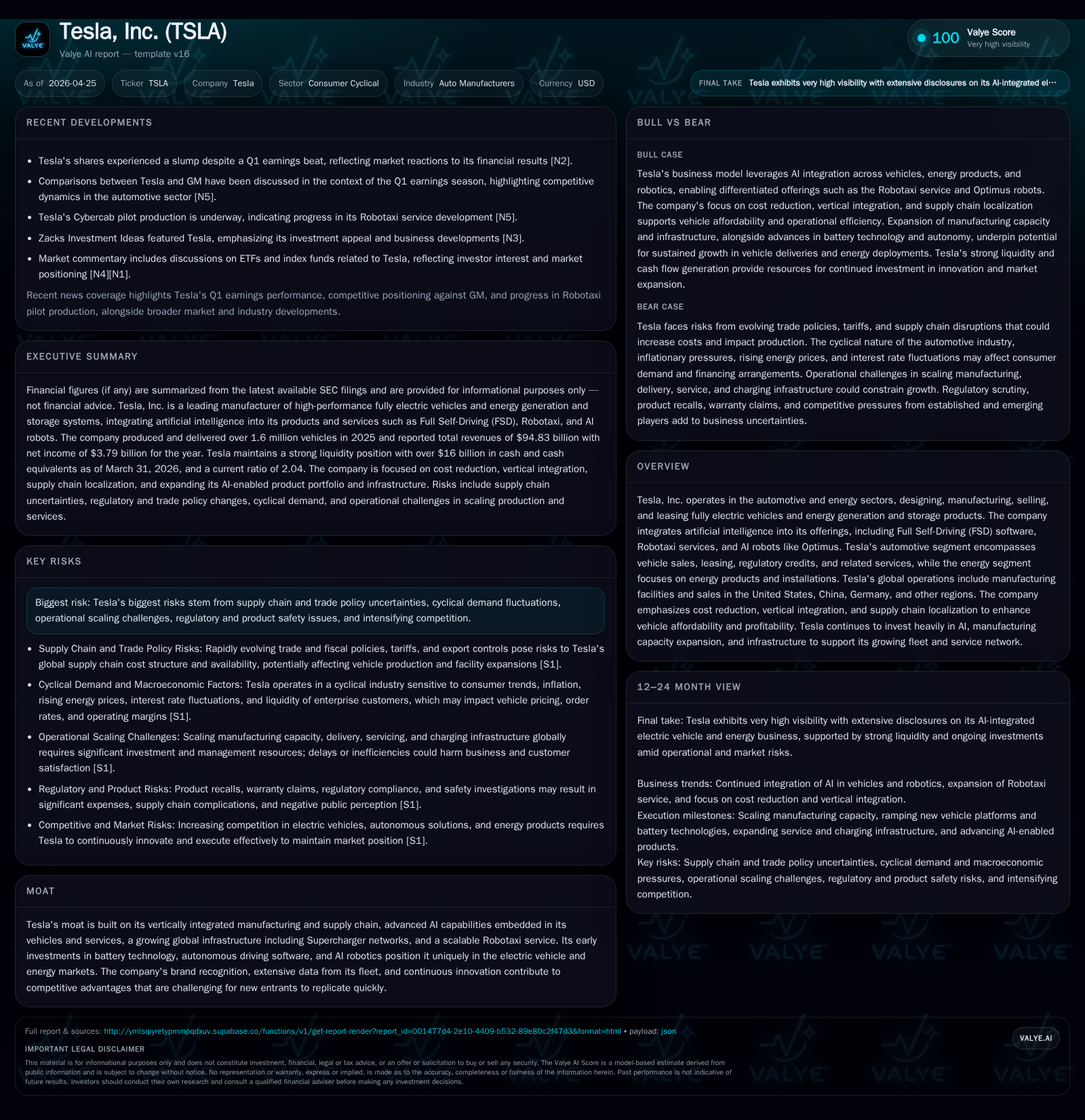
In Q1 2026, Tesla reinforced its focus on marrying advanced AI capabilities with electric vehicle manufacturing and autonomous mobility services. Despite facing supply chain pressures from tariff regimes and component sourcing complexities, Tesla continues expanding its manufacturing footprint and refining its Robotaxi platform. The company's vertically integrated model and fleet data advantage sustain its competitive edge amid intensifying market rivalry. Investors and industry watchers should closely monitor production ramp efficiency, regulatory outcomes for autonomy features, and the pace of Robotaxi commercialization for signals of execution success.
Q1 2026 Operating Performance Highlights
Tesla’s April 2026 Form 10-Q [S2] affirms ongoing operational progress intertwined with persistent headwinds affecting near-term growth dynamics. The company reiterates its focus on growing manufacturing capacity while deploying advances in Full Self-Driving (FSD) supervised technology. Nissan disclosed in its concurrent Form 8-K update [S3] that the operational rollout of Tesla’s purpose-built Cybercab Robotaxi continues apace following its June 2025 commercial launch.
Despite a robust production volume backdrop — recalling Tesla produced roughly 1.66 million vehicles in 2025 [S1] — supply chain complications tied to heightened U.S. tariffs and retaliatory international measures have increased costs particularly for energy segment components. These geopolitical trade factors have led to nuanced disruptions in materials sourcing and logistics that Tesla must navigate carefully without disrupting delivery targets.
Automotive deliveries remain strong but margin pressure stems partly from a challenging mix effect amplified by tariff-induced input cost inflation. The filings confirm improvement initiatives target reducing these costs via vertical integration efforts including domestic cell production ramp-ups. Meanwhile, incremental investments aim to enhance data center capacity needed for AI compute processing powering autonomy advancements.
Supercharger network expansion continues alongside enhancements to servicing infrastructures designed to support an expanding global fleet with increasing complexity due to layered software functionalities or hardware updates.
Tesla’s Business Model: Electrification Meets AI-Enabled Mobility
Tesla generates revenue primarily through vehicle sales, leasing options, regulatory credits tied to clean energy standards, and an ecosystem of services such as paid Supercharging sessions and automotive insurance [S1]. Beyond the automotive segment lies a growing emphasis on energy generation and storage products—Powerwall residential units and Megapack utility-scale batteries—which represent a fast-growing revenue stream though currently more susceptible to tariff-driven cost volatility.
Strategically distinctive is Tesla’s integrated approach where vehicle hardware meshes tightly with proprietary software solutions including FSD supervised driving capabilities. The company leverages extensive real-world driving data collected from millions of active vehicles worldwide to iteratively train AI models that fuel autonomous driving improvements and underpin the feasibility of a Robotaxi business model.
This synergy yields multiple value levers: beyond direct sales margins from cars themselves, Tesla monetizes over-the-air software upgrades enhancing user experience post-purchase; regulatory credits provide ancillary income influenced by evolving governmental policies favoring electrification; fleet data-driven services foster customer stickiness and create high switching costs for competitors lacking similar scale.
Vertically integrated battery cell manufacturing targeting cost reduction contributes significantly toward lowering total vehicle ownership costs—an increasingly vital competitive parameter amid growing EV adoption globally.
Industry Context and Tesla's Competitive Moat
Within the increasingly crowded auto manufacturer space transitioning to electric vehicles (EVs), Tesla's moat centers on scale, integration, technology leadership, and network effects. Its expansive gigafactory footprint—including key facilities in the U.S., China, Germany—and ramped battery production capacity provide formidable advantages over smaller entrants or traditional automakers pivoting slowly.
Tesla’s scale enables substantial unit economics benefits including higher fixed-cost absorption ratios compared with peers still investing heavily in EV transitions [S6]. More importantly, an unmatched computing infrastructure supports complex AI workloads critical for refined autonomy—a differentiator rivals struggle to replicate quickly given steep capital expenditure requirements apropos investing in dedicated data centers alongside manufacturing lines.
The global Supercharger network offers an ecosystem lock-in dimension rarely matched by alternative providers or OEMs dependent on third-party networks. Further ecosystem assets include robust service centers optimized for Tesla’s unique hardware/software stack enhancing customer satisfaction relative to multi-brand service dependencies common elsewhere [S20].
Regulatory environments present both opportunities via subsidies or credits but also risks stemming from product safety oversight especially concerning Autopilot/FSD technologies currently under intense scrutiny worldwide—highlighted by ongoing litigation [S4][S5][S9]. Nonetheless, Tesla’s pioneering early-mover status translating into fleet learning advantages fortifies competitive barriers as new entrants grapple with costly learning curves.
Growth Catalysts: Robotaxi Rollout, AI Innovations, and Capacity Expansion
The recently initiated Robotaxi program represents a strategic inflection point transitioning Tesla toward a service model complementing traditional vehicle sales. Leveraging its extensive onboard datasets enables continuous algorithmic improvement underpinning safer driverless ride experiences—central to realizing scalable autonomous mobility revenue streams [S1].
Investments exceeding $20 billion planned for 2026 reflect significant commitments not just to physical factory expansion but also bolstering compute infrastructure necessary for training sophisticated neural networks powering AI systems embedded in vehicles and robotics platforms such as Optimus [S12]. These ambitious R&D outlays illustrate Tesla’s bet on software-defined future mobility where product differentiation increasingly rests on sophisticated AI rather than solely hardware specs alone.
Production efficiencies at gigafactories remain paramount as Tesla launches newer platform vehicles aiming at both performance enhancement and cost containment—critical levers that will drive deeper market penetration without sacrificing margins amid intensifying competition [S1]. Moreover, vertically localizing supply chains reinforces resilience against global disruptions while enabling price competitiveness by avoiding certain tariffs.
Expansion of ancillary revenue avenues such as automotive insurance tailored around behavioral data from connected cars further diversify income streams signaling maturation beyond pure manufacturing revenue dependency.
Risks and Operational Constraints: Supply Chain, Scaling, and Regulation
Tesla faces myriad risks underscored in recent filings including:
- Supply Chain Vulnerabilities: Tariff environment complexity coupled with single-source dependencies for critical materials exacerbate component shortage risks which could delay ramps or inflate costs unexpectedly [S25].
- Product Liability & Regulatory Liabilities: Continuation of class action lawsuits around Autopilot/FSD claims alongside safety investigations pose reputational as well as financial exposures [S9][S10][S22].
- Scaling Challenges: Introducing new vehicle platform technologies while maintaining high quality during rapid volume increases imposes operational strain potentially leading to costly delays or recalls [S26][S18].
- Labor & Litigation: Pending discrimination lawsuits scheduled for trial mid-2026 introduce legal uncertainty potentially impacting workforce morale or incurring sizable costs [S5].
- Energy Segment Tariff Sensitivity: Energy generation/storage business faces proportionally greater tariff exposure impacting margins distinct from automotive operations [S1][S24].
These constraints require vigilant management balancing aggressive growth ambitions with execution discipline given capital intensity of innovation cycles.
Key Upcoming Milestones and Indicators to Monitor
Investors should track key performance markers across coming quarters:
- Production Ramp Rates: Speed and efficiency metrics related to new vehicle variants including Cybertruck expansions will reveal scalability progress.
- Robotaxi Revenue Development: Growth trajectories post-commercial launch signal viability of autonomous ride-hailing service profitability.
- Regulatory Approvals: Outcomes related to full autonomy certifications especially across major markets like the U.S., EU, and China will govern addressable market size.
- Battery Innovations: Breakthroughs in proprietary cell designs targeting longer range/lower costs could redefine competitive dynamics dramatically.
- Trade Policy Evolution: Changes in U.S.-China tariffs or other international trade agreements materially influence input cost baselines requiring ongoing adjustment.
- AI Infrastructure Deployment: Capital spend execution on data centers evidences commitment level toward sustaining software prowess integral to future differentiation.
Taken together these indicators form an actionable framework assessing Tesla’s ability to convert technological bets into sustainable growth pathways while managing macroeconomic uncertainties.
This analysis synthesizes information solely from official SEC filings dated January through April 2026 [S1]-[S3] supplemented by established company fundamentals as per latest annual disclosures without extrapolating unverified financials or performance claims.
Disclaimer: This is research-only, informational analysis and not investment advice. It may include AI-generated interpretation and general industry context. Always verify important details using primary sources.

Comments