
CenterPoint Energy Inc's Capital Investment Push Underpins Regulated Utility Expansion
Quarterly disclosures highlight CenterPoint Energy’s continued infrastructure modernization and Ohio divestiture progress within a regulated utility framework.
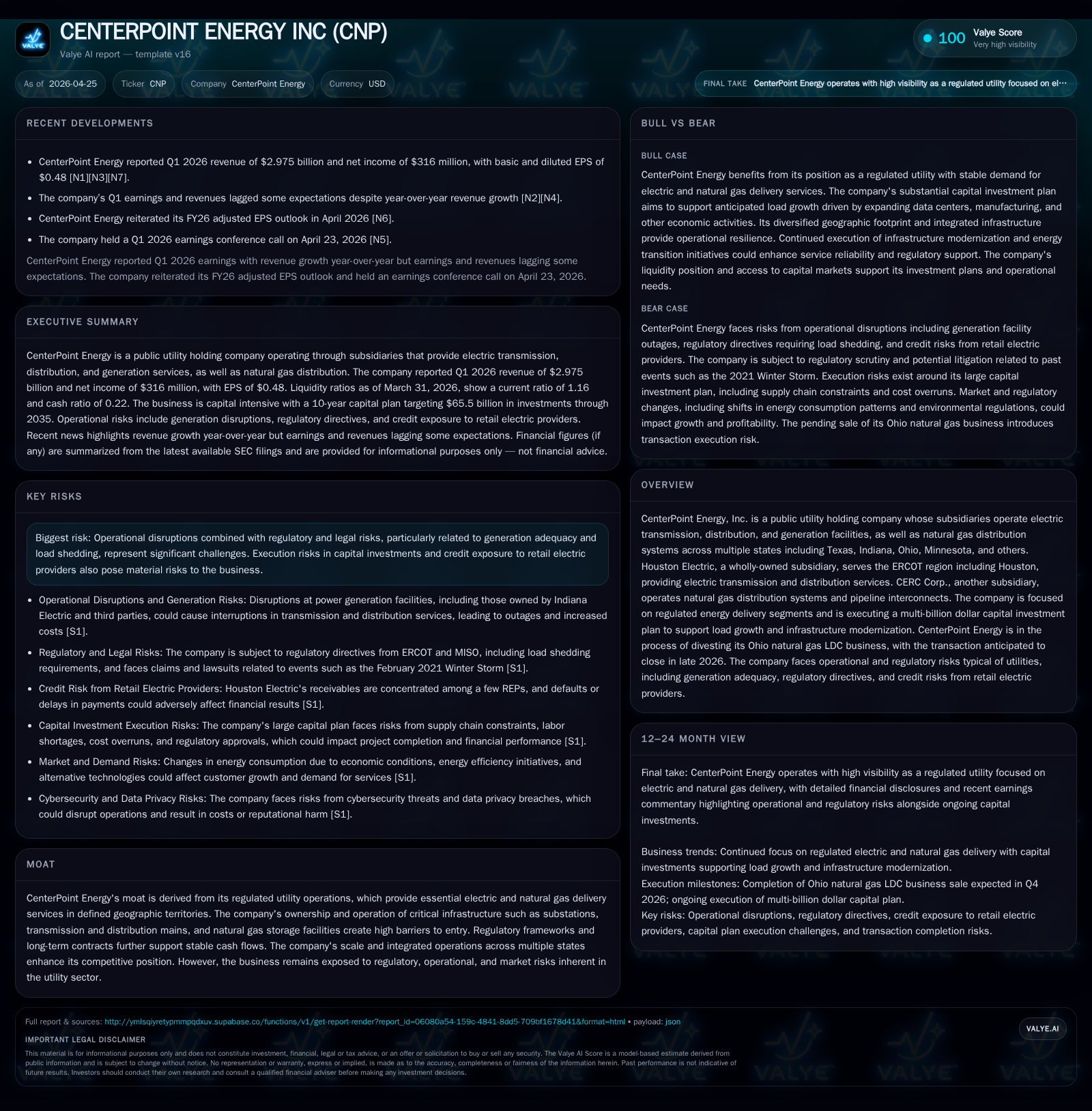
CenterPoint Energy’s latest quarterly filings demonstrate steady advancement on its multi-billion-dollar capital investment program, emphasizing upgrades in electric transmission and natural gas distribution assets. The company is progressing toward the late-2026 closing of its Ohio natural gas LDC divestiture while managing operational risks tied to regulatory oversight and generation shortages prevalent in ERCOT and MISO markets. Its integrated business model of geographically segmented, regulated utility operations underpins stable cash flow but exposes it to rate case outcomes and load shedding contingencies. Key near-term developments include strategic asset lease transitions in Texas, turbine replacements in Indiana, and regulatory decisions impacting rate bases.
Latest Quarterly Operating Update: Progress in Q1 2026
CenterPoint Energy's most recent quarterly disclosure dated April 23, 2026 [S2], complemented by an earnings-related event filing that same day [S3], highlights continued operational momentum consistent with prior guidance. The company reaffirmed steady progress on its sizeable capital investment plan focused on upgrading electric transmission and distribution infrastructure across multiple states—particularly through Houston Electric's operations in ERCOT and CERC's natural gas distribution networks.
A notable development pertains to Houston Electric’s disposition of several large Temporary Emergency Electric Energy Facilities (TEEEF) following changes in Texas legislation post-2021 Winter Storm reforms. Under the ERCOT Transaction approved by the Public Utility Commission of Texas (PUCT), Houston Electric has released its larger TEEEF units to ERCOT at CPS Energy facilities serving greater San Antonio until March 2027. This maneuver reduces the leased fleet capacity and associated expenses recognized as part of lease costs from January 1, 2026 onwards [S1]. Continued abatement requests into early 2026 reflect ongoing settlement discussions around load management obligations.
Concurrently, CenterPoint Energy is actively executing the divestiture of its Ohio natural gas LDC business (CEOH), with the securities purchase agreement entered in October 2025 now targeting a late 2026 closing date [S1],[S2]. This move aims to streamline CenterPoint’s footprint toward core regulated markets while mitigating regulatory complexity inherent in multi-state operations.
Operational updates also included Laurentian adjustments linked to substation transformer capacities (246 substations with roughly 74,665 Mva capacity at Houston Electric alone as of end-2025) reflecting layered infrastructure replacement cycles [S1]. These capacity expansions underpin reliability improvements crucial amid rising load demands that continue to challenge ERCOT's generation adequacy landscape.
CenterPoint Energy's Regulated Utilities Business Model and Offering Quality
CenterPoint Energy operates primarily as a regulated public utility holding company with subsidiaries serving discrete geographic areas across Texas (notably ERCOT via Houston Electric), Indiana, Ohio (pending divestiture), Minnesota, among others through CERC Corp. [S1],. Its revenue streams are anchored by electric transmission and distribution services combined with natural gas delivery supported by stable tariff structures sanctioned by state regulators.
Houston Electric does not own bulk power generation but instead maintains critical transmission/distribution infrastructure representing a natural monopoly characterized by high capital intensity and regulatory protection against competition. Indiana Electric supplements this portfolio with both generation assets—including recently commissioned natural gas combustion turbines replacing older coal plants—and an electric grid network [S1].
Service quality is driven by extensive infrastructure investments such as the deployment of Posey Solar project (191 MW) acquired in early 2025 that enhances renewable integration within Indiana Electric’s service territory [S1]. Service centers hosting office buildings, warehouses, and repair shops further maintain operational reliability.
This vertically integrated yet geographically segmented model allows CenterPoint Energy to achieve diversified stable cash flows backed by long-term contracts and cost-of-service based rate regulation providing predictable earnings visibility while limiting customer churn due to significant switching costs tied to localized network dependency.
Competitive Dynamics and Industry Structure in Multi-State Energy Delivery
The energy delivery sector CenterPoint inhabits functions largely as a regulated natural monopoly within defined service territories. Regulatory commissions govern pricing through ratemaking mechanisms anchored on prudently incurred costs plus reasonable returns on allowed rate bases [S1]. The entrenched control over physical infrastructure such as transmission lines, substations, pipeline interconnects, and storage capacity constitutes significant entry barriers deterring new competitors.
In Texas’ ERCOT market—where Houston Electric operates—regulatory shifts post-2021 Winter Storm saga introduced increased oversight on Load Shed protocols and emergency response equipment like TEEEFs controlling supply redundancy [S1]. Directives from independent system operators like ERCOT and MISO impose operational constraints including controlled outages during generation shortfalls which have prompted litigation risk exposure for CenterPoint due to claims arising from outage implementations [S1].
From a competitive standpoint, alternative energy suppliers or distributed generation options marginally impact overall transmission & distribution utility demand given the essential nature of bulk grid services. However, evolving policy frameworks surrounding renewable integration require continuous adaptation of system capabilities.
Growth Catalysts and Potential Constraints: Infrastructure, Divestitures, and Regulation
CenterPoint Energy’s growth outlook is underpinned structurally by multi-billion-dollar capital expenditure campaigns disclosed through annual filings ($4.87 billion capex in FY 2025) aimed at addressing aging infrastructure bottlenecks, expanding capacity for load growth especially in Texas’ metropolitan hubs, and integrating clean energy sources like solar projects [F1],[S1]. Examples include Indiana Electric’s deployment of new turbine capacity replacing coal-fired assets—critical for compliance with environmental mandates and grid reliability enhancement.
Yet this surge in capex exerts pressure on free cash flow generation given simultaneous operating cash flow trends (~$2.49 billion CFO in FY 2025), necessitating careful financial stewardship balancing dividends and debt leverage [F1]. Regulatory outcomes such as pending rate cases heavily influence effective pricing power since returns hinge on commission approvals that reflect investment recoveries plus operation costs.
Divestiture risks remain salient; the pending sale of Ohio’s gas LDC business entails execution risk related to transaction closure timing and reinvestment or redeployment of proceeds into higher-return segments [S2],. Additionally, operational constraints persist from ERCOT/MISO mandated controlled outages often triggered during peak demand seasons when generation availability tightens—highlighting systemic grid vulnerabilities beyond direct utility control that can affect service continuity.
Key Near-Term Milestones and Market Signals to Monitor
Investors should prioritize monitoring the scheduled completion of the Ohio natural gas LDC divestiture transaction expected late 2026 as it reshapes CenterPoint’s asset base [S2],[N12]. Concurrently, regulatory developments concerning rate case adjudications will be critical for understanding shifts in allowed return metrics influencing future earnings trajectories.
On operational fronts, progression reports on decommissioning or repurposing leased TEEEF units following legislative amendments will inform about cost structure evolution within Houston Electric’s ERCOT footprint [S2],[N3]. The ongoing integration of renewable assets like Posey Solar will also serve as key performance indicators for how effectively CenterPoint adapts its generation mix amidst decarbonization pressures.
Volume growth trends across natural gas distribution networks—with sensitivity to weather cycles—and settlement discussions around Load Shed liabilities emerging from legacy events warrant close observation for potential financial or reputational impact [N1],[N3]. Management guidance revisions issued around capital spend forecasts or earnings outlooks provide additional contextual clarity about execution discipline against strategic targets.
Financial Overview: Liquidity, Leverage, and Capital Deployment
As per the latest quarter ending March 31, 2026 balance sheet snapshot and fiscal year-end data [F1],[S2], CenterPoint Energy maintains a total debt level approximating $20.57 billion as of December 31, 2025 alongside cash & equivalents near $639 million as of Q1 2026—a liquidity position buttressed further by a current ratio standing at approximately 1.16 indicating sufficient short-term asset coverage over liabilities.
Operating income rose modestly reflecting steady top-line growth ($9.357 billion revenue for FY 2025) with operating income at $2.11 billion for the same period representing incremental margin improvement attributable to scale efficiencies amid investment-led asset base expansion [F1]. Net income climbed slightly year-over-year sustaining an approximate ROE near 9.4%.
Capital expenditure intensity surged by over eighteenfold compared to longer-term historical averages driven largely by accelerated system modernization imperatives—this capital deployment underpins future rate base growth but compresses free cash flow which was negative approximately $2.38 billion last fiscal year below operating cash flow levels after subtracting capex outlays [F1].
Dividend payouts remain stable (~$574 million paid FY 2025) consistent with peer-regulated utility payout policies balancing shareholder returns coupled with prudent leverage management typical within this industry segment.
Selected Financial Metrics Summary:
Historical performance (annual)
|
| FY | Rev ($bn) | Net ($mm) | CFO ($bn) | OpInc ($bn) | Rev YoY | Net YoY |
|---|---|---|---|---|---|---|
| 2025 | 9.4 | 1052 | 2.5 | 2.1 | +8.3% | +3.2% |
| 2024 | 8.6 | 1019 | 2.1 | 2.0 | -0.6% | +11.1% |
| 2023 | 8.7 | 917 | 3.9 | 1.8 | -6.7% | -13.2% |
| 2022 | 9.3 | 1057 | 1.8 | 1.6 |
Source: SEC companyfacts cache [F1].
Capital returns and efficiency (annual)
|
| FY | Div ($mm) | ROE% |
|---|---|---|
| 2025 | 574 | 9.4 |
| 2024 | 522 | 9.6 |
| 2023 | 485 | 9.5 |
| 2022 | 440 | 10.5 |
Source: SEC companyfacts cache [F1].
This financial profile supports a moderately leveraged capital structure customary for regulated utilities undergoing aggressive reinvestment cycles while maintaining creditworthiness aligned with sector norms.
Disclaimer: This analysis is based solely on publicly available information from SEC filings dated up to April 23, 2026 ([S1], [S2], [S3]), supplemental earnings materials (), and companyfacts financial data ([F1]). It does not constitute investment advice or recommendations but aims to provide an informed perspective on CenterPoint Energy Inc.'s operating environment and strategic trajectory within regulated utilities.
Disclaimer: This is research-only, informational analysis and not investment advice. It may include AI-generated interpretation and general industry context. Always verify important details using primary sources.

Comments