
Visteon Corp Advances Cockpit Innovation Despite Automotive Production Headwinds
Q1 2026 results reveal persistent vehicle production declines but validate Visteon's strategic emphasis on digital cockpit platforms and strong OEM partnerships.
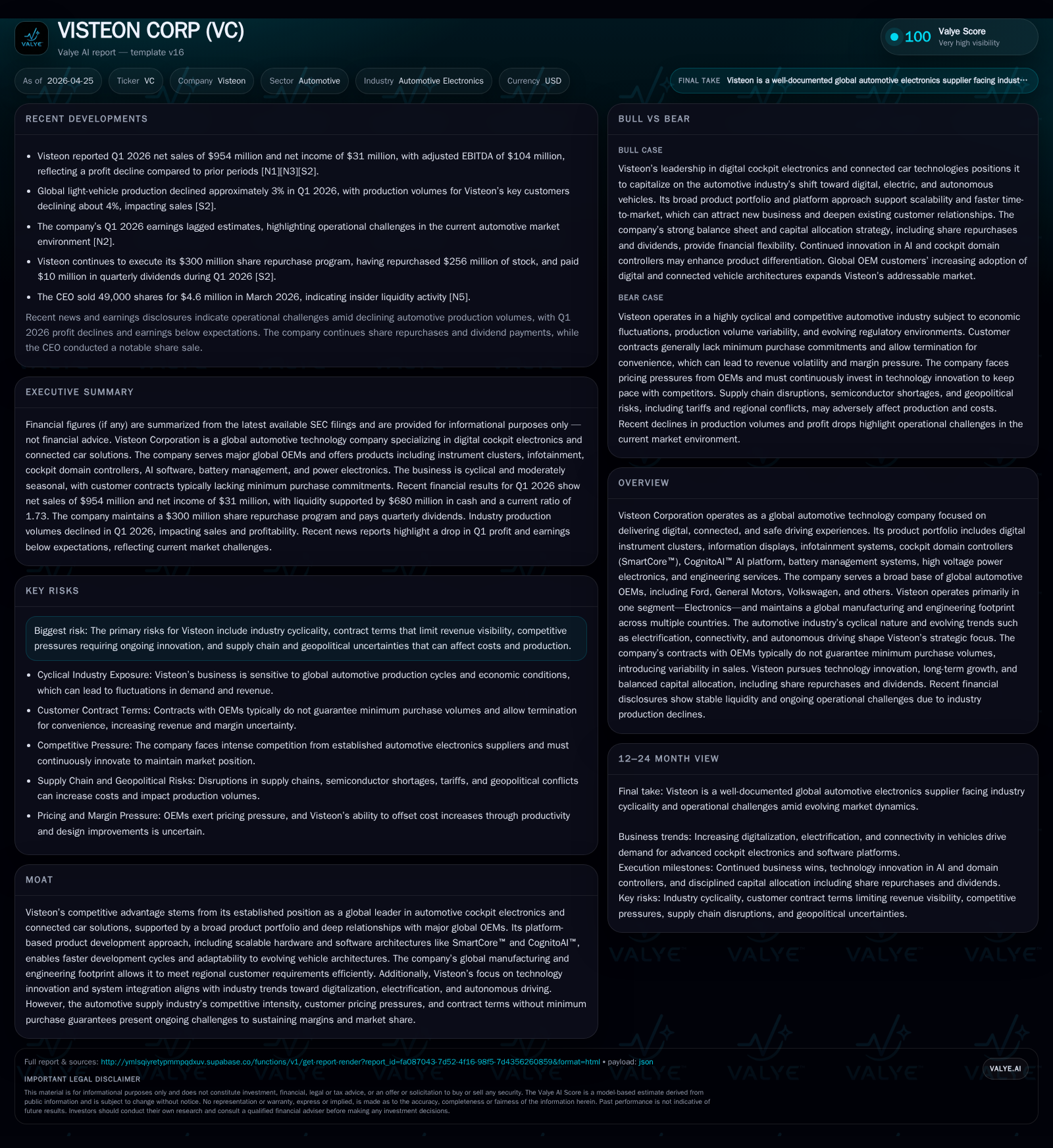
Visteon's Q1 2026 earnings reflect a near-term revenue headwind tied to approximately 4% production declines at key OEM customers, exceeding the broader global light-vehicle production drop of about 3%. The company maintains a robust platform-driven product suite anchored by SmartCore™ cockpit domain controllers and CognitoAI™, positioning it well amid ongoing industry transitions to electrification and connectivity. Visteon's broad OEM relationships and global manufacturing footprint underpin its competitive moat, though cyclical automotive market softness and absence of guaranteed minimum purchase volumes constrain revenue visibility. Financially, the company exhibits solid liquidity with net cash positioning and continues share repurchases and dividends while navigating margin pressures from lower volumes.
Q1 2026 Operating Update Highlights and Market Context
Visteon's latest quarterly filing for the period ended March 31, 2026 [S2] paints a realistic portrait of near-term challenges confronting automotive suppliers today. Global light-vehicle production contracted about 3% in Q1 2026 per April's S&P Global data, but Visteon's key OEM customers experienced a slightly sharper drop of approximately 4%. In North America, though industry output was down roughly 2%, production at major customers fell twice as much (4%). Europe saw a milder industry decline (1%) but customer volumes were again lower (~4%), while China faced a pronounced slump with both overall industry and Visteon’s customers down about 10%. Despite these softer production metrics, retail demand held up relatively well in the U.S., buoyed by continued appetite for internal combustion engine (ICE) and hybrid vehicles. This resilience was partially offset by tapering electric vehicle (EV) purchases following expiration of federal EV tax credits.
This divergence between resilient consumer demand and declining vehicle production underscores the timing disconnect in inventory cycles and indicates that supplier revenues like Visteon’s may face continued volatility. Importantly, Visteon’s contracts generally do not contain minimum purchase volume commitments from OEMs [S4], reflecting both customer bargaining power and inherent cyclicality risk in reported sales. Consequently, the company must adapt to fluctuating vehicle output while balancing investment in growth areas.
Visteon’s Business Model and Core Product Suites
At its core, Visteon acts as a global Tier-1 automotive technology supplier focused on cockpit electronics and electrification components [S1]. Its business is concentrated in a single reportable segment: Electronics. This segment includes digital instrument clusters ranging from conventional analog gauges to high-end configurable full digital displays featuring advanced graphics capabilities. Complementing clusters are information displays set within the cockpit environment that integrate sleek form factors with touch-enabled surfaces.
Key innovations revolve around the SmartCore™ cockpit domain controller platform — a scalable multicore computing architecture enabling consolidation of multiple electronic control units into unified hardware/software platforms [S1]. This approach addresses OEM demands for reducing complexity while expanding functionality through increased electronic content. CognitoAI™, an AI-powered software suite layered on these platforms, enhances user experience through voice recognition, driver monitoring, contextual assistance, and adaptive interfaces.
Battery management systems (BMS) and high-voltage power electronics form another crucial pillar serving EVs and hybrids in line with global electrification trends. Visteon also offers high-value engineering services encompassing system architecture design, functional safety assessment, cybersecurity integration, user interface design, software integration & validation — supporting OEMs’ evolving vehicle development life cycles [S4].
This product/service mix reflects tight alignment with megatrends shaping automotive architectures: digitalization of cockpits; consolidation toward centralized domain controllers; increased connectivity; electrified powertrains; and emerging autonomous driving capabilities.
Competitive Positioning in the Automotive Electronics Industry
Visteon’s moat derives from several structural advantages [S1], [S22]. First is its global manufacturing footprint spread across Brazil, Bulgaria, China, India, Japan, Mexico, Portugal, Slovakia, Thailand, Tunisia which facilitates localized operations close to major OEM plants worldwide [S15]. This proximity enables responsiveness to regional requirements including regulatory standards while optimizing logistics costs.
Second is its depth of established relationships with leading global OEMs such as Ford (accounting for about 26% of annual net sales), General Motors (12%), and Volkswagen (10%) [S4]. These client engagements span multiple vehicle programs across regions creating embedded product placements difficult for competitors to dislodge due to certification hurdles and system integration complexity.
Thirdly is its platform technology strategy—products like SmartCore™ enable diverse application across vehicle segments promoting faster development turnaround times and scale economies. Similarly, deployment of CognitoAI™ positions the company ahead in an industry increasingly transitioning from hardware-centric to software-defined vehicle ecosystems.
Nonetheless, competitive intensity remains elevated as automotive electronics contend against broad Tier-1 peers including Aptiv PLC, Denso Corporation, Harman/Samsung Electronics subsidiary, Bosch GmbH among others [S18]. The supplier landscape has consolidated considerably raising price competition. Additionally, semiconductor shortages—specifically DRAM shortages—continue to challenge capacity stability; while Visteon actively collaborates with suppliers/OEMs to mitigate impact [S21]. Contract terms lacking binding minimum volumes exacerbate revenue uncertainty as OEMs exercise order flexibility depending on production shifts.
Key Growth Drivers and Industry Challenges
Structural growth drivers underpinning Visteon’s outlook include the secular boost from rising electronic content per vehicle driven by transition toward digital cockpits featuring larger multi-function displays replacing analog instruments [S2]. Adoption of domain controllers accelerates as automakers unify discrete ECUs into multi-core architectures simplifying wiring harnesses while enabling over-the-air updates—a critical attribute for connected/autonomous vehicles.
Electrification remains another pivotal catalyst. Battery management systems combined with high-voltage power electronics are integral for EV/heavy hybrid platforms globally. Although geographic adoption varies—Europe & China accelerating versus some moderation in US EV uptake post-tax credit expiry—varied powertrain strategies necessitate broad component compatibility expanding addressable market breadth [S1].
Autonomous driving systems increase sensor fusion reliance placing premium on real-time data processing power embedded within cockpits/domains further spurring complexity—and thus content growth.
Conversely growth constraints include pronounced cyclicality inherent to vehicle assembly schedules coupled with recent macroeconomic headwinds suppressing new car order intake effectively limiting immediate user demand for supplier products [S2]. Pricing pressure remains a heated battleground with aggressive OEM cost reduction demands annually requiring Visteon to continually pursue cost efficiency initiatives or risk margin erosion [S9]. Commodity inflation affecting key inputs—from semiconductors to resins—adds margin volatility given limited ability for full customer cost recovery under contractual terms [S21]. Supply chain instability tied to political/geopolitical risks remains another latent threat creating potential shocks disrupting consistent fulfillment timelines.
Near-Term Milestones and Indicators to Monitor
Investors tracking Visteon's trajectory should watch several quantitative milestones anchored around the automotive production cycle. Key will be quarterly updates on major OEM client vehicle output trajectories especially Ford/GM/Volkswagen given their outsized sales contributions [N1], [N2]. New platform design wins or renewals signaled via press releases or earnings calls will reflect traction of SmartCore™ and CognitoAI™ solutions embedding deeper within next-generation model portfolios.
Supply chain normalization progress is critical—advances toward mitigating semiconductor scarcity or DRAM bottlenecks would stabilize shipping cadence enhancing revenue predictability. Capital allocation decisions such as pace of completed share buybacks under the $300 million program announced March 2023 (with $256 million repurchased through Q1 2026) alongside consistent dividend payments provide a window into management confidence in mid-cycle financial health [S20]. Notable shifts in product mix away from EV-related modules following tax credit expirations could also reveal adjustment dynamics impacting component mix profitability.
Financial Overview: Balance Sheet Strength and Profitability Trends
Historical performance (annual)
|
| FY | Rev ($bn) | Net ($mm) | CFO ($mm) | Rev YoY | Net YoY |
|---|---|---|---|---|---|
| 2025 | 3.8 | 74 | 410 | -2.5% | -73.0% |
| 2024 | 3.9 | 274 | 427 | -2.2% | -43.6% |
| 2023 | 4.0 | 486 | 267 | +5.3% | +291.9% |
| 2022 | 3.8 | 124 | 167 |
Source: SEC companyfacts cache [F1].
Capital returns and efficiency (annual)
|
| FY | Buybacks ($mm) | ROE% |
|---|---|---|
| 2025 | 57 | 4.7 |
| 2024 | 63 | 22.3 |
| 2023 | 107 | 46.8 |
| 2022 | 0 | 18.4 |
Source: SEC companyfacts cache [F1].
Supporting this operational narrative is a financial snapshot based on latest quarter data ending March 31, 2026 corroborated by fiscal year-end analysis from December 31, 2025 [F1], [S2].
Operating margins face blunt pressure given lower volumes but innovation-driven wins along with global footprint efficiencies support capability for recovery should macro conditions stabilize. The balance sheet strength conveys flexibility to invest organically in R&D or engage selectively in inorganic opportunities ensuring strategic optionality amid evolving automotive landscapes.
Disclaimer: This analysis is provided solely for informational purposes without any recommendation regarding buying or selling securities.
Disclaimer: This is research-only, informational analysis and not investment advice. It may include AI-generated interpretation and general industry context. Always verify important details using primary sources.

Comments