
Newmont Corp Advances Production Efficiency Amid Joint Venture Tensions and Rising Ghanaian Costs
Q1 2026 results highlight operational gains in the U.S. and Latin America offset by cost pressures in Ghana and strategic challenges at Nevada Gold Mines.
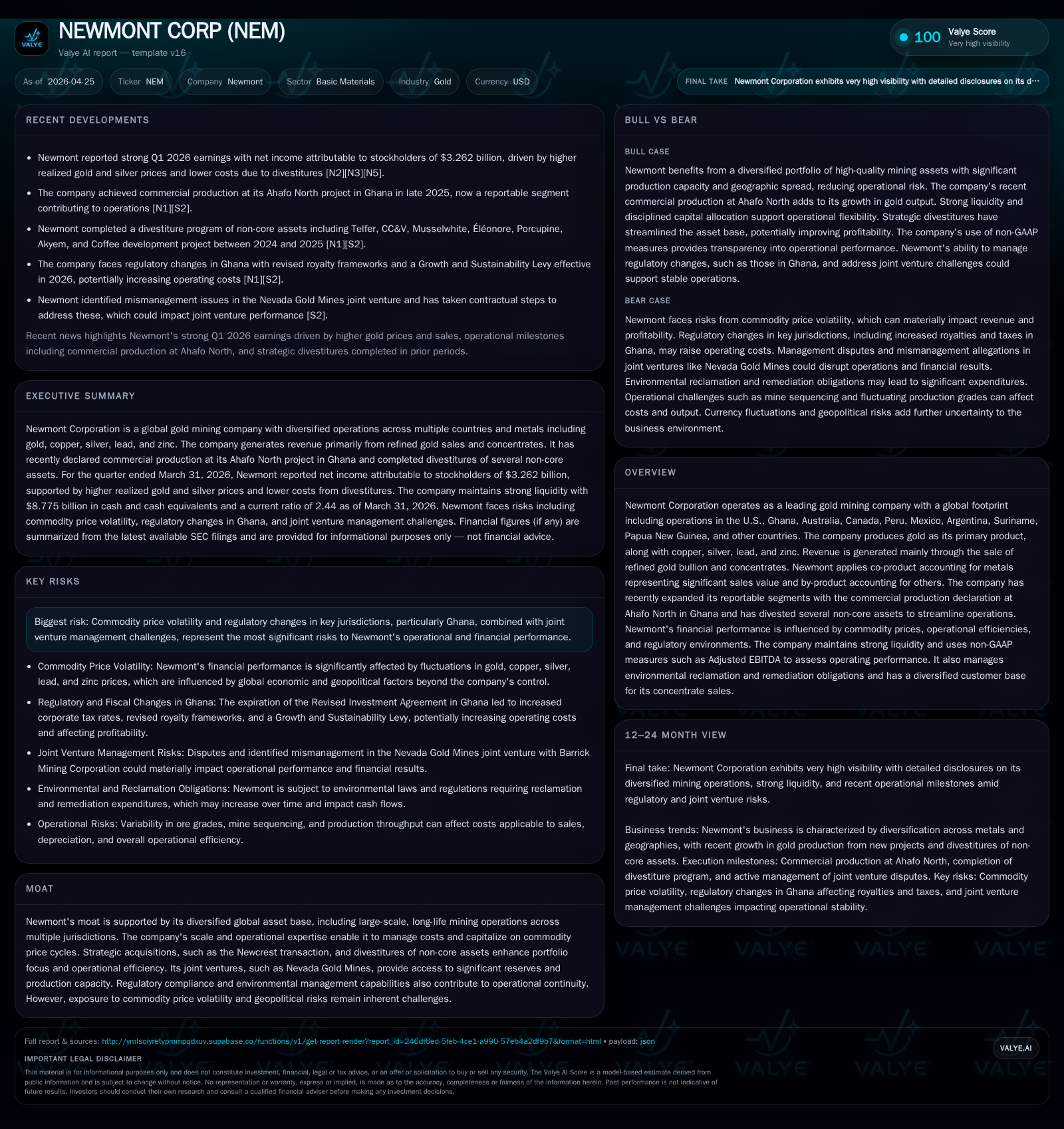
Newmont Corporation reported its Q1 2026 operating update showing notable improvements in gold production and cost efficiencies at key U.S. sites and Latin American operations, including a 42% production increase at Suriname’s Merian and a 64% rise at Argentina’s Cerro Negro. However, the company flagged potential cost increases in its Ghanaian segment due to a revised tax framework. Additionally, Newmont disclosed an intensifying dispute with Barrick over alleged mismanagement at their joint venture Nevada Gold Mines, which may affect future operational synergy. The company’s global diversification and scale underpin its competitive moat, though commodity price volatility and geopolitical risks remain material concerns. Liquidity remains robust with net cash exceeding debt by approximately $3.5 billion, supporting ongoing capital investment and shareholder returns.
Recent Operating Update
In its latest quarterly filing dated April 23, 2026 [S2], Newmont reported advancing operational efficiencies alongside emerging challenges that illuminate the company's near-term trajectory. Notably, attributable gold production from Nevada Gold Mines (NGM) in the U.S. grew by 9%, propelled by increased mill throughput and ore grades at Carlin and Turquoise Ridge mines—key assets within NGM's portfolio. This volume gain resulted in a meaningful reduction in depreciation and amortization costs per produced gold ounce (down 28%) as well as a 10% decrease in costs applicable to sales per ounce primarily linked to volume leverage effects.
Latin American operations exhibited particularly strong growth momentum: Merian in Suriname boosted gold output by 42%, driven largely by higher ore grades milled and strategic drawdowns of inventory-in-process; Cerro Negro in Argentina outpaced prior levels with a 64% increase due chiefly to resumption of mill throughput post prior shutdowns despite somewhat reduced ore grade; Yanacocha in Peru also delivered improved production (+37%) through enhanced leach pad processes.
Conversely, the Peñasquito mine in Mexico faced headwinds with a significant gold production drop (-56%) attributed to unfavorable mine sequencing impacting ore grade milled alongside declining mill recovery rates. Correspondingly, costs applicable to sales saw steep rises here (+32%). Red Chris in Canada experienced relatively flat gold output but a sharp decline (-50%) in other metals production measured on gold equivalent ounces due to pricing adjustments.
Management flagged that Ghanaian operations could confront elevated costs going forward due to expiration of prior investment agreements at year-end 2025 which introduces exposure to prevailing corporate income tax rates up to 35%, an increment from previous negotiated terms [S2]. This shift embodies a structural risk component given Ghana's importance within Newmont’s African asset base.
Of pivotal note is rising tension within the Nevada Gold Mines joint venture governed jointly with Barrick Mining Corporation. In early Q1 2026, Newmont identified evidence suggestive of mismanagement involving resource diversion benefiting Barrick’s independent Fourmile property. The company invoked contractual audit provisions followed by serving notice of default under the JV management agreement effective February 3, indicating potential governance conflicts that may affect joint capacity utilization and cost optimization [S2], [S3].
Business Model
Newmont operates as one of the world’s largest gold mining companies with a diversified portfolio spanning multiple continents across developed and emerging markets [S1]. Its core revenue stream derives principally from sale of refined gold bullion complemented by sales of copper, silver, lead, zinc concentrates where co-product or by-product accounting applies depending on sales value contribution.
The business model leverages scale economies afforded by large, long-life mines supported by capital-intensive infrastructure for extraction processing (both open pit and underground). Processing efficiency improvements—as seen recently at Carlin/Turquoise Ridge—and effective inventory management yield lower unit costs benefiting margins amid volatile commodity pricing.
Profitability is also managed through portfolio rebalancing via strategic acquisitions like the transformative Newcrest transaction completed in late 2023 augmenting asset quality and geographic reach [S1], alongside divestitures simplifying focus away from non-core or marginal segments such as Telfer or Coffee [S1]. This dynamic repositioning supports stronger operating cash flows and capital allocation flexibility toward sustaining capex or shareholder returns.
Joint ventures form an intrinsic element of Newmont’s model - exemplified by Nevada Gold Mines combining assets from both Newmont and Barrick under unified operating oversight though with shared governance complexities.
Industry Structure & Competitive Position
The global gold mining industry is characterized by high capital intensity and cyclical commodity pricing largely influenced by macroeconomic factors including inflation trends, currency fluctuations (gold priced globally in USD), geopolitical uncertainties driving safe-haven demand, and central bank policies impacting reserves accumulation.
Newmont benefits structurally from its diverse footprint spanning politically varied jurisdictions which dilutes single-country risk. Its sizable scale provides competitive advantage through lower all-in sustaining costs (AISC), enabling it to maintain profitability even during downward metal price cycles.
Operational expertise is another differentiator: ability to optimize throughput rates while maintaining ore quality control—as witnessed by positive trends at Carlin—and integration efficiencies following large M&A transactions enhances overall resilience against pure price volatility-driven earnings fluctuations.
However, challenges such as increasing regulatory scrutiny (notably tax revisions in Ghana) coupled with elevated labor or governmental royalties impose incremental cost pressures industry-wide necessitating adaptive capital planning.
Management disputes within joint ventures represent an idiosyncratic risk factor for multi-operator complexes like NGM that can disrupt consensus-based strategic execution if unmitigated.
Growth Drivers & Constraints
Positive growth catalysts for Newmont include commissioning new deposits (such as Ahafo North’s recent commercial status) that add incremental production capacity while boosting segmental reporting transparency [S2]. Technological investments enhancing recovery rates or lowering environmental footprints also underpin longer-term sustainable expansion opportunities.
Commodity price strength often correlates positively with exploration spending across the sector feeding pipeline replenishment essential for mid- to long-term reserve replacement.
On constraints side are inherent: finite mine lives requiring continual capital renewal; geopolitical risks especially impacting African and Latin American assets; environmental regulations increasingly mandating higher reclamation standards; currency exposure; plus fluctuating metals prices creating revenue uncertainty that complicates planning horizons.
Elevated operating costs resulting from expired investment agreements or revised tax regimes—as exemplified recently in Ghana—represent tangible near-term headwinds potentially compressing margins unless offset by productivity gains.
Governance frictions within major joint ventures (e.g., NGM default notices toward Barrick) could impede operational synergies costly both financially and strategically if disputes prolong or escalate.
What to Watch Next
Investors should closely monitor developments surrounding the NGM JV dispute resolution mechanism outcomes as these could materially influence asset-level performance at the company's largest operation accounting for significant attributable output.
Further quarterly updates on Ghana-related tax impacts will be critical to assess whether cost inflation manifests beyond current forecasts or prompts reconsideration of regional strategies.
Technological progress or new project milestones (e.g., expansions around Ahafo North or ongoing enhancement worksite optimizations) will serve as indicators for sustained medium-term output growth prospects.
Metal prices remain an exogenous yet dominant driver shaping revenue outlooks; hence macroeconomic conditions influencing gold prices should be tracked comprehensively alongside internal cost management metrics such as unit cost trends reported every quarter [N3].
Financial Profile
Historical performance (annual)
|
| FY | Net ($bn) | CFO ($bn) | Capex ($bn) | Net YoY |
|---|---|---|---|---|
| 2025 | 7.1 | 10.3 | 3.0 | +111.6% |
| 2024 | 3.3 | 6.4 | 3.4 | +234.2% |
| 2023 | -2.5 | 2.8 | 2.7 | -481.4% |
| 2022 | -0.4 | 3.2 | 2.1 |
Source: SEC companyfacts cache [F1].
Capital returns and efficiency (annual)
|
| FY | Div ($mm) | Buybacks ($bn) | FCF ($bn) |
|---|---|---|---|
| 2025 | 1106 | 2.3 | 7.3 |
| 2024 | 1145 | 1.2 | 3.0 |
| 2023 | 1415 | 0.0 | 0.1 |
| 2022 | 1746 | 0.0 | 1.1 |
Source: SEC companyfacts cache [F1].
Supported by [F1] data referencing latest balance sheet metrics as of March 31, 2026, Newmont retains $8.775 billion cash & equivalents against total debt approximating $5.301 billion yielding net cash position near $3.474 billion reflecting considerable financial flexibility [F1]. The current ratio stands healthy at approximately 2.44 underscoring liquidity adequacy for near-term obligations [F1].
Operating cash flows have demonstrated robust growth—with FY2025 CFO reaching above $10 billion contributing to free cash flow nearing $7.3 billion post-capital spending—indicative of strong internal generation capacity [F1]. Capital expenditures declined slightly year-over-year pointing towards disciplined capex management balancing sustaining needs against profitability [F1].
Profitability rebounded sharply with FY2025 net income recorded at approximately $7.085 billion doubling prior year results reflecting favorable metal prices combined with improved operational efficiency [F1]. Return on equity remains attractive around 20.9%, reinforcing shareholder value creation ability [F1].
Dividends paid remained steady just above $1.1 billion while share repurchases accelerated signalling management intent to return capital amid strong free cash flow generation [F1].
Overall financial health supports continued execution on growth initiatives alongside resilience toward market headwinds.
This analysis is based strictly on information available up to April 25, 2026 from SEC filings including the latest quarterly report (10-Q), recent event filings (8-K), annual reports (10-K), supplemental news releases, and companyfacts numeric disclosures without offering any investment advice or recommendations.
Disclaimer: This is research-only, informational analysis and not investment advice. It may include AI-generated interpretation and general industry context. Always verify important details using primary sources.

Comments