
Getty Realty's Q1 2026 Highlights Growth in Convenience Retail Portfolio Amid Steady Leasing
Getty Realty Corp. reports portfolio expansion and stable triple-net lease income underpinned by long-term tenant contracts.
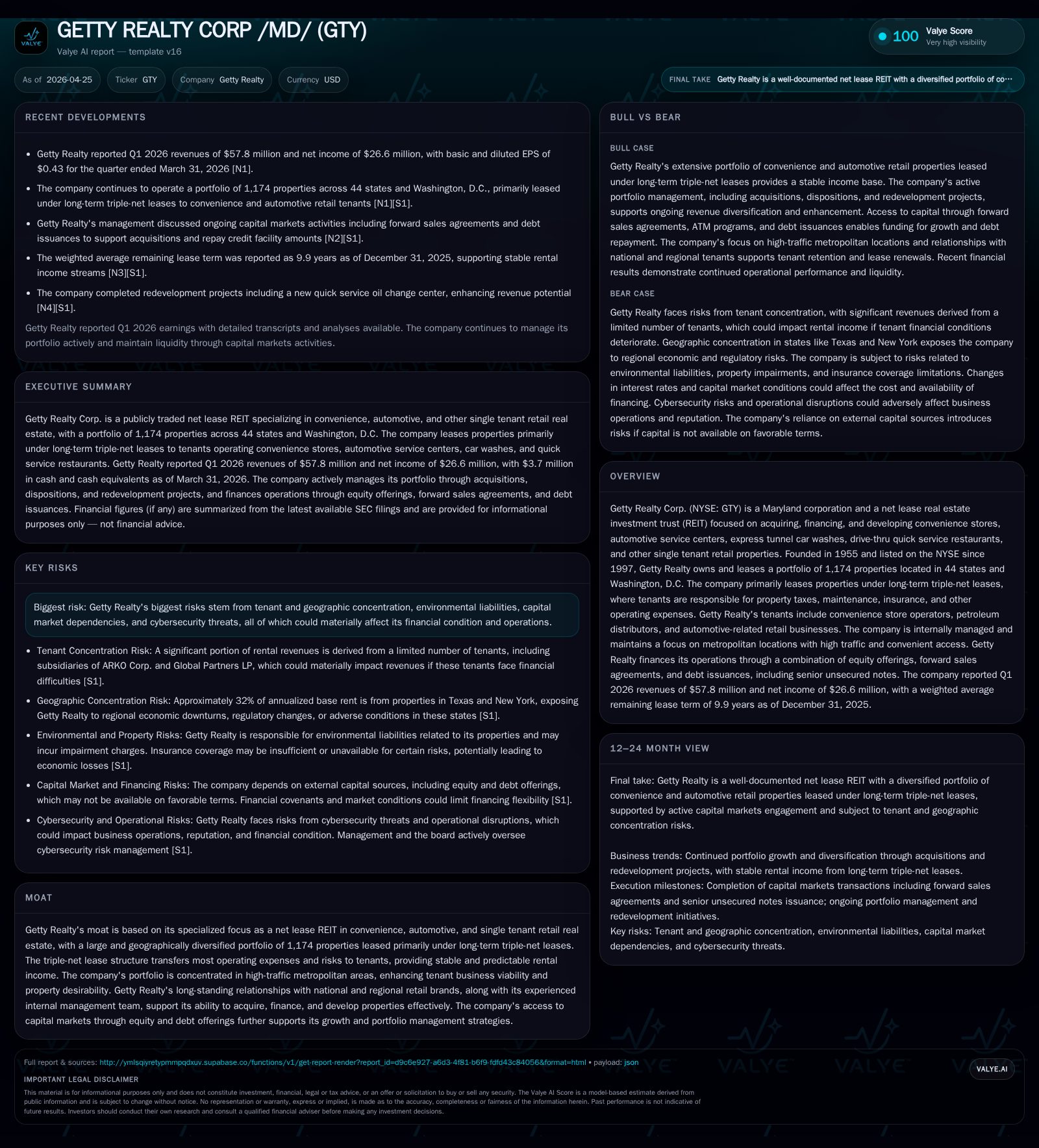
In its latest 10-Q filing for Q1 2026, Getty Realty Corp. reaffirmed its position as a focused net lease REIT specializing in convenience stores and automotive-related properties. The company maintains a geographically diverse portfolio of over 1,170 properties leased under long-term triple-net agreements, supporting predictable cash flows. Recent capital market activities and property acquisitions underscore its strategic growth plan, though tenant concentration and environmental liabilities remain risks to monitor. Financially, Getty continues to exhibit steady revenue growth and disciplined capital allocation while managing leverage prudently.
Recent Operating Update: Q1 2026 Quarterly Filing
Getty Realty Corp.'s most recent quarterly report filed on April 23, 2026 ([S2]) provides the latest operational snapshot detailing continued execution on its acquisition and leasing strategy within the niche convenience store and automotive retail real estate sector. The firm manages a portfolio of 1,174 properties across 44 states plus Washington D.C., maintaining a focus on high-traffic urban intersections and accessible highway locations critical to tenant business success.
The company reaffirmed its commitment to long-term triple-net leases where tenants shoulder property taxes, maintenance, insurance, and environmental liabilities. This lease structure underpins Getty’s predictable rental cash flows—from tenants operating from or subleasing these retail sites—and supports financial stability even during economic fluctuations.
Capital market activities remain active; Getty continues utilizing forward sales agreements alongside an ATM (at-the-market) equity program as well as recently issuing senior unsecured notes ([S3], [S5], [S24], [S25]). These efforts fund targeted acquisitions while managing leverage sustainably. The company reports ending Q1 2026 with approximately $3.7 million in cash equivalents against roughly $1 billion in total debt ([F1]), confirming ongoing access to capital despite market uncertainties.
Business Model: Specialized Net Lease REIT Focused on Convenience & Automotive Retail
Getty Realty operates as a net lease REIT focusing exclusively on single-tenant retail properties—primarily convenience stores, express tunnel car washes, automotive service centers (including gasoline sales, repair services, oil changes), drive-thru quick service restaurants, among similar freestanding operations ([S1]). Founded in 1955 and NYSE-listed since 1997, the company is internally managed with deep expertise in this segment.
The pivotal competitive advantage lies in its triple-net leases: tenants cover virtually all structural operating costs including environmental remediation liabilities during their lease term—thus insulating Getty from common landlord expenses and giving more stable net rent streams. Additionally, the long initial terms (typically 15-20 years) combined with renewal options extending cumulative contracted periods create durable cash flow visibility; weighted average remaining lease duration stood at approximately 9.9 years as of year-end 2025 ([S1]).
Most tenants belong to established national or regional brands in petroleum distribution or convenience retailing; some also sublet these sites while supplying fuel through third parties. This tenant profile creates ecosystem lock-in effects that reduce vacancy risk since these businesses depend on location traffic patterns Getty’s site selection emphasizes.
Industry Structure and Competitive Positioning
Within the REIT sector focused on net leased retail real estate, Getty Realty occupies a specialized vertical concentrating on automotive-related assets coupled with convenience-based consumer needs. Competitors exist broadly across general retail net leases but few have comparable scale strictly dedicated to this niche which demands specific property characteristics such as proximity to highways or urban traffic nodes to ensure tenant success.
Tenant concentration risk is significant: just two major tenants’ subsidiaries—ARKO Corp. and Global Partners LP—constitute roughly 22% of total revenues ([S15], [F1]). While these are large creditworthy operators increasing scale often inherently raises exposure concentration risk; however management’s emphasis remains on balancing deep tenant relationships with geographic diversification spanning multiple states.
Another differentiating factor is Getty’s active development pipeline funding new asset types like quick service oil change centers indicating innovation beyond simple acquisitions ([S14]). This product mix expansion can enhance future growth avenues while supporting existing tenant operations.
Growth Drivers and Constraints
Growth hinges structurally on: (a) sustained consumer reliance on automobility generating demand for convenience retail formats accessible by vehicle; (b) continued acquisition of accretive properties fitting Getty’s underwriting criteria focusing on traffic density and location desirability; (c) expanding tenant base in emerging metropolitan markets added during recent years including Houston, Dallas, Las Vegas, Atlanta ([S14]); (d) disciplined capital management leveraging forward sale equity programs complemented by bond issuance for funding deals at attractive rates ([S5], [S22]).
Constraints include:
- Tenant & geographic concentration risks limiting upside from diversification;
- Environmental liability risks stemming from historic fuel storage contamination obligating continuous monitoring and reserve accruals;
- Dependence on capital markets access subject to rate environment volatility affecting cost of debt funding;
- Regulatory exposure particularly regarding environmental remediation laws or cybersecurity requirements impacting operations.
Demand drivers appear structurally resilient given the ongoing prioritization of convenience by American consumers coupled with robust highway infrastructure sustaining automotive dependency. Leasing dynamics benefit from long-term contracts embedding fixed or escalating rents supporting predictable income streams less sensitive to economic cycles.
What to Watch Next
Key upcoming markers include:
- Milestones related to closing additional property acquisitions or newly funded developments,
- Tenant financial health signals especially among top contributors like ARKO subsidiaries,
- Renewal discussions around large master leases approaching extension option dates,
- Impact analysis of any regulatory adjustments particularly in environmental compliance costs,
- Capital allocation decisions concerning share repurchases versus dividend payments given distribution obligations as a REIT ([S23]);
- Market conditions influencing refinancing spreads or equity issuance costs affecting growth economics.
Continued transparency around forward sales agreement settlements noted in recent filings will also provide insights into equity dilution timing or proceeds utilization efficiency ([S13], [S24]).
Financial Profile Overview (Supporting Context)
Historical performance (annual)
|
| FY | Rev ($mm) | Net ($mm) | CFO ($mm) | OpInc ($mm) | Rev YoY | Net YoY |
|---|---|---|---|---|---|---|
| 2025 | 222 | 79 | 127 | 127 | +9.0% | +11.4% |
| 2024 | 203 | 71 | 131 | 110 | +9.4% | +18.1% |
| 2023 | 186 | 60 | 105 | 91 | +12.2% | -33.2% |
| 2022 | 166 | 90 | 93 | 117 |
Source: SEC companyfacts cache [F1].
Capital returns and efficiency (annual)
|
| FY | Div ($mm) | ROE% |
|---|---|---|
| 2025 | 109 | 7.4 |
| 2024 | 100 | 7.4 |
| 2023 | 87 | 6.3 |
| 2022 | 78 | 11.9 |
Source: SEC companyfacts cache [F1].
For fiscal year ended December 31, 2025, Getty reported approximately $221.7 million in revenue—a 9% increase over prior year—and operating income climbed by over 15% to nearly $126.8 million ([F1]). Net income expanded by roughly 11%, totaling about $79.2 million. Operating cash flow softened slightly (-2.3%) partly reflecting timing of working capital elements but remained strong at $127.4 million.
On the balance sheet front as of March 31, 2026 ([F1]), the company held about $3.7 million cash versus a total debt load near $1 billion yielding net debt near $996 million consistent with prior leverage positioning ([S2]). Return on equity approximated a modest but stable ~7.4%. Capital expenditures surged significantly due mainly to new development initiatives but overall free cash flow remained negative given investment pace (-$92 million among last full year) which aligns with growth stage capital deployment.
Dividend distributions were above $108 million for FY2025 reflecting compliance with REIT payout rules alongside share issuance programs supporting balance sheet strength ([F1], [S28]).
Getty’s access to multiple sources of liquidity – operational cash flow combined with ATM equity offerings and secured/unsecured debt instruments – position it well for sustaining portfolio augmentation while navigating interest rate variability risks described at length in SEC filings ([S16], [S26]).
This analysis is based solely on disclosed SEC filings dated through April 23–25, 2026 plus accompanying financial data with no investment recommendation implied.
Disclaimer: This is research-only, informational analysis and not investment advice. It may include AI-generated interpretation and general industry context. Always verify important details using primary sources.

Comments