
Tesla Advances AI-Powered Manufacturing and Expands Robotaxi Fleet in Q1 2026
Tesla’s Q1 2026 update highlights operational progress in AI-enhanced vehicle production and the scaling of its Robotaxi service as pivotal growth drivers.
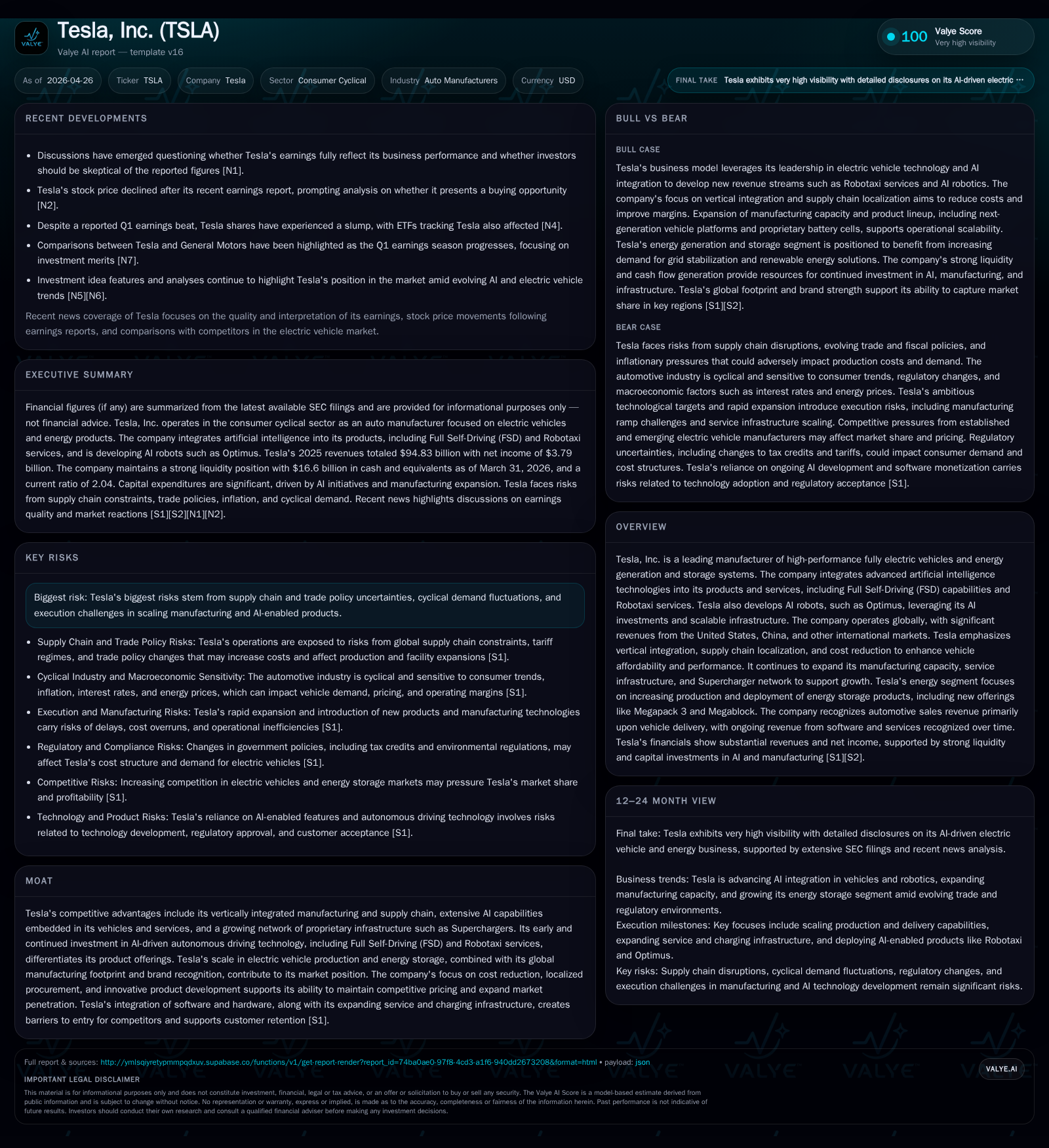
In its latest quarterly filing dated April 23, 2026, Tesla emphasized significant advances in manufacturing efficiency driven by artificial intelligence integration alongside an accelerated deployment of its Robotaxi fleet following the June 2025 launch. The company continues to focus on vertically integrated operations and supply chain localization to mitigate risks from trade policy shifts. Growth is powered by new vehicle variants, expanding energy storage solutions, and ambitious AI initiatives including the Optimus robot program. However, execution risks persist around component availability, regulatory scrutiny of autonomous features, and scaling complexities.
Q1 2026 Operating Update: Delivery Momentum and Capacity Expansion
Tesla’s most recent SEC filing (10-Q dated April 23, 2026) delineates steady operational progress characterized by maintained vehicle delivery volumes complemented by capacity expansion at several Gigafactory sites [S2][S3]. The company refined its Model 3 and Model Y lineups during prior quarters, now achieving optimized production throughput rates while addressing unit economics through enhanced automation supported heavily by AI algorithms embedded throughout manufacturing processes.
The quarterly update confirms the continued rollout of the Cybercab Robotaxi fleet following its public commercial debut mid-2025. Management underscores that leveraging AI-driven autonomous navigation systems enables not only a differentiated product offering but also a fundamentally new mobility-as-a-service revenue stream. This transition aligns with Tesla’s strategic pivot from purely hardware sales toward software-enabled services utilizing its vehicle fleet as a scalable asset [S2][S3].
Operational challenges identified include ongoing component supply volatility linked to geopolitical tensions and tariff regimes introduced since 2025. While supply chain localization efforts—such as sourcing battery raw materials regionally—partially mitigate these risks, residual cost pressures necessitate efficiency gains within manufacturing lines, especially to uphold margins amid pricing competition [S1][S7].
Integrated Business Model: AI-Driven EVs, Energy Solutions, and Robotics
Tesla operates with a vertically integrated model encompassing design, development, manufacturing, sales, leasing of electric vehicles (EVs), complemented by energy generation/storage products and emerging robotics technology [S1][S19]. Notably, Tesla embeds advanced Full Self-Driving (FSD) capabilities across its electric vehicles which deepen customer engagement through continuous over-the-air software enhancements.
The company’s energy generation segment focuses on large-scale battery deployments such as Megapack installations while also advancing residential solutions like the Powerwall. These products leverage Tesla’s scalable battery cell production innovations alongside proprietary software for energy management. Beyond this core, Tesla pursues commercialization of Optimus—a general-purpose humanoid robot that exploits Tesla's extensive AI infrastructure—signaling diversification towards next-generation autonomous robotics [S1].
This integrated approach fosters multiple revenue streams linked by a common technology foundation: AI-enabled software delivery layered onto physical assets operating globally at scale. Such alignment aids margin resilience through cross-segment synergies spanning hardware cost control to software monetization via subscriptions or fleet utilization fees.
Competitive Moat: Vertical Integration, Proprietary Infrastructure, and Supply Chain Strategy
Tesla’s moat is anchored in vertical integration across critical value chain components—from battery cell design to final assembly—allowing cost control unmatched by many legacy automakers transitioning slowly into EVs [S1][S7][S19]. Localization of supply chains reduces tariff exposure especially on lithium-ion cells and raw materials whose prices have experienced inflationary pressure post-2024 trade policies.
Additionally, Tesla’s proprietary Supercharger network creates a significant barrier to entry for competitors lacking comparable fast-charging infrastructure coverage. This ecosystem lock-in effect drives customer retention while supporting ecosystem revenues through paid charging sessions [S1][S19].
Real-time data aggregated from Tesla’s global fleet informs continuous improvement of AI autonomy stacks — a capability few rivals can parallel given Tesla’s size advantage in deployed vehicles functioning as data collection platforms. Battery technology leadership further consolidates cost advantages enabling more affordable vehicle offerings without sacrificing performance or margin structures.
Industry Positioning: Scale Advantage Versus Pricing Headwinds and Trade Risks
Tesla operates amid intensifying industry competition where entrenched OEMs face steep costs transitioning legacy combustion platforms toward electrification. Tesla benefits from early investment timing, translating into scale advantages that partially offset raw material inflation and regulatory credit revenue contractions visible in recent years [S1][N1].
However, trade policy volatility has injected uncertainty into global sourcing strategies impacting both automotive and energy segments differently—the latter more sensitive due to higher tariffs applicable to energy product components [S1]. Pricing power retains durability but competitive pressure on affordability mandates ongoing innovation in cost reduction technologies such as next-generation battery cells planned for volume output with lower capital intensity.
Growth Catalysts: Full Self-Driving, Robotaxi Ramp-Up, and Global Manufacturing Footprint
Central near-term growth drivers revolve around further penetration of FSD-enabled software accompanied by scaling of the Robotaxi fleet based on Cybercab platform vehicles launched mid-2025 [S1][S2][N14]. This fosters recurring revenue potential from autonomous ride-hailing services which diverge from traditional auto sales models reliant solely on one-time hardware transactions.
Global footprint expansion continues apace with multiple Gigafactory sites augmenting production capacity not only for current popular models but paving way for next-gen platforms that integrate improved autonomy hardware/software at scale [S1][S2]. This scaling is crucial for enabling accelerated unit volume growth needed to absorb fixed costs more efficiently while broadening geographic reach.
Complementary energy storage deployments grow steadily with increasing market acceptance of Megapack utility-scale batteries alongside residential systems targeted at solar + storage customers. These markets compound opportunity sets beyond personal transportation alone.
Execution Challenges: Supply Constraints, Regulatory Uncertainties, and Product Launch Risks
Risks outlined stem predominantly from supplier delivery reliability affected by geopolitical factors including tariffs imposed since 2025 disrupting component availability and escalating procurement costs [S4]. Additional execution complexity arises from regulatory oversight concerning autonomous driving functionalities where Tesla faces multiple investigations spanning safety claims around Autopilot/FSD labeling accuracy with attendant litigation exposures [S4][S5][S12].
Manufacturing ramp delays remain plausible due to complexities associated with new product introductions—both vehicles built upon next generation platforms as well as robotics units like Optimus. Labor market tightness within skilled segments adds risk layer affecting uptime at key facilities [S1]. Moreover, service infrastructure growth must keep pace with expanding installed base else customer satisfaction could suffer impacting brand equity long term.
Outlook: Key Milestones to Monitor in AI Capability Deployment and Market Penetration
Investors should track regulatory developments affecting expanded release permissions for advanced autonomous features underpinning fuller FSD commercialization plus broader Robotaxi expansion benchmarks marked against quarterly unit economics shifts [S1][S2].
Capex trends focusing on exceeding $20 billion spend levels principally allocated towards AI compute infrastructure upgrades, data center expansions,and new factory openings illuminate commitment to future growth vectors alongside immediate production ramp objectives [S1].
Further evolution of battery technologies aiming for lower-cost cells with superior range will be critical inflection points determining overall competitiveness.
In conclusion, Tesla's Q1 2026 disclosures illustrate a technology-led operation balancing rapid global scale expansion with complex external uncertainties. Its differentiated approach leveraging AI both in product capability and production efficiency arguably sustains competitive positioning amidst evolving EV industry dynamics. Nonetheless, execution risks remain high reflecting component supply fragilities and regulatory scrutiny inherent in pioneering autonomous vehicle commercialization.
This analysis synthesizes information exclusively from publicly filed SEC documents up to April 23, 2026 ([S1], [S2], [S3]) combined with industry context known as of late April 2026 without conjecture or investment recommendations.
Disclaimer: This is research-only, informational analysis and not investment advice. It may include AI-generated interpretation and general industry context. Always verify important details using primary sources.

Comments