
Intel's Q1 2026 Surge Reflects Strengthening IDM Strategy and Market Diversification
Intel’s latest quarterly results demonstrate operational momentum driven by its integrated manufacturing model and broadening product mix amid competitive semiconductor dynamics.
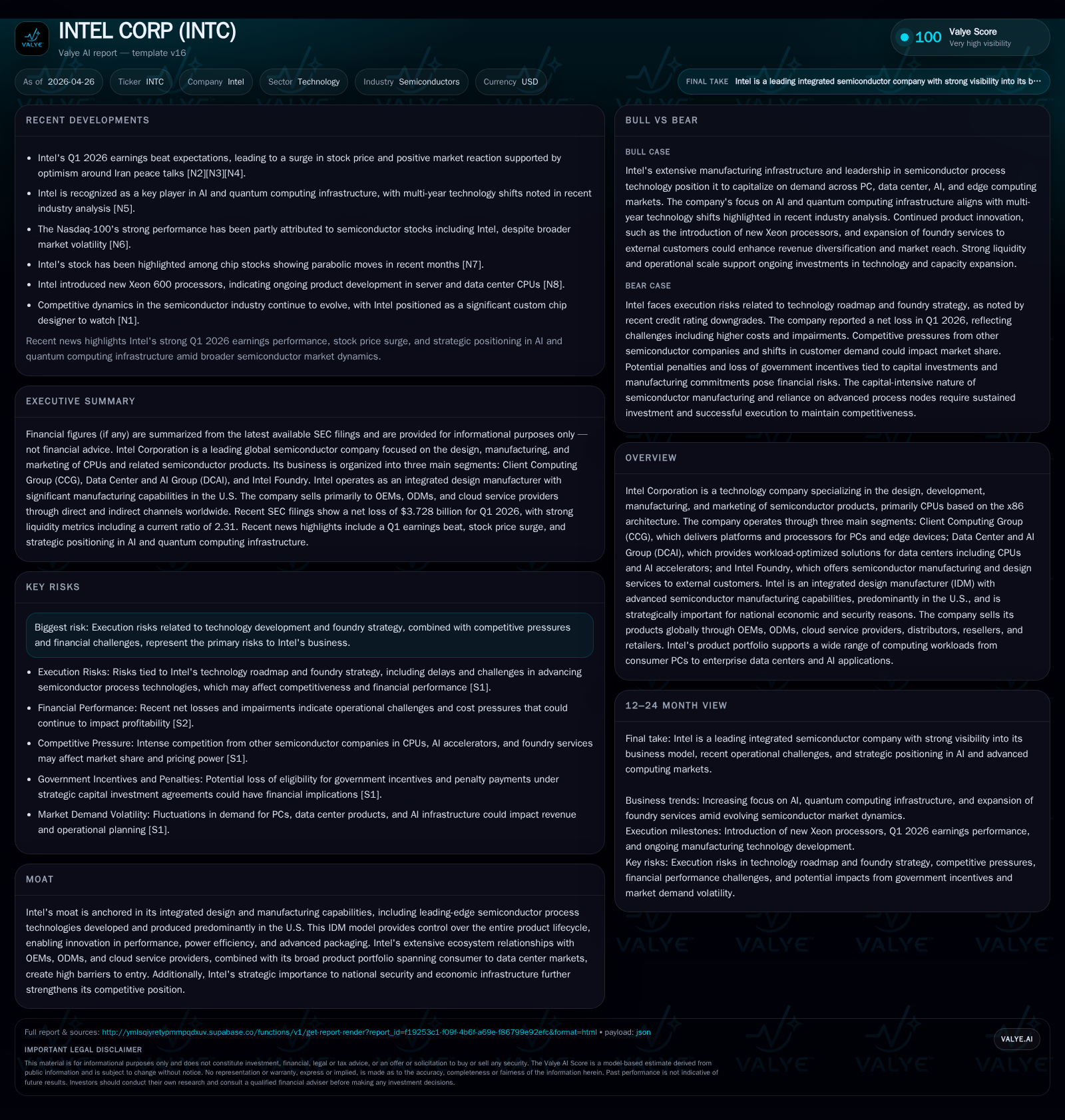
In Q1 2026, Intel posted better-than-expected revenue and profitability improvements, anchored by strong demand rebounds in its Client Computing Group and accelerating growth in Data Center and AI workloads. The company’s integrated device manufacturer (IDM) model remains a critical differentiator, enabling controlled innovation cycles and supply resilience while expanding foundry services to external clients. Intel faces intensified rivalry from fabless peers and foundry specialists, but growth catalysts include rising AI data center deployments and its strategic U.S.-centric foundry capacity expansion. Execution risks tied to process ramp timelines and evolving industry pricing dynamics persist, with upcoming guidance updates and capacity milestones pivotal for sustaining momentum.
Q1 2026 Results Underscore Momentum in Core Business Segments
Intel’s latest quarterly filing dated April 24, 2026 [S2] reveals that the company delivered a solid revenue beat in Q1 2026 compared to expectations [N2], supported primarily by a rebound in the Client Computing Group (CCG) segment alongside strong demand for the Data Center and AI Group’s (DCAI) workload-optimized processors. The CCG segment experienced a revival in PC platform shipments after several quarters of softness due to inventory corrections earlier in the cycle [S2]. At the same time, DCAI capitalized on structural growth trends related to AI adoption across cloud computing and enterprise data centers. Margins improved notably as manufacturing yields at Intel’s fabs climbed higher, reflecting operational leverage within their Integrated Device Manufacturer (IDM) model [S2]. This combination helped Intel strengthen its operating performance while maintaining solid cash flow generation.
Liquidity remains a key focus area; cash and cash equivalents stood at approximately $17.2 billion as of March 28, 2026 [F1], complemented by a current ratio of 2.31 reflecting solid short-term balance sheet flexibility [F1]. These liquidity metrics provide Intel breathing room to continue investing heavily in R&D and capital expenditures central to their technology roadmap execution.
How Intel’s Integrated Device Manufacturer Model Powers Competitive Advantage
Intel operates an IDM strategy where it not only designs its x86 processors but also manufactures them internally at advanced semiconductor fabs predominantly located within the United States [S1][S18]. This vertical integration is foundational for sustaining Moore's Law scaling benefits by tightly coupling proprietary process technologies with product development cycles. The IDM approach enables close coordination between design teams and manufacturing engineers to optimize wafer yields, power/performance trade-offs, advanced packaging solutions such as Foveros or EMIB interposers, and supply chain robustness.
This contrasts with the prevailing fabless-foundry model adopted by competitors like AMD or Nvidia that rely heavily on third-party foundries such as TSMC. While fabless models benefit from pure-play foundry specialization, they suffer from dependency on external capacity allocation amid surging industry demand for AI chips [N5]. Intel’s control over its production apparatus affords strategic advantages in managing lead times, quality control, production costs at scale, and security considerations—especially given the increasing geopolitical emphasis on domestic semiconductor manufacturing.
Moreover, Intel leverages established OEM/ODM relationships embedded deeply into global supply chains spanning consumer electronics makers to hyperscale cloud providers [S10]. These customer lock-in effects result from ecosystem collaborations including co-engineering initiatives that create switching costs beneficial for Intel’s moat.
Product Portfolio and Customer Base: Breadth Meets Strategic Depth
Intel's business is segmented primarily into three reportable units: Client Computing Group (CCG), Data Center & AI Group (DCAI), and Intel Foundry Services [S14][S15].
CCG focuses on CPUs powering PCs ranging from consumer desktops to commercial notebooks including emerging AI-enabled edge computing devices. Its offerings combine CPU cores with integrated graphics and platform features supporting connectivity enhancements tailored for sectors such as retail or industrial robotics [S11].
DCAI addresses cloud-scale datacenter usage along with telecommunications infrastructure that requires high-performance x86 CPUs plus specialized AI accelerators such as Gaudi-based chips or programmable IPUs [S26]. This segment benefits from secular increases in AI workloads driven by neural network training/inference demands.
Intel Foundry aims to compete as a foundry partner to external customers requiring access to cutting-edge semiconductor process nodes developed under Intel’s technology roadmap with significant U.S.-based capacity expansions underway.
This diverse portfolio allows revenue stability through exposure to end markets with varying cyclicality. The growing weight of DCAI underscores a pivot towards higher-margin cloud workloads heavily influenced by generative AI adoption trends. Customer bases include OEMs/ODMs producing branded PCs globally; cloud service providers extending infrastructure capabilities; plus industrial equipment manufacturers utilizing custom silicon solutions via foundry services sales channels [S10].
Industry Rivalry and Structural Dynamics Impacting Pricing and Capacity
The semiconductor sector faces intense competition from multiple fronts: AMD advancing multi-core chip designs; Nvidia’s surge with GPU-dominated AI chipsets; TSMC’s foundry leadership providing technology nodes even beyond peer levels; alongside emerging custom chip designers targeting niche verticals [N4][N5].
Intel competes not only on design performance but also seeks differential advantage via wafer fabrication innovations enabled by its IDM presence. However, industry-wide capacity constraints persist due to booming silicon consumption for AI acceleration driving wafer order backlogs beyond standard planning horizons [N8]. These shortages contribute upward pressure on prices but also risk customer deferral if premium pricing crosses affordability thresholds.
Despite these pressures favoring fabless players who can quickly pivot their foundry sourcing optimally worldwide, Intel's control over domestic high-tech fabs mitigates risks related to geopolitical supply disruptions—a consideration increasing regulatory support for U.S.-centered semiconductor manufacturing investment [S20].
Internally managing cost structures while ramping next-generation process technologies like Intel 18A or 14A remain critical given competitive advancements at rivals’ foundries continuing unabated [S2][S27]. This balancing act shapes Intel pricing power sustainability over medium term horizons.
Growth Accelerators: Data Center AI Demand and Foundry Expansion
Near-term growth catalysts are markedly driven by accelerated uptake of emerging AI workloads within hyperscale data centers fueling demand for specialized x86 CPUs alongside custom accelerators offered through DCAI [S2]. Launches of successor processor families geared towards efficient inference/training workloads have started regular deployments at major cloud operators signaling inflection points in volume adoption.
Simultaneously, Intel Foundry Services is scaling externally sourced semiconductor manufacturing contracts leveraging investments in state-of-the-art U.S.-based fabs dedicated partly to advanced nodes suitable for both commercial clients’ logic IC needs and government-backed supply chain resilience projects [S2]. This external foundry push diversifies revenue streams beyond internally consumed chips reinforcing long-term industrial scale economics.
These factors combined underpin management confidence expressed during public disclosures about sustained TAM expansion despite cyclical softness encountered elsewhere within PC-related markets earlier last year.
Risks and Constraints: Execution Challenges and Market Environment
Significant execution risk persists around the speed of maturation of next-generation process nodes required to maintain competitiveness against fabricators like TSMC. Delays could defer product launches impacting near-term market share gains especially for high-value data center processor lines involving collaborative co-design complexity with hyperscalers [S27].
Competitive pressures from more agile fabless firms employing cutting-edge foundries intensify margin compression risks prompting ongoing restructuring efforts across cost bases [S2]. Additionally geopolitical tensions threaten supply chain reliability given reliance on rare materials or equipment sourced internationally requiring rigorous contingency planning.
Macroeconomic uncertainties tied to cyclical IT spend variability also impose demand volatility concerns particularly for client computing hardware products subject to consumer trends rather than enterprise contracts that tend toward subscription or multiyear agreements.
Capital Structure and Liquidity in the Current Operating Cycle
From a financial perspective indicating operational flexibility amid execution challenges: cash & equivalents were at $17.2 billion as of end-March 2026 complemented by current assets totaling $62.1 billion against current liabilities near $26.9 billion yielding an ample current ratio of 2.31 supporting working capital needs confidently [F1][S2].
Gross debt stood at about $47.2 billion measured at year-end December 2025 with net debt around $30 billion reflecting elevated leverage but offset partially by cash holdings [F1]. This capital structure accommodates aggressive R&D spending exceeding $13 billion annually focusing on breakthrough processes including Intel’s proprietary 18A/14A developments critical for future leadership claims while also funding expansion efforts within the Intel Foundry unit [S13].
Debt maturities remain manageable without major near-term refinancing pressure reported so far providing room for strategic investments despite recent credit rating downgrades emphasizing execution clarity needs moving forward [S8].
What Investors Should Monitor Next: Guidance, Milestones, and Industry Signals
Looking ahead into forthcoming quarters investors should focus closely on Intel management’s updated financial guidance reflecting ongoing recovery trends within CCG balanced against incremental expenses associated with foundry ramp-ups detailed in subsequent earnings announcements [S2]. Key operating milestones will include adoption velocity metrics for newly launched AI-capable CPUs plus acceleration timelines for process node yields especially for flagship DCAI products vital for maintaining technology differentiation.
Supply chain indicators emerging from foundry throughput reports will signal how well Intel can meet rising demand without bottlenecks compared with fabless competitors reliant on third-party fabs experiencing backlog challenges [N8]. Regulatory developments influencing U.S. semiconductor self-sufficiency programs may unlock additional subsidies facilitating further capex deployment enhancing long-term capacity investments.
Finally product implications tied directly to rival launches from AMD/Nvidia must be assessed regarding price/mix impact shifts potentially stressing market share gains especially if competitors introduce disruptive core count or efficiency advances prematurely challenging Intel’s roadmap assumptions.
Disclaimer: This report is an analytic assessment intended solely for informational purposes. It does not constitute investment advice or recommendations regarding securities of any entity discussed herein.
Disclaimer: This is research-only, informational analysis and not investment advice. It may include AI-generated interpretation and general industry context. Always verify important details using primary sources.

Comments