
Mobileye’s Q1 2026 Growth Anchored by EyeQ SoC Demand Amid Supply Chain Vigilance
Mobileye reported strong first-quarter revenue growth fueled by EyeQ™ SoC shipment recovery and announced a $250 million share buyback program, highlighting confidence amid supply chain complexities.
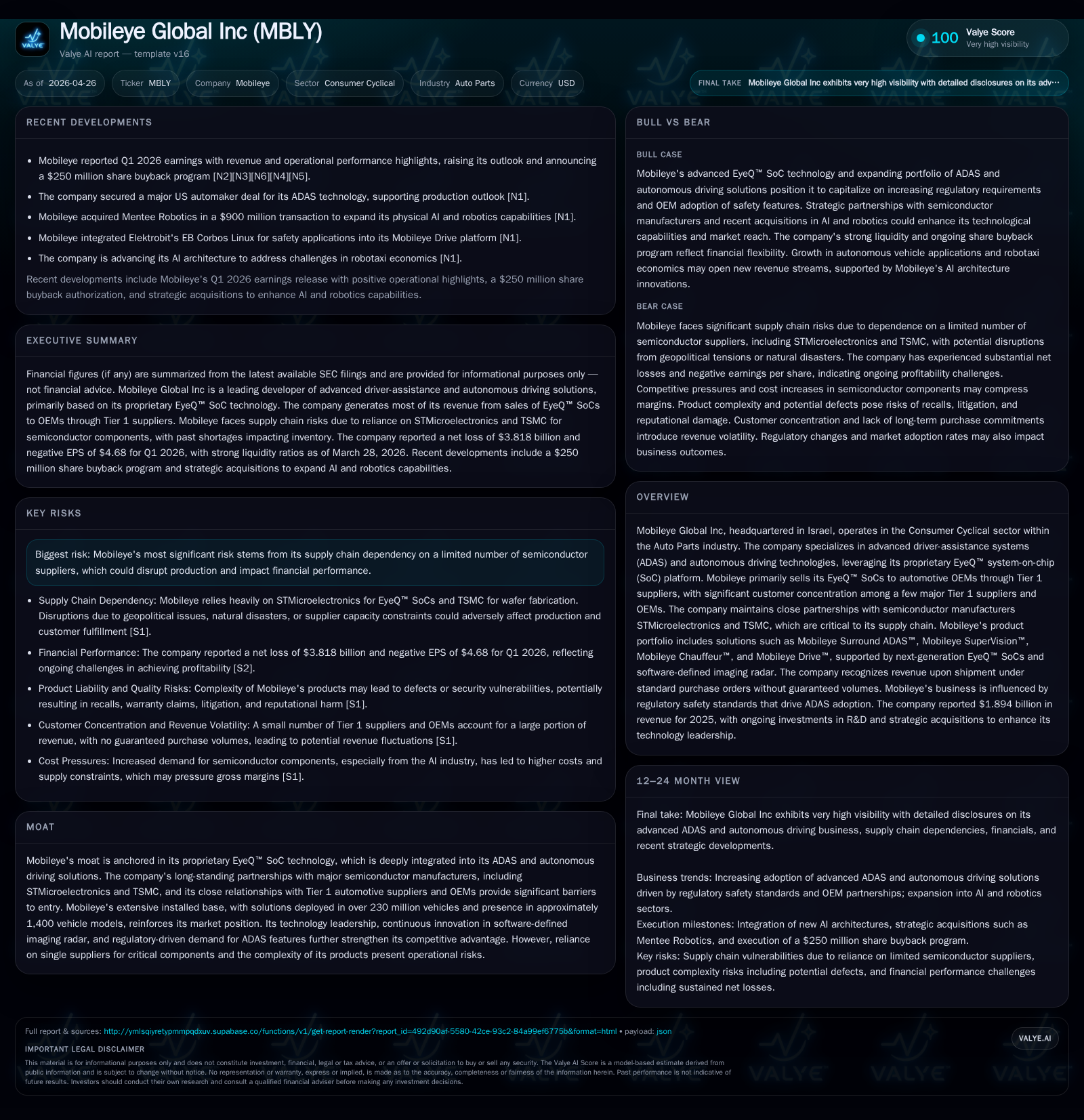
In its latest quarterly filing, Mobileye Global Inc. demonstrated a 15% year-over-year revenue increase driven mainly by higher volumes of its EyeQ™ system-on-chip products, reflecting normalization of previously built-up Tier 1 customer inventories. The company maintains strategic dominance in advanced driver-assistance systems (ADAS) through proprietary technology, deep OEM relationships, and platform innovation. Despite solid demand, Mobileye faces supply chain risks owing to reliance on limited semiconductor suppliers. Its path to growth hinges on broadening adoption of premium ADAS & autonomous vehicle solutions, expansion into software-defined radars, and new system sales. Robust liquidity and a fresh share repurchase program underline financial flexibility as the company executes amidst evolving automotive industry dynamics.
Recent Operating Update: Q1 2026 Performance Highlights
Mobileye Global Inc’s 10-Q disclosure for the quarter ended March 28, 2026, reveals accelerating revenue growth primarily propelled by robust sales volume increases of its EyeQ™ system-on-chip (SoC) units. Quarterly revenue reached approximately $1.89 billion—up about 15% year-over-year—against a backdrop of recovering demand following inventory normalization among key Tier 1 automotive customers who had accumulated excess stock earlier [S2][N1]. The company shipped an estimated 23% more EyeQ™ SoCs, which represent the core compute element embedded in advanced driver-assistance systems (ADAS) across vehicle fleets globally.
Importantly, Mobileye simultaneously announced a $250 million share repurchase authorization [S3][N7], signaling management’s confidence in capital allocation flexibility amidst dynamic market conditions. Operating income remains impacted by investments in technology development and infrastructure but is moving toward improvement as revenue scales [S2]. The firm ended Q1 with cash and equivalents of approximately $1.21 billion and a current ratio of about 4.76, underscoring balance sheet strength [F1].
Business Model: Proprietary SoCs Powering Safety Innovation
At Mobileye’s core is the proprietary EyeQ™ SoC platform—custom-designed silicon that enables sophisticated vision processing required for ADAS functionalities such as collision avoidance, lane keeping assistance, adaptive cruise control, and eventually autonomous driving capabilities [S24]. The company primarily generates revenues from the sale of these chips through Tier 1 suppliers to automotive original equipment manufacturers (OEMs), adhering to volume-based pricing structures that reflect the complexity and integration level of each solution.
While the EyeQ™ chip accounts for roughly 90%+ of revenue [S9], Mobileye is evolving its offering toward full-system solutions incorporating hardware beyond just SoCs—including next-generation imaging radars and more comprehensive software stacks—as embodied by products like Mobileye SuperVision™ (a high-end ADAS suite) and Mobileye Chauffeur™ (autonomous driving platform). This shift aims to capture higher gross profit dollars per unit despite margin percentage dilution due to increased hardware content [S4][S16].
Customer engagement involves early design collaboration with OEMs alongside suppliers to secure long production runs; the multi-year visibility aids capacity planning but introduces exposure to shifts in auto production cycles. Close partnerships with semiconductor foundries like STMicroelectronics (sole supplier of EyeQ chips) and TSMC remain critical given wafer fabrication constraints [S24][S14].
Industry Structure and Competitive Position
The auto parts sector is undergoing rapid transformation driven by regulatory mandates increasing ADAS feature penetration and automakers' ambitions toward autonomy. Mobileye differentiates itself within this consumer cyclical industry through deep domain expertise built over more than two decades pioneering camera-centric computer vision.
According to filings, Mobileye’s technology is integrated into over 230 million vehicles globally across approximately 1,400 distinct vehicle models—a scale that represents one of the broadest footprints in this specialized market segment [S24]. Its embedded footprint spans major auto-producing regions including USA, China, Germany, South Korea, UK among others [S9].
Barriers to entry are substantial given the complexity of hardware/software co-design inherent in developing reliable safety-critical solutions combined with controlling intellectual property around chip design. Relationships with OEMs and reliance on Tier 1 suppliers not only complicate competition but lock customers into switching costs. However, reliance on single suppliers like STMicroelectronics for EyeQ chips poses concentration risks that competitors could exploit if supply chains are disrupted or new entrants innovate alternative sensor fusion approaches combining LiDAR or ultrawideband technologies.
Growth Drivers and Constraints
Structural growth drivers include:
- Regulatory impetus globally mandating incremental ADAS features (e.g., emergency braking systems becoming standard).
- Automation progress incentivizing OEMs to adopt increasingly sophisticated sensing platforms linked to autonomy tiers.
- Expansion into full system solutions including software-defined imaging radar pushing average selling prices upward despite certain margin pressure.
- Geographic diversification capturing faster growing auto markets such as China juxtaposed with sustained demand in mature markets.
Conversely, constraints are:
- Supply chain vulnerabilities: Semiconductor shortages could curtail shipments; Mobileye remains heavily dependent on timely deliveries from a limited vendor base [S14][S24].
- Product complexity: As systems grow more sophisticated integrating radars and AI software layers, development cycles lengthen and cost structures rise.
- Customer concentration risk: A few large OEMs represent most sales; fluctuations in their production or procurement plans materially impact revenues [S18].
The company has taken steps to alleviate supply pressures including inventory builds completed during late 2023 [S14] but must remain vigilant against renewed disruptions that could suppress near-term growth or profitability.
What To Watch Next
Investors should monitor:
- Launch cadence and adoption rates of next-generation EyeQ™6 SOCs along with broadened rollouts of full system ADAS/autonomous platforms.
- Progress integrating software-defined imaging radar capabilities that complement existing camera-based solutions — central to staying ahead competitively.
- Supply chain developments around STMicroelectronics’ capacity commitments or diversification initiatives.
- Updates on key OEM partnerships indicating potential design wins or losses impacting future volume trajectory.
- Execution milestones related to recently acquired robotics tech (Mentee Robotics) which may augment autonomous mobility offerings [S24].
Emerging regulatory changes that could alter mandatory ADAS requirements in major markets would also influence Mobileye’s ASP trajectory.
Financial Profile Brief
Cash reserves of approximately $1.21 billion at quarter end provide a solid liquidity base for growth investments or capital return initiatives like the newly authorized share repurchase plan [F1][N7]. The latest quarterly update confirms solid demand resurgence after prior customer inventory corrections alongside deliberate financial stewardship evidenced by share buybacks. It does not constitute investment advice.*
Disclaimer: This is research-only, informational analysis and not investment advice. It may include AI-generated interpretation and general industry context. Always verify important details using primary sources.

Comments