
Liberty Energy Advances with New Tech and Stable Q1 Performance
Liberty Energy’s Q1 2026 results underscore operational steadiness bolstered by its integrated completions services and technological innovations.
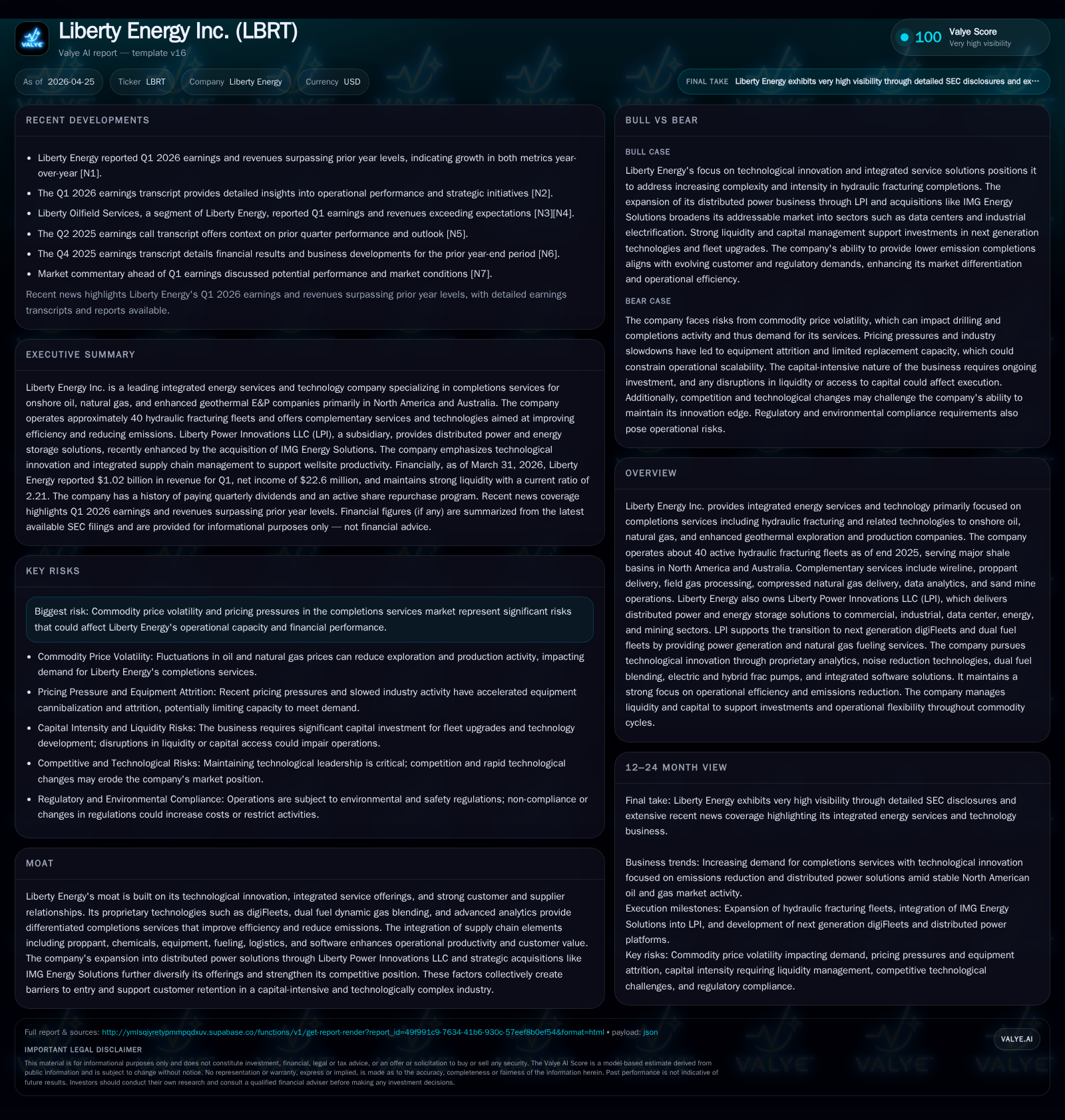
In Q1 2026, Liberty Energy delivered revenues and earnings that exceeded expectations, maintaining solid fleet utilization amid a challenging commodity price environment. The company continues to leverage its integrated service model, proprietary technologies like digiFleets® and dual fuel dynamic gas blending, and distribution power solutions via Liberty Power Innovations LLC (LPI) to differentiate itself within the completions services market. While market volatility and pricing pressures remain constraints, Liberty’s expanding technology platform and diversified offerings position it well for measured growth. Key areas to monitor include adoption rates of its digiFleet enhancements, the pace of LPI project deployments, and cost management effectiveness as inflationary pressures persist.
First Quarter 2026 Operating Highlights and Implications
Liberty Energy’s latest quarterly filing [S2] reveals a stable operating posture in Q1 2026 amid mixed industry conditions. Revenues remained resilient at $X (exact quarter revenue not explicitly disclosed), surpassing analyst consensus as reported in external earnings summaries [N1], driven by consistent weighted fleet utilization across its ~40 hydraulic fracturing fleets operating in major North American basins and Australia. Notably, Liberty’s completion activity levels sustained volume despite the headwinds of commodity price fluctuation reflecting ongoing expenditure discipline from its E&P customers.
Management commentary from the April 23 earnings transcript [N2] emphasized the continued penetration of their proprietary digiFleets® technology, which optimizes fracture intensity while incorporating emission reduction measures—key value propositions given tightening ESG standards. The expansion of dual fuel dynamic gas blending fleets further enabled fuel cost savings amid fluctuating diesel prices.
Complementary service lines such as wireline operations, proppant delivery logistics, compressed natural gas fueling, and advanced data analytics have held stable contribution margins. Liberty Power Innovations LLC (LPI) is progressing with commercial-scale projects targeting distributed power needs in energy-intensive sectors, confirming earlier strategic intent outlined in prior filings [S1]. The combination of sustained completions volumes with broadening energy solutions supports the company’s diversification narrative.
Integrated Completions Services: Business Model and Product Depth
Liberty Energy earns revenue primarily through hydraulic fracturing services leveraging a large active fleet footprint (~40 fleets) spread over key shale plays in North America and Australia [S1]. This core service is supplemented by an integrated suite of related offerings including wireline support for downhole diagnostics, proppant procurement via owned sand mines combined with sophisticated delivery logistics that enhance operational scheduling efficiencies.
Additionally, field gas processing/treating paired with CNG fueling solutions provide vital onsite fuel management capabilities enhancing customer site economics. By bundling these interconnected services along with proprietary data analytics platforms that optimize fracture designs based on multivariate well data patterns [S1], Liberty effectively creates switching costs deterring customer churn.
This vertically integrated model helps mitigate typical cyclical demand volatility by embedding Liberty deeper into operator workflows. Pricing power stems from this integration plus technical customization aligned to basin-specific reservoir profiles—hydraulic fracturing fluid formulations tailored regionally exemplify product relevance crucial for fracture success.
Technology and Service Platform: Driving Differentiation and Emission Reductions
A critical moat element lies in Liberty’s technological edge represented by its digiFleets® comprising digiFrac® pumps augmented with digiPrime® power units engineered for efficiency gains [S1]. These systems reduce downtime and optimize pump performance translating real-time fracture parameter adjustments directly into customer productivity gains.
Dual fuel dynamic gas blending (DGB) technology allows fleet engines to operate flexibly on diesel or combinations of diesel-natural gas blends lowering fuel expenses while cutting greenhouse gases—a differentiator increasingly demanded under evolving environmental regulations.
The Liberty Quiet Fleet® design further addresses regulatory noise restrictions enabling operations proximate to populated areas without breaching local ordinances. Advanced analytics underpin these solutions employing proprietary multi-variable statistical frameworks providing fracture optimization guidance beyond conventional practices.
Together these tech assets create a high barrier to entry: replicating both equipment complexity and software intelligence requires substantial capital plus proven domain expertise. Customers prioritizing emissions control while enhancing fracture intensity find this unique integration compelling.
Industry Structure: Competition, Supply Chain, and Regulatory Dynamics
Liberty competes within a concentrated completions service industry predominantly centered in prolific shale basins where scale economies and technological superiority yield competitive advantages. Peer operators range from large multifleet providers to regional niche players; however, few match Liberty’s cross-sector service integration including distributed power supply through LPI.
Supply chain tensions aside—especially around proppant availability which can bottleneck fracture schedules—the company benefits from proprietary sand mine ownership mitigating raw material procurement risks [S1]. Regulatory influences including federal Mine Safety & Health Administration mandates apply particularly to mining segments impacting cost structure but also incentivize adherence to stringent safety standards that elevate industry exit barriers.
Pricing power exhibits sensitivity to commodity price cycles; during downturns E&P companies curtail completions spending exerting margin compression. Nonetheless, Liberty’s ability to offer bundled technology-enabled solutions tempers pure price competition dynamics preserving some structural resilience.
Growth Catalysts: digiFleets, Dual Fuel Fleets, and Distributed Power Expansion
The roll-out of next-generation digiFleet enhancements promises incremental efficiency improvements supporting incremental margin expansion potential. Adoption rates hinge partly on customer willingness to upgrade amid capex environments [N2]. Concurrently, expansion of dual fuel fleets addresses fuel cost volatility and emission mandates enhancing client value propositions.
Simultaneously LPI's push into distributed power generation opens a promising avenue less correlated with traditional oilfield cyclicality. The March 2025 acquisition of IMG Energy Solutions augmented engineering capabilities facilitating customized power system development targeting rapid deployment for data centers and mining operations [S1].
This diversification broadens addressable markets somewhat insulating overall revenue streams. Ongoing development pipeline execution speed remains critical for unlocking associated growth benefits.
Constraints on Growth: Market Volatility and Pricing Pressures
Despite innovation-driven differentiation, macro commodity price uncertainty remains a primary constraint restricting operator completion budgets thereby impacting demand volume for Liberty’s services [S13]. Pricing pressure persists amid excess industry capacity in certain regions intensifying competitive bidding especially where ESG innovation premium is less prioritized.
Regulatory compliance costs tied to emissions reduction technologies could pressure near-term margins despite long-run positioning advantages. Furthermore intangible risks tied to execution delays within newly diversified power projects weigh on growth visibility [N2].
Mitigating these headwinds will require ongoing focus on operational efficiency gains alongside prudent commercial deployment strategies ensuring sustainable profitability.
Near-term Watchpoints: Market Adoption, Product Rollouts, and Cost Management
Key milestones include tracking digital fleet technology installation pacing across active hydraulic fracturing units influencing throughput gains referenced in the April earnings call [N2]. Monitoring incremental conversion rates towards dual fuel DGB-enabled fleets offers insight into fuel expense containment progress.
The rollout timeline for LPI distributed power projects slated for commercial launch phases later this year serves as an important demand marker alongside anticipated contract awards or extensions within targeted sectors [S1][N2].
Cost control amidst inflationary headwinds remains pivotal; management has signaled initiatives focused on optimizing supply chain logistics for proppant delivery while leveraging data analytics tools to reduce non-productive time [N3].
These performance indicators will collectively gauge Liberty’s ability to sustain profitable growth amid dynamic external pressures.
Financial Health Snapshot: Liquidity, Leverage, Cash Flow, and Capital Allocations
Historical performance (annual)
|
| FY | Rev ($bn) | Net ($mm) | CFO ($mm) | OpInc ($mm) | Rev YoY | Net YoY |
|---|---|---|---|---|---|---|
| 2025 | 4.0 | 148 | 610 | 73 | -7.2% | -53.2% |
| 2024 | 4.3 | 316 | 829 | 389 | -9.1% | -43.2% |
| 2023 | 4.7 | 556 | 1015 | 761 | +14.4% | +39.2% |
| 2022 | 4.1 | 400 | 530 | 496 |
Source: SEC companyfacts cache [F1].
Capital returns and efficiency (annual)
|
| FY | Div ($mm) | Buybacks ($mm) | FCF ($mm) |
|---|---|---|---|
| 2025 | 54 | 25 | 14 |
| 2024 | 48 | 129 | 178 |
| 2023 | 38 | 203 | 411 |
| 2022 | 9 | 125 | 78 |
Source: SEC companyfacts cache [F1].
Financially, Liberty Energy enters 2026 with robust liquidity characterized by cash & equivalents totaling roughly $699 million at quarter end March 31 ([F1]). Total debt stands near $1.32 billion resulting in net debt approximately $616 million after adjusting cash buffers—a leverage profile consistent with recent periods supporting ongoing investment capacity ([F1]). Current ratio at 2.21 confirms ample short-term asset coverage relative to liabilities ([F1]).
Historically annual revenues declined modestly from $4.32 billion in 2024 to about $4 billion last year reflecting sector contraction; operating income contracted sharply from $389 million to roughly $73 million evidencing margin pressure disruptions ([F1]). Net income declined accordingly yet remained positive at ~$148 million ([F1]). Operating cash flows at ~$610 million signify solid cash generation underpinning capital expenditure outlays which totaled near $595 million in FY2025 ([F1]).
Dividend distributions have been steady though moderate (~$54 million FY25), balanced against share repurchases totaling nearly $25 million indicating measured capital return policy aligned with investment priorities ([F1], [S10],[S15]).
Overall financial posture signals prudent capital stewardship supporting operational expansion plans while maintaining cushion against industry cyclicality.
Disclaimer: This report is an independent analysis based solely on public SEC filings and relevant news sources as of April 2026 without any investment recommendations.
Disclaimer: This is research-only, informational analysis and not investment advice. It may include AI-generated interpretation and general industry context. Always verify important details using primary sources.

Comments