
Waste Connections Strengthens Financial Position with Steady Q1 2026 Operations and Strategic Market Focus
Q1 2026 results highlight operational resilience and disciplined capital deployment in integrated waste management.
Waste Connections' latest quarterly filing reveals continued focus on vertical integration and exclusive market contracts driving efficient operations. The company's revenue recognition methodology remains consistent, with no material impact expected from new accounting standards adoption. Growth is supported by acquisitions and organic price increases, while financial leverage remains within targeted ranges. Key challenges include managing regulatory landfill liabilities and maintaining pricing power amid localized competition.
Recent Operating Update
Waste Connections’ Q1 2026 10-Q filing dated April 23, 2026 provides an important operational snapshot confirming continuity in its solid waste service revenue recognition approach. The company recognizes revenue predominantly at service performance time; any advance billing translates into deferred revenue, which is reversed upon service delivery ([S2]). This accounting clarity aligns with the December 2025 FASB guidance on interim disclosure requirements but Waste Connections does not expect any material impact from adopting new standards for internal-use software or expense disclosures through early 2027 ([S2], [S16]).
A significant balance sheet movement from the quarter is the rise in final capping, closure, and post-closure landfill liabilities from approximately $651.6 million at year-end to $701.1 million at March-end ([S2], [S20]). This upward adjustment reflects non-cash liability reevaluations tied to ongoing regulatory and environmental obligations typical for operators owning landfill assets. The company systematically amortizes these site costs as depletion expense commensurate with landfill airspace consumption.
Capital deployment activity during the period included seven immaterial acquisitions totaling cash consideration of about $63 million ([S19]). This smaller acquisition spend contrasts with $380 million deployed in the prior comparable period but underscores Waste Connections’ ongoing inorganic growth strategy through bolt-on deals in niche markets ([S19]).
Cash on hand stands at $112 million at quarter-end coupled with a substantial total debt load of $9.09 billion ([F1], [S4]). Despite the high leverage profile intrinsic to capital-intensive waste infrastructure businesses, Waste Connections targets a manageable leverage ratio between 2.5x and 3.0x net debt/EBITDA as part of its disciplined financial strategy ([S13]).
Business Model
Waste Connections functions as an integrated solid waste services provider predominantly across North America, covering non-hazardous collection, transfer, disposal, recycling, and resource recovery services ([S1]). Its business model centers on operating in mainly exclusive or secondary markets where it can achieve economies of scale and operational efficiencies via vertical integration—specifically through ownership or control of landfills and transfer stations that facilitate internal disposal of collected waste ([S1]).
The company typically wins long-term contracts that afford predictable cash flows while its landfills also generate tipping fees from third-party haulers using its facilities. This dual revenue stream mechanism combines collection service revenues with disposal fees, reinforcing margin stability.
Complementing its core municipal solid waste services, Waste Connections targets specialized niches such as non-hazardous exploration & production (E&P) waste management and intermodal container movement services primarily concentrated in select U.S. basins and Canadian provinces ([S1]). These higher-margin segments diversify overall risk exposure and capitalize on specific regulatory or logistical barriers that deter entry.
The company's scale—operating across 46 U.S. states plus six Canadian provinces—and focus on rural/secondary markets reduce direct competition from larger urban-centric players like Waste Management or Republic Services ([S1], analysis). Exclusive contractual arrangements combined with asset ownership help mitigate customer churn risks and improve operating leverage.
Industry Structure & Competitive Position
Integrated waste management is localized yet competitive; price competition dominates for collection services while tipping fees hinge on landfill location convenience and permitted capacity ([S1]). Favorable operators tend to be vertically integrated firms that can internally route waste streams to owned disposal points, allowing improved margin control.
Waste Connections' distributed footprint across less densely populated locales creates natural barriers for competitors who face higher costs scaling into these regions without existing infrastructure. Its strategic transfer stations optimize load aggregation prior to final disposal, yielding cost efficiencies absent in more fragmented independent operators ([S1]). Also significant are rigorous regulatory compliance requirements for environmental safety that necessitate sophisticated operational expertise—factors that cumulatively fortify Waste Connections' moat.
Long-term franchise agreements typical in this sector underpin steady cash flow visibility while limiting market entry dynamics for smaller new entrants owing to entrenched local relationships and permitting hurdles ([S14], analysis).
Growth Drivers & Constraints
Growth has been fueled by a combination of acquisition activity (adding roughly $377 million incremental revenue in FY2025) together with organic pricing power enabled by contract structures that support regular rate escalations above inflationary input pressures ([F1], [S1]). Expansion into niche segments such as non-hazardous E&P waste treatment offers upside leveraging specialized facilities difficult for broad-spectrum competitors to replicate ([S1]).
Capacity investments remain critical as landfill space depletes regionally; accordingly, Waste Connections continues capital expenditures targeting property acquisition and equipment upgrades reflecting an annual capex run rate exceeding $1 billion augmented over recent years ([F1], [S17]). This capex supports maintenance plus selective expansion enhancing network quality.
However, growth faces headwinds from increasingly stringent environmental regulations on landfill closures and remediation costs reflected in rising closure liabilities impacting both earnings volatility and cash flow timing ([S20], analysis). Further, competitive pricing pressure persists locally although mitigated through exclusivity clauses where applicable.
Demand dynamics are largely structural given the steady volume growth tied to population expansion and economic activity; however, cyclical industrial slowdowns can somewhat temper commercial waste volumes temporarily ([S1] analysis).
What to Watch Next
Key milestones include monitoring quarterly acquisition cadence now scaled back after heavy investment in prior periods—rate of bolt-on deals will signal whether consolidation momentum sustains ([S19]). Tracking closure liability adjustments closely will indicate evolving regulatory cost exposures affecting free cash flow conversion potential ([S20]).
Pricing trends embedded within contract renewals or municipal franchising rounds remain crucial to verify the durability of yield improvement narratives amid inflationary backdrop.
Capital allocation decisions around share repurchase pacing versus dividend increases will reveal evolving shareholder return priorities aligned with underlying free cash flow progression ([S24], [S13]). Pay attention also to leverage ratio trajectories relative to EBITDA reflecting debt servicing flexibility should interest rates fluctuate further.
Financial Profile (Supporting Evidence)
Historical performance (annual)
|
| FY | Rev ($bn) | Net ($mm) | CFO ($bn) | OpInc ($mm) | Rev YoY | Net YoY |
|---|---|---|---|---|---|---|
| 2025 | 9.5 | 1077 | 2.4 | 1710 | +6.1% | +74.3% |
| 2024 | 8.9 | 618 | 2.2 | 1068 | +11.2% | -19.0% |
| 2023 | 8.0 | 763 | 2.1 | 1236 | +11.2% | -8.7% |
| 2022 | 7.2 | 836 | 2.0 | 1242 |
Source: SEC companyfacts cache [F1].
Capital returns and efficiency (annual)
|
| FY | Buybacks ($mm) | FCF ($mm) | ROE% |
|---|---|---|---|
| 2025 | 506 | 1235 | 13.1 |
| 2024 | 0 | 1173 | 7.9 |
| 2023 | 0 | 1193 | 9.9 |
| 2022 | 425 | 1110 | 11.8 |
Source: SEC companyfacts cache [F1].
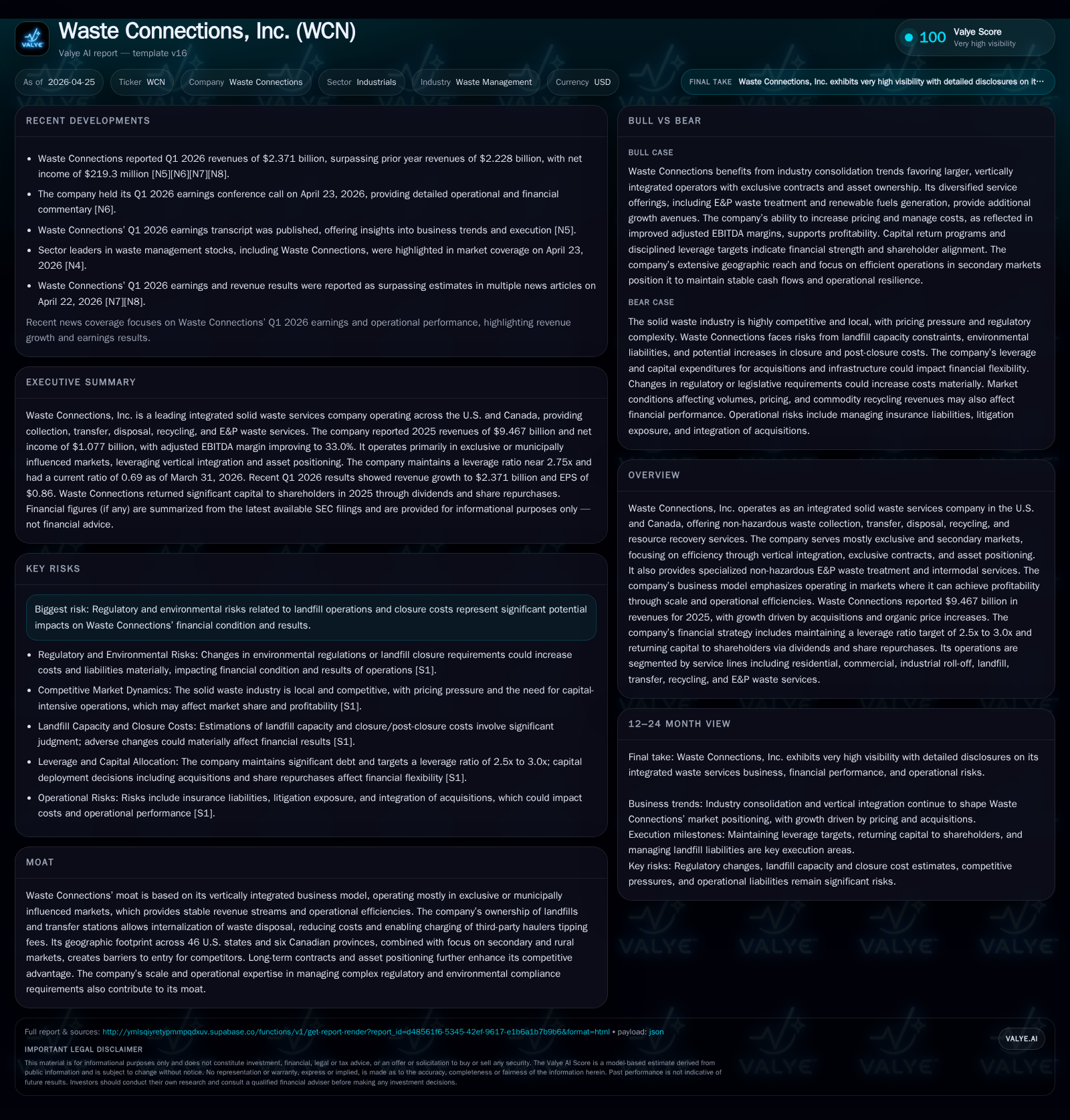
For fiscal year ending December 31, 2025: revenues reached $9.467 billion representing a healthy 6.1% year-over-year increase largely from acquisitions plus organic pricing improvements ([F1], [S1]). Operating income surged over 60% year-over-year to approximately $1.71 billion highlighting operating leverage despite incremental compliance costs ([F1]). Net income was elevated at around $1.08 billion reflecting improved profitability margins as well as tax effects ([F1]). Operating cash flow stood strong at about $2.41 billion providing ample coverage for capex needs which totaled nearly $1.18 billion reflecting capacity investments key to sustaining growth (capex + acquisition spend combined roughly exceed depreciation) ([F1]). The approximate free cash flow (CFO minus capex) remained robust near $1.23 billion supporting ongoing dividends plus share repurchases totaling over half a billion dollars executed under normal course issuer bids during the year ([F1], [S13], [S24]).
At quarter-end March 31, 2026: current assets total approximately $1.38 billion against current liabilities near $2.01 billion yielding a current ratio of ~0.69 consistent with capital-heavy sector norms requiring reliance on revolving credit lines alongside operating cash inflows ([F1]). Total debt levels hold stable around $9.09 billion compared with cash balances just over $112 million simultaneously indicating substantive leverage but manageable within targeted debt/EBITDA bands reported previously ([F1], [S4]). The increase in closure liabilities signals prudent reserve booking consistent with long-term environmental commitments inherent in landfill ownership models ([S20]).
This analysis summarizes Waste Connections' latest operating developments anchored on SEC filings without offering investment advice or price forecasts. It highlights the company's strategic positioning within the integrated solid waste industry emphasizing its financial discipline alongside key growth drivers and inherent risk factors such as environmental liabilities.
Disclaimer: This is research-only, informational analysis and not investment advice. It may include AI-generated interpretation and general industry context. Always verify important details using primary sources.

Comments