
ServiceNow’s Strategic Advances in AI-Driven Workflow Automation Post-Q1 2026
ServiceNow’s latest quarterly disclosures reveal targeted capital deployment and platform enhancements focusing on AI workflow orchestration and security integration.
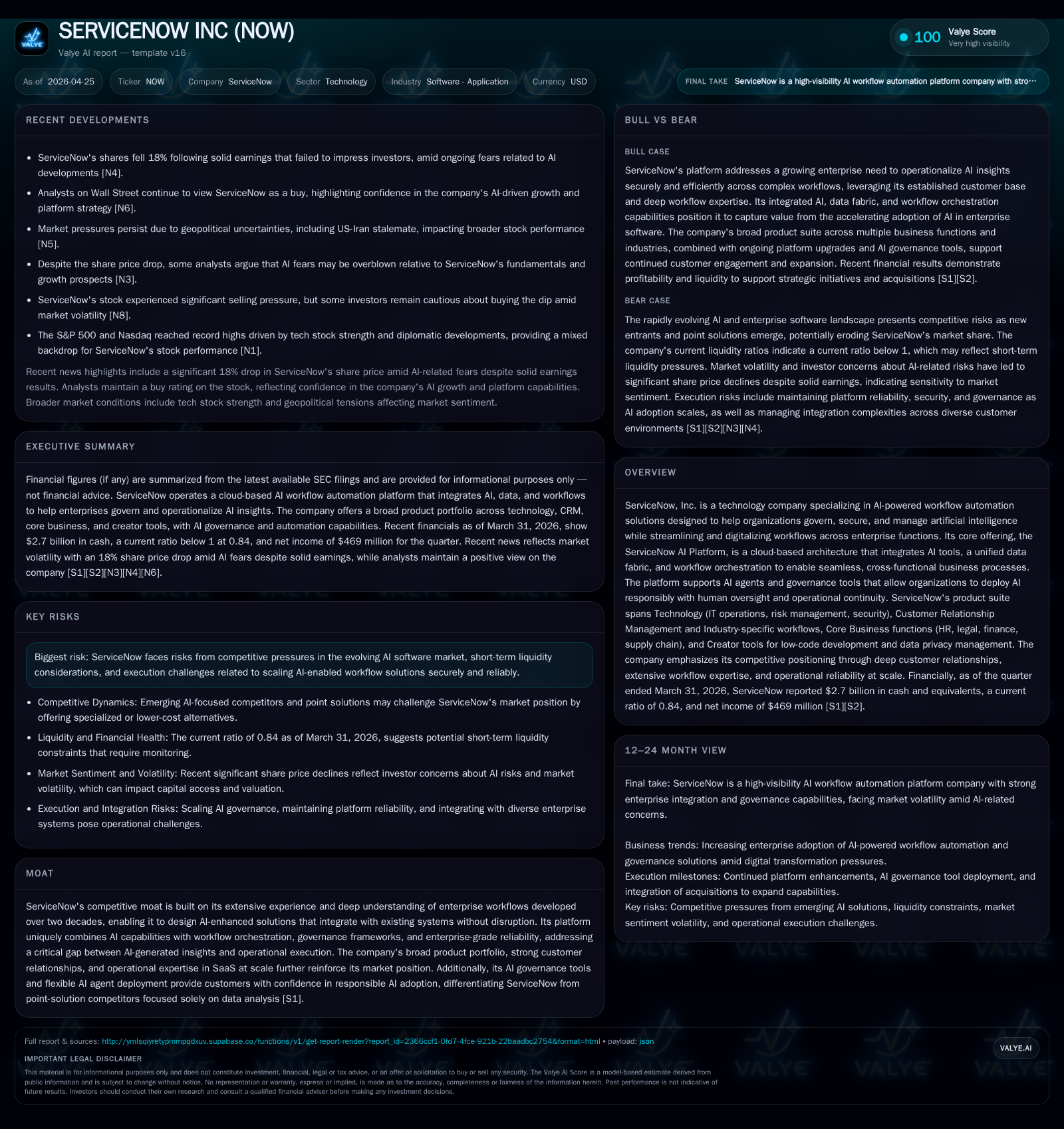
In Q1 2026, ServiceNow secured a $4 billion unsecured term loan to finance the acquisition of Armis Security, signaling a focused expansion into cybersecurity within its AI-driven workflow platform. The company's cloud-based AI Platform continues to bridge the gap between AI insights and operational execution across enterprise functions. Despite strong execution, investor sentiment has been cautious following the earnings release, reflecting ongoing concerns about AI market risks and competitive pressures. ServiceNow’s strategic moves reinforce its expansive moat anchored in workflow automation and governance tools, while execution of integrations and regulatory navigation remain key near-term focal points.
Latest Quarterly Developments Reflecting Strategic Growth Moves
ServiceNow's Q1 2026 filing disclosed a significant capital move: an unsecured $4 billion term loan to partly fund its acquisition of Armis Security Ltd., a strategic play aimed at integrating advanced security solutions into its AI workflow automation platform [S2][S3]. This move addresses an increasingly critical enterprise demand for robust cybersecurity as organizations embed AI deeper into mission-critical processes. The loan matures in October 2026 and carries floating interest rates tied to benchmark rates reflecting moderate short-term refinancing risk but providing immediate liquidity for expansion [S3].
Aside from financing activity, the company released solid operating results accompanied by reaffirmed guidance. However, stock-market reaction was muted with shares falling approximately 18% post-earnings due to cautious investor sentiment over broad AI-related uncertainties and competitive dynamics [N1][N2]. This dichotomy underscores how strategic capital deployment is key to maintaining competitive advantage amid macroeconomic jitters.
Business Model: AI-Powered Workflow Orchestration at the Core
ServiceNow primarily generates revenue through subscription licenses to its SaaS platform that digitizes and automates workflows across enterprise functions using embedded artificial intelligence tools aligned with governance frameworks [S1]. Its proprietary AI Platform serves as an end-to-end orchestrator — extending beyond mere data analytics by managing workflow execution such as transaction approvals, system updates, policy enforcement, and compliance adherence.
The suite encompasses modules spanning IT operations management (ITOM), risk and security governance (expanded notably via Armis), customer service management (CSM), and industry-specific workflow applications. In addition, the low-code/no-code Creator tools empower internal stakeholder innovation while ensuring consistent data privacy controls.
This setup creates significant switching costs as enterprises deeply embed these automated workflows into their operational fabric — integrating with existing systems of record without disruption — leading to stickiness that supports strong recurring revenue streams and margin durability.
Competitive Dynamics and Industry Positioning in Enterprise SaaS Automation
ServiceNow’s moat arises from its two-decade development pedigree in workflow software married now with extensive AI capabilities tailored for responsible deployment. Unlike fragmented point solutions focusing narrowly on data insights or niche automation tasks, ServiceNow delivers a cohesive platform that bridges insight-to-execution at scale with governance layers critical for regulated industries.
The integration complexity of comprehensive workflow platforms naturally deters new entrants. Moreover, global regulatory intricacies around data residency (e.g., EU Data Act), privacy laws, and evolving antitrust environments underscore the value of ServiceNow’s compliance-ready infrastructure.
While large hyperscalers offer competitive cloud infrastructure services embedding generic AI models, they lack ServiceNow’s deep verticalized workflow know-how and governance tooling tailored for enterprise needs. Emerging specialists offer strong analytic capabilities but rarely provide seamless cross-functional execution control.
Thus, ServiceNow leverages synergy across product breadth (ITSM + CSM + industry workflows + creator tools) and reliability at SaaS scale to fend off peer pressures effectively [S1][N6].
Growth Catalysts and Potential Headwinds in AI Integration
Structural tailwinds persist as enterprises accelerate digital transformation mandates demanding integrated AI automation coupled with robust risk management embedded directly into workflows. The rise in hybrid cloud adoption amplifies demand for unified platforms that can orchestrate diverse systems securely.
However, headwinds include evolving regulations around AI transparency and fairness which may slow adoption or compel costly upgrades. The competitive environment is intensifying as cloud providers bolster native AI tools while startups innovate specialized capabilities targeting isolated domains.
Pricing power appears resilient given the mission-critical nature of managed workflows but may face episodic pressure in segments vulnerable to commoditization. Execution risks also loom around smoothly integrating recent acquisitions like Armis without disruption while scaling complex platform features reliably [S1][S8][N2].
Upcoming Operational Milestones and Demand Indicators to Monitor
Key milestones include:
- Completion and smooth operational integration of Armis Security capabilities into the core platform expected over next two quarters.
- Monitoring subscription renewal rates and net dollar retention metrics indicative of customer satisfaction amid evolving AI landscape.
- Assessment of cost optimization initiatives partially funded through newly secured credit facilities aimed at sustaining margin expansion.
- Pipeline maturation signals from cross-industry client expansions leveraging expanded security features merged with workflow tools.
- Reaction to broader macroeconomic signals influencing IT budgets impacting discretionary software spend.
These markers will provide clarity on how effectively ServiceNow translates strategic investments into commercial traction post-Q1 [S2][N1].
Current Financial Health, Capital Strategy, and Balance Sheet Snapshot
Historical performance (annual)
|
| FY | Net ($mm) | CFO ($bn) | OpInc ($mm) | Capex ($mm) | Net YoY |
|---|---|---|---|---|---|
| 2025 | 1748 | 5.4 | 1824 | 868 | +22.7% |
| 2024 | 1425 | 4.3 | 1364 | 852 | -17.7% |
| 2023 | 1731 | 3.4 | 762 | 694 | +432.6% |
| 2022 | 325 | 2.7 | 355 | 550 |
Source: SEC companyfacts cache [F1].
Capital returns and efficiency (annual)
|
| FY | Buybacks ($mm) | FCF ($bn) | ROE% |
|---|---|---|---|
| 2025 | 1840 | 4.6 | 13.5 |
| 2024 | 696 | 3.4 | 14.8 |
| 2023 | 538 | 2.7 | 22.7 |
| 2022 | 2.2 | 6.5 |
Source: SEC companyfacts cache [F1].
As of March 31, 2026, ServiceNow held approximately $2.7 billion in cash and equivalents juxtaposed against roughly $1.48 billion reported debt as per last public major reference point (September 2021) augmented by the fresh $4 billion term loan drawn in April 2026 dedicated to funding Armis acquisition [F1][S3]. This positions net debt modestly negative when accounting for liquidity buffers.
Current assets stood at $8.44 billion against current liabilities totaling approximately $9.98 billion yielding a current ratio of around 0.84—indicative of working capital constraints which are not uncommon in high-growth SaaS companies investing heavily in R&D and go-to-market expansion simultaneously [F1].
Operational cash flow remains robust based on trailing annual performance exceeding $5 billion with free cash flow healthy after ongoing capex commitments supporting platform development [F1]. Share repurchase activity resumed aggressively in recent years underscoring confidence in long-term value creation.
Overall balance sheet flexibility appears sufficient to support continued acquisitions or R&D investment though near-term refinancing vigilance is prudent given short maturity profile on the recent term loan at October 2026 [S3].
| Fiscal Year | Revenue (USD bn) | Operating Income (USD bn) | Net Income (USD bn) | Operating Cash Flow (USD bn) | Capex (USD bn) | Buybacks (USD bn) | Current Ratio |
|---|---|---|---|---|---|---|---|
| 2025 | n/a | 1.82 | 1.75 | 5.44 | 0.87 | 1.84 | n/a |
| Q1 2026 | n/a | n/a | n/a | n/a | n/a | n/a | 0.84 |
Note: Full quarterly revenue figures not available from provided sources; current ratio reflects Q1 latest update.
This analysis draws exclusively on regulatory filings through April 2026 complemented by relevant market commentary without extrapolating unpublished financials or speculative forward-looking statements.
Disclaimer: This report is intended solely for informational purposes based on publicly available SEC filings and related disclosures as of April 2026. It does not constitute investment advice or recommendations regarding any securities mentioned herein.
Disclaimer: This is research-only, informational analysis and not investment advice. It may include AI-generated interpretation and general industry context. Always verify important details using primary sources.

Comments