
Rein Therapeutics Advances LTI-03 Pipeline with Regulatory Clearance and Strategic Financing
Clinical-stage biopharma Rein Therapeutics progresses idiopathic pulmonary fibrosis therapy amid financing moves and operational updates.
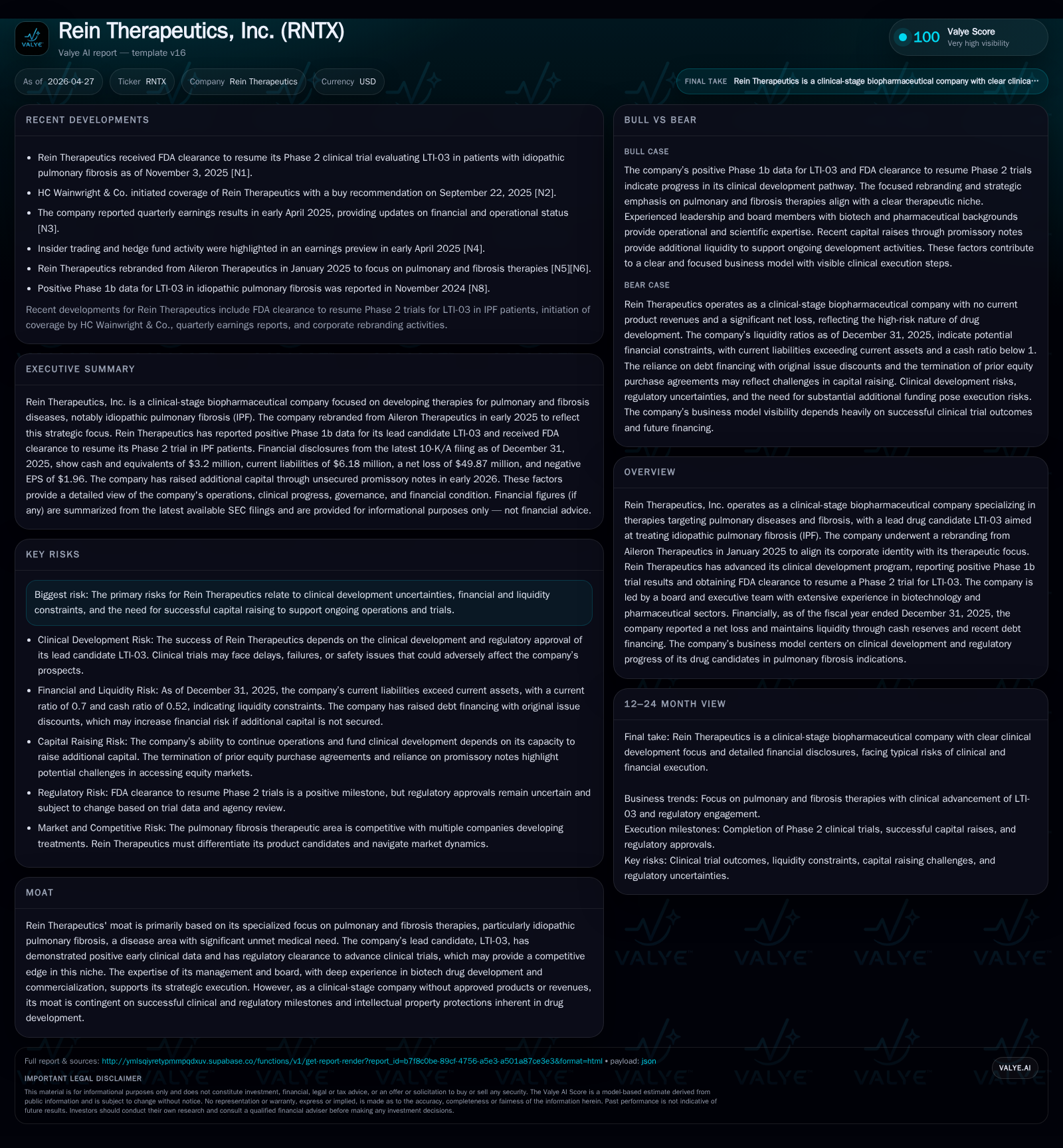
Rein Therapeutics, a clinical-stage biopharmaceutical company focused on pulmonary diseases, notably idiopathic pulmonary fibrosis (IPF), recently secured FDA clearance to resume its Phase 2 trial of the lead candidate LTI-03. The company bolstered its liquidity position through private placements raising nearly $5 million via unsecured promissory notes in early 2026, addressing ongoing cash flow challenges. Despite operating losses and a sub-unity current ratio, Rein leverages specialized management expertise and a narrow but promising pipeline targeting high unmet medical needs. Key near-term milestones include successful execution of clinical trials and capital raises needed to sustain operations toward potential regulatory approval.
Recent Operating Update: Resumption of Phase 2 Trial and Financing Activity
Rein Therapeutics' latest quarterly report filed November 14, 2025 [S2] confirmed progress on its lead drug candidate LTI-03 for idiopathic pulmonary fibrosis (IPF), announcing FDA clearance obtained earlier that month to resume its Phase 2 clinical trial after positive Phase 1b data was reported previously [S12]. This regulatory milestone is a crucial step for the company’s pipeline progression as IPF has limited treatment options and significant unmet medical need.
Concurrently, in the first months of 2026, Rein undertook two private placements (January 15 and February 24-27) issuing unsecured promissory notes aggregating approximately $4.8 million at a steep original issue discount of 20% [S3][S15][S10]. These financings reflect the company's need to manage liquidity tightly given its ongoing negative cash flow and lack of revenues. Termination of previous prepaid advance agreements with Yorkville in December 2025 further signals shifts in financing strategy away from equity-linked or advance mechanisms toward debt instruments [S16].
Board composition remained stable with the exception of one director resignation announced in February 2026 without operational disagreement [S20]. Leadership continuity under CEO Brian Windsor, Ph.D., who has deep prior experience leading related biopharmaceutical companies focused on pulmonary therapies, is intact [S29].
Business Model: Focused Clinical Development for Pulmonary Fibrosis Treatments
Rein Therapeutics operates purely as a clinical-stage biotechnology entity; it generates no commercial revenues. Instead, its business model centers on discovery, development, and regulatory advancement of novel therapeutic candidates aimed primarily at pulmonary diseases such as IPF—a progressive fibrotic lung disorder with few effective treatments.
The company’s flagship program is LTI-03—a drug candidate that has shown favorable safety and tolerability in early-phase trials [S12]. Approval by the FDA to resume Phase 2 studies suggests the drug met initial endpoints for safety to justify expanded testing for efficacy signals. Rein's strategic focus on IPF aligns with an increasing recognition within pulmonology that fibrosis pathways are ripe for targeted intervention.
Because Rein does not yet commercialize products, its financial viability depends heavily on capital raises and partnerships until pivotal trials are successfully completed. This model is typical among small-cap biotech companies where value creation hinges on milestone achievements rather than recurring operating cash flows.
Industry Structure and Competitive Positioning
The biopharmaceutical segment targeting fibrotic lung disease is highly specialized but competitive. Approved therapies such as nintedanib (Ofev) and pirfenidone (Esbriet) provide modest benefits but also leave substantial room for innovation. Rein’s LTI-03 is positioned as a novel agent potentially differentiating itself by mechanism or tolerability profile if late-stage results confirm early promise.
Barrier-to-entry factors include high R&D costs, complex clinical trial design demanding rigorous endpoints like forced vital capacity stabilization/improvement in IPF patients, and stringent FDA scrutiny. Rein's advantage lies in its concentrated expertise within this niche area combined with nimble operational capabilities under seasoned leadership capable of navigating regulatory complexities.
However, lacking an approved product means Rein is still unproven commercially; entry into the market will require overcoming standard biotech risks including trial failures, competitive launches from larger firms investing heavily in fibrosis research pipelines, and reimbursement dynamics post-approval.
Growth Drivers and Constraints
Key growth drivers:
- Clinical Trial Advancement: Successful completion of Phase 2—and eventually Phase 3—clinical trials providing positive efficacy/safety data will be critical value inflections.
- Regulatory Milestones: Gaining further FDA approvals for expanded development stages or eventual marketing authorization will materially de-risk the investment thesis.
- Capital Access: Raising sufficient funding at favorable terms is essential to sustain operations through costly development periods.
- Collaborations/Partnerships: Potential alliances for co-development or commercialization could accelerate growth trajectories.
Growth constraints:
- Clinical Uncertainties: As with all experimental drugs in fibrotic diseases, efficacy or unforeseen adverse events could derail progress.
- Financial Limitations: Cash reserves and liabilities indicate tight runway management; continued dilution or debt issuance could impair shareholder value.
- Market Competition: Increasing activity from both established pharma players and emerging biotech ventures intensifies the race toward first-to-market advantages.
- Patient Recruitment: Slow enrollment or difficult-to-measure clinical endpoints can delay timelines disproportionately.
What To Watch Next
Investors and industry watchers should monitor:
- Interim data releases from ongoing Phase 2 trials to assess LTI-03’s efficacy trends and safety profiles.
- Additional capital raising activities or partnerships that might extend financial runway beyond mid-2026 when current promissory notes mature [S3][S15].
- Regulatory communications regarding potential fast-track designations or orphan drug status given IPF’s rare disease classification.
- Management commentary during earnings or investor calls clarifying timelines for pivotal study launches or readouts.
- Pipeline diversification efforts beyond LTI-03 indicating broader strategic ambitions within pulmonary disorders.
Financial Profile Context
According to the latest available fiscal year-end data (December 31, 2025) [F1], Rein reported a net loss of approximately $49.9 million with operating expenses reflective of heavy investment in R&D absent any drug sales revenue. Cash and equivalents stood at about $3.2 million.
These financial metrics reveal ongoing reliance on external financing to fund operations observed through recent unsecured promissory note issuances totaling nearly $5 million at significant original issue discounts [S3][S15]. The termination of prior prepaid advance agreements indicating adjustments to funding mechanisms also reflects active treasury management efforts aimed at preserving financial flexibility while minimizing dilution where possible.
Overall, the financial snapshot portrays a company actively managing developmental risks inherent with clinical-stage biopharmas. The success trajectory remains contingent upon hitting important clinical milestones promptly to unlock subsequent funding sources and potential commercial value creation opportunities.
Disclaimer
This analysis is intended solely for informational purposes regarding Rein Therapeutics, Inc.’s business operations and industry context based on recent SEC filings and publicly available information as of April 27, 2026. It does not constitute investment advice or recommendations regarding buying or selling securities.
Disclaimer: This is research-only, informational analysis and not investment advice. It may include AI-generated interpretation and general industry context. Always verify important details using primary sources.

Comments