
Ladder Capital Corp Consolidates Position with Flexible CRE Finance Amid Market Challenges
The Q1 2026 report underscores Ladder’s operational stability and strategic execution in commercial real estate lending through its diversified financing and disciplined underwriting.
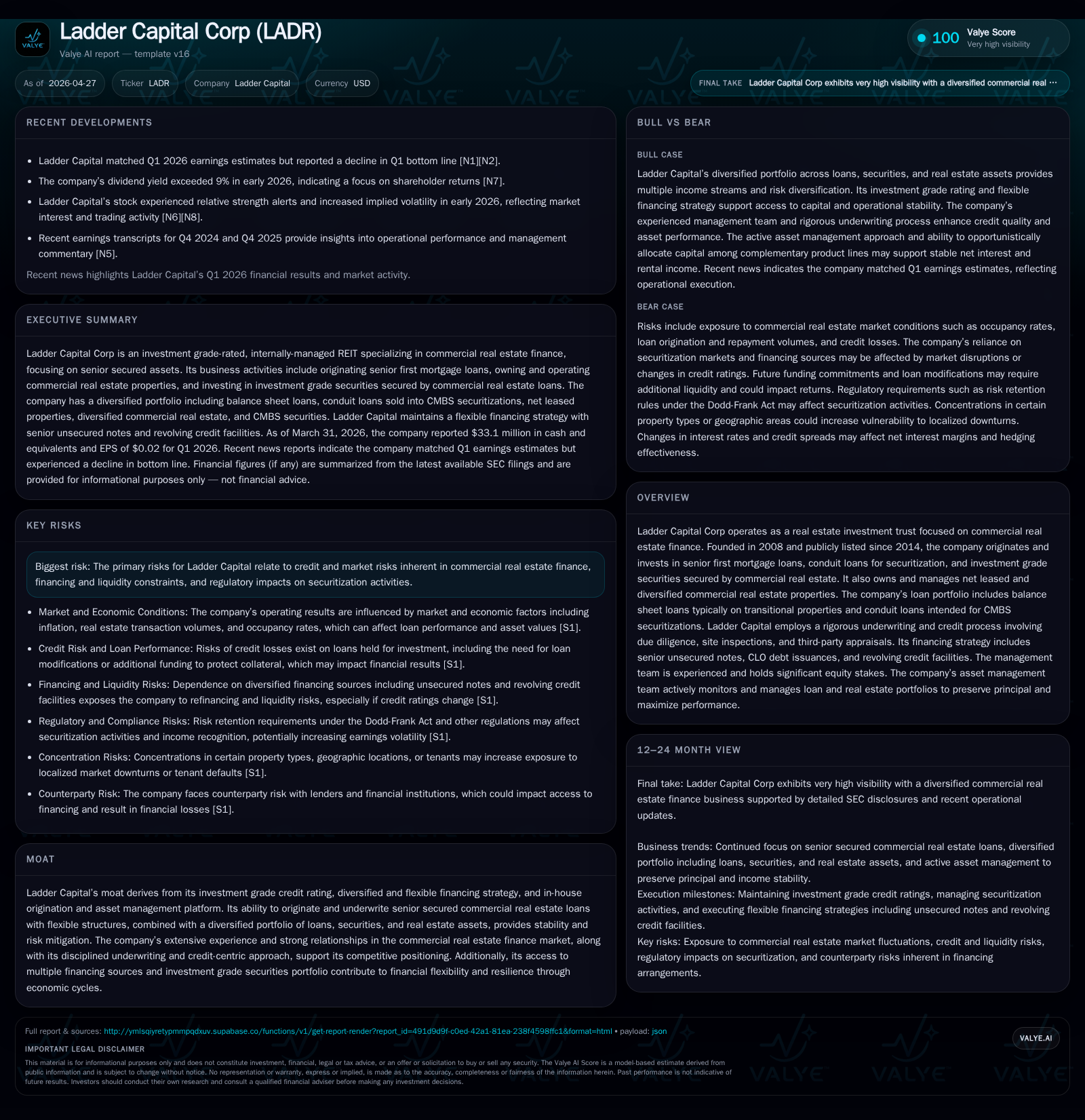
Ladder Capital Corp’s April 2026 quarterly filing highlights steady loan origination and asset quality in a volatile commercial real estate finance environment. The company’s integrated origination and asset management platform, supported by an investment grade credit profile and flexible capital structure, enable it to maintain resilience amid cyclical headwinds. Its strategy centers on senior first mortgage loans with a blend of conduit and balance-sheet lending, facilitating risk-adjusted returns through economic cycles. Key risks remain credit exposure in transitional assets and regulatory sensitivities, while upcoming securitization activity and financing execution will be critical near-term markers.
Latest Quarterly Operating Performance: Stability in a Volatile CRE Finance Market
Ladder Capital's 10-Q for Q1 2026 [S2] confirms operational resilience during ongoing challenges in the commercial real estate (CRE) finance sector. The company matched earnings expectations as reported by Nasdaq [N1], signaling stable net interest income supported by steady loan originations. Notably, no material changes were disclosed in risk factors during the quarter, consistent with the previous annual report's assessment [S15]. This reflects Ladder's maintenance of disciplined underwriting standards and effective credit risk mitigation practices despite sector-wide headwinds.
Further insights from the recent 8-K filing [S3] reveal that Ladder continues to monitor portfolio performance closely without indication of rising delinquencies or significant credit impairments thus far this year. The absence of adverse developments underscores the firm’s measured approach to underwriting balance sheet loans while actively managing its conduit loan pipeline for securitization.
Ladder Capital’s Business Model: Integrated Origination and Asset Management Strengths
At its core, Ladder Capital operates an internally-managed REIT platform specialized in originating and investing primarily in senior first mortgage loans collateralized by commercial real estate [S1]. These loans fall into two categories: balance sheet loans typically made on transitional properties requiring value enhancement or repositioning; and conduit loans intended for eventual sale into CMBS securitizations.
The company complements lending activities with investments in investment-grade securities secured by such commercial mortgages alongside ownership of net leased commercial real estate properties. This diversified portfolio mix generates stable net interest income supplemented by rental revenues from owned assets.
Central to Ladder’s business model is its comprehensive underwriting process involving rigorous due diligence, including site inspections and third-party appraisals [S1]. These quality controls combined with a credit-centric risk framework help sustain asset quality across economic cycles. The firm’s integrated asset management function continuously monitors collateral performance, enabling proactive workout strategies where needed.
Industry Positioning: Competitive Dynamics and Financing Flexibility
Ladder Capital occupies a unique niche within the U.S. CRE finance ecosystem as one of the largest non-bank contributors to CMBS conduit loan issuance over the past decade [S1]. Ladder employs multiple capital tools including senior unsecured notes, non-recourse Collateralized Loan Obligations (CLOs), and revolving credit facilities structured with considerable undrawn capacity [S4][S5].
This layered financing strategy not only enhances liquidity flexibility but also supports capital recycling essential for scaling originations via conduit lending channels. Such optionality distinguishes Ladder from smaller or more narrowly capitalized competitors whose ability to swiftly deploy capital against new opportunities may be constrained by tighter leverage or narrower access to premium debt markets.
Industry challenges persist around regulatory frameworks governing CMBS securitization—risk retention rules impose ongoing compliance obligations—and potential volatility in secondary funding markets could constrain future issuance volumes. Nevertheless, Ladder’s strong institutional relationships and seasoned management mitigate these risks relative to less-established players.
Growth Drivers: Capital Allocation and Market Opportunities in CRE Lending
Looking ahead, growth for Ladder hinges primarily on expanding its conduit loan pipeline which feeds robust secondary market CMBS issuance activity [S1]. The securitization mechanism enables efficient equity recycling—funds realized from loan sales can be redeployed into new originations or diversified investments.
Additionally, the company pursues selective balance sheet lending on transitional properties that present enhanced return prospects through asset repositioning or operational improvements. This dual product approach balances volume growth with margin enhancement potential while maintaining prudent risk controls.
Macro factors influencing demand include prevailing interest rate regimes—floating rate loans provide natural hedges against rising rates—and evolving patterns of CRE tenant demand impacting collateral valuations. While short-term headwinds from economic uncertainty may temper origination velocity temporarily, Ladder’s flexible capital allocation positions it well to capitalize on dislocations benefiting disciplined lenders.
Risks and Constraints: Credit, Market Cycles, and Regulatory Factors
Credit risk associated with transitional property loans remains a notable vulnerability within Ladder’s portfolio given their reliance on successful asset repositioning amid uncertain market conditions [S1]. Illiquidity inherent in certain subordinated interests or B-note positions amplifies potential loss severity if borrower performance deteriorates unexpectedly.
Market cyclicality further affects the timing and pricing of securitizations—the availability of favorable warehouse lines or investor appetite can ebb quickly under financial stress [S1]. Regulatory requirements tied to Dodd-Frank risk retention also impose structural constraints on conduit loan packaging.
Management retains vigilance over financing exposures as reiterated by unchanged risk disclosures this quarter [S15].
Near-Term Catalysts and Execution Watchpoints
Stakeholders should watch for developments around Ladder’s forthcoming CMBS securitizations which drive capital recycling cadence critical for sustaining origination momentum. Monitoring quarterly delinquencies or modifications reported will provide early signals on portfolio credit health amidst evolving economic trends.
New CLO offerings represent another lever facilitating liquidity deployment; successful placements would reinforce funding diversity. Incremental commentary from management during earnings calls or press releases could also offer clarity on execution progress amid fluctuating market conditions [S3][N1].
Estimated net debt remains elevated near $3.2 billion using the latest available data points though exact recent debt figures are not detailed explicitly for Q1 2026 [F1]. Earlier annual disclosures affirm substantial unencumbered asset pools primarily consisting of first lien mortgage loans enabling borrowing capacity across revolving facilities sized at nearly $850 million with incremental expansion rights [S4][S5].
The company maintains a balanced capital structure targeting approximately a 3:1 debt-to-equity leverage ratio allowing room for growth while ensuring compliance with imposed covenants from bond indentures and financing agreements [S5][S26]. Following redemption events related to prior CLO issues in mid-2025 [S5], Ladder appears positioned with manageable refinancing pathways.
Overall liquidity management combined with refinancing flexibility are crucial supports underpinning ongoing loan origination capabilities as well as absorbing potential temporary shocks arising from transitional loan performance variability.
Disclaimer: This analysis is based on publicly available SEC filings up to April 27, 2026 ([S1], [S2], [S3]) supplemented by relevant news sources ([N1]). It is intended solely for informational purposes without any explicit investment advice or recommendation regarding Ladder Capital Corp securities.
Disclaimer: This is research-only, informational analysis and not investment advice. It may include AI-generated interpretation and general industry context. Always verify important details using primary sources.

Comments