
CL Workshop Group Launches New Equity Incentive Plan to Support Long-Term Growth
The company adopts a Nasdaq-compliant equity incentive plan amidst ongoing efforts to diversify and stabilize its forestry business.
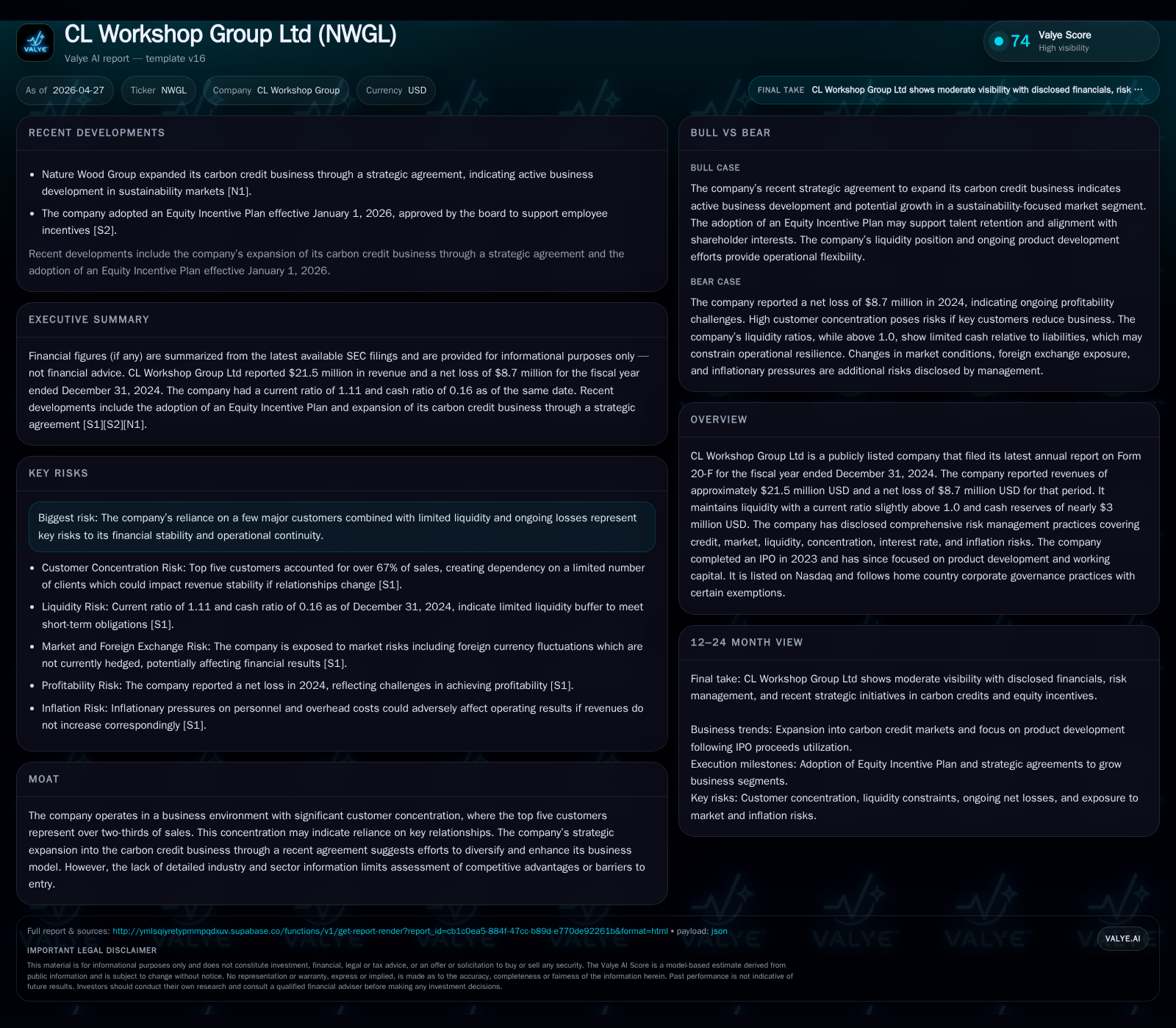
CL Workshop Group Limited announced the adoption of a 2026 Equity Incentive Plan effective January 1, 2026, aligning with Nasdaq corporate governance requirements for shareholder approval on equity arrangements [S2]. This move coincides with strategic initiatives to mitigate operational risks stemming from concentrated customer exposure and geopolitical supply chain disruptions [S1]. The company's expansion into the carbon credit market represents a key diversification step [N1], aiming to balance cyclical challenges in the wood product sector. Liquidity remains tight but manageable, with a current ratio of 1.11 and $3 million in cash reserves as of year-end 2024 [F1]. Ongoing profitability pressures and concentrated revenues necessitate close monitoring of financing execution and operational efficiency improvements [S3].
Recent Corporate Governance Developments and Equity Incentives
On January 1, 2026, CL Workshop Group Limited (Nasdaq: NWGL) implemented its 2026 Equity Incentive Plan following board approval documented in the January 2, 2026 Form 6-K filing [S2]. This plan addresses Nasdaq's Rule 5635(c), mandating shareholder consent prior to material amendments or establishment of equity compensation schemes allowing stock acquisition by company insiders or consultants. As a British Virgin Islands foreign private issuer relying on home country exemptions for certain Nasdaq governance rules, this adoption represents an important step toward aligning employee incentives with long-term growth ambitions amid evolving corporate governance expectations post-IPO in 2023. Establishing this plan signals management’s commitment to retain talent critical for executing strategic initiatives under challenging market conditions.
Business Model Overview and Product Offering Quality
CL Workshop operates as a holding company primarily engaged through subsidiaries in Peru, France, Hong Kong, and Macau in forestry product trading. The company markets logs, decking, flooring, and sawn timber under its proprietary 'NATU' brand aimed at importers, retailers, and processors located predominantly across China, Peru, France, Hong Kong, Belgium, the United States, and South Asia [S1]. Offering high-quality wood products at competitive prices constitutes its core value proposition. Pricing strategies are dynamically reviewed to remain responsive to input cost inflation driven by factors like rising diesel prices and electricity fees accentuated by COVID-19 operational disruptions.
Industry Positioning and Competitive Dynamics
The global wood products industry exhibits sensitivity to geopolitical events—CL Workshop's revenue trajectory reflects impacts from armed conflicts including the Russia-Ukraine war and US-Iran tensions that have constrained consumer demand particularly in home building sectors across key markets [S1]. Costs have escalated due mainly to increased raw material prices and sharply higher sea freight rates (up ~300% post-pandemic). Supply bottlenecks such as reduced container availability exacerbate delivery delays.
Despite these headwinds limiting pricing power somewhat within international trade constraints, CL Workshop seeks differentiation via sustainable product offerings and brand positioning through NATU. However, ongoing challenges linked to global economic uncertainty necessitate agile procurement adjustments and supply chain optimizations.
Concentration Risks and Client Relations
A pronounced risk factor lies in significant revenue dependence concentrated among a small group of customers—approximately 71% of sales derive from the top five clients as of December 31, 2025 [S3]. Correspondingly, trade receivables exposure is notable with total amounts around $2 million linked to these major customers. Increased expected credit losses recognized ($893k at end-2025) reflect elevated provisioning consistent with overdue payment profiles beyond 60 days past due [S17]. This dynamic underscores the necessity for robust credit risk management frameworks alongside proactive relationship stewardship.
Strategic Moves into Carbon Credit Business
In an important pivot to diversify beyond traditional timber trading, CL Workshop has expanded into the carbon credit arena through a strategic agreement announced on April 27, 2026 [N1]. This initiative aligns with increasing regulatory focus on environmental sustainability globally while tapping into emergent ecological finance markets offering new revenue potentials. Such diversification may partly insulate earnings against cyclical softness afflicting conventional wood product segments arising from macroeconomic volatility.
Growth Drivers Amid Macroeconomic Headwinds
Operational resilience remains a priority against inflationary pressures stemming from wage increases and raw material cost surges aggravated during the pandemic period. CL Workshop has actively adjusted product pricing structures to safeguard margins while streamlining operations notably through workforce rationalization aimed at matching decreased order volumes [S9]. Supply chain improvements centered around stabilizing the Peru production base also contribute positively.
Growth is more conservatively defined as regaining stability rather than rapid expansion within current market realities, with revenues declining from $16.3 million in 2024 to $14.6 million in 2025, linked directly to weakened demand across core geographical markets aggravated by tariff barriers especially from US trade policies [S5][S6][S7].
Potential Constraints on Expansion and Liquidity Considerations
The company's working capital position features a current ratio of approximately 1.11 supported by $2 million+ net current asset excess over liabilities per latest snapshot as of December 31, 2024 [F1]. Cash & equivalents stood near $3 million at that date highlighting modest buffers available. Management emphasizes ongoing efforts to secure additional financing from banks or investors as vital for sustaining operating continuity under going concern assumptions endorsed within their disclosures [S3][S13]. Currency exchange volatility further adds financial risk since no active hedging strategy exists presently exposing results to foreign exchange fluctuations primarily involving HKD, EUR, CNY exposures held on balance sheet liabilities exceeding assets according to latest financial notes [S22].
Looking Ahead: Key Milestones and Execution Priorities
Near-term execution will focus heavily on delivering shareholder approval outcomes related to the Equity Incentive Plan introduced early in Q1'26 as well as progress updates on carbon credit business ramp-up potentially diversifying future revenue bases beyond traditional timber sales [S2][N1]. Monitoring booking patterns from concentrated customers combined with successfully managing receivables quality will serve as key demand markers signaling operational stability or deterioration risks.
Cost control optimization programs must continue iterating alongside efforts securing external capital resources which remain critical catalysts for addressing liquidity pressures delineated clearly by management commentary throughout recent annual disclosures [S3][S16]. Implementation fidelity will likely influence investor perceptions materially given ongoing doubts flagged about sustainable profitability outlooks attached presently.
Financial Snapshot: Liquidity, Capital Structure, and Going Concern Status
The company reported approximately $21.5 million USD revenue for fiscal year ending December 31, 2024 but continued generating net losses totaling nearly $8.7 million USD that year indicating persistent profitability challenges reflective of market conditions weighed by geopolitical uncertainty effects on supply-demand fundamentals [F1][S8]. Cash reserves measured about $3 million USD at that time while current assets sufficiently exceeded current liabilities supporting a working capital cushion aligned with a current ratio near 1.11 indicating moderate liquidity sufficiency though tight given scale of losses incurred concurrently [F1].
Financing activities have historically consumed cash reflecting repayments alongside interest expenses reduced through convertible bond conversions post-IPO events; nevertheless debt refinancing capabilities remain pivotal go-forward factors explicitly acknowledged by management warranting ongoing scrutiny given their impact on going concern viability assumptions embedded within filings [S3][S4][S13].
This analysis is provided solely for informational purposes without investment recommendation or advice.
Disclaimer: This is research-only, informational analysis and not investment advice. It may include AI-generated interpretation and general industry context. Always verify important details using primary sources.

Comments