
Fulcrum Therapeutics Reassesses Portfolio After CAMP4 License Termination
Termination of CAMP4 License reshapes Fulcrum's strategic focus on its core rare disease pipeline, spotlighting pociredir advancement and financial prudence.
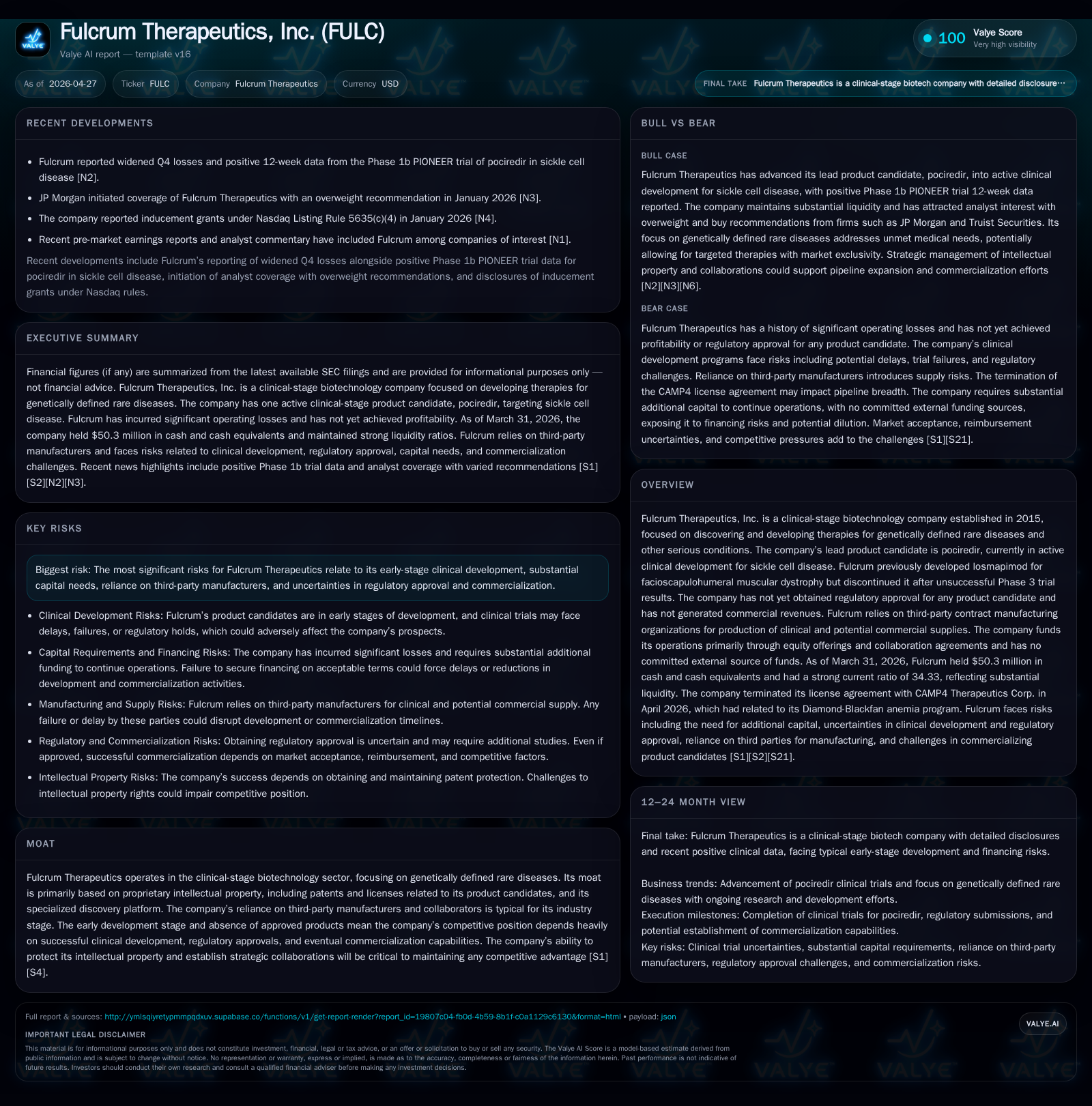
In its April 2026 quarter filing, Fulcrum Therapeutics announced termination of the CAMP4 license agreement covering a Diamond-Blackfan anemia program, signaling a portfolio pruning to refocus resources on pociredir, its lead candidate for sickle cell disease. This decision reflects adaptive management amid early-stage clinical biotech challenges and resource allocation pressures. The company continues to leverage third-party manufacturing and collaborations in developing genetically defined rare disease therapies but faces ongoing capital needs and regulatory uncertainties. Fulcrum’s healthy balance sheet provides runway for near-term clinical milestones, though commercialization remains a future hurdle.
Latest Quarterly Developments and Strategic Update
Fulcrum Therapeutics’ Q1 2026 10-Q filing revealed a material shift in its strategic portfolio management: the company formally terminated the License Agreement with CAMP4 Therapeutics Corp., effective as per the terms outlined in the original July 2023 contract [S2][S3]. The CAMP4 License had granted Fulcrum worldwide exclusive rights—including sublicensing rights—to develop therapeutic candidates targeting Diamond-Blackfan anemia (DBA), encompassing small molecule compounds and associated patents under CAMP4’s agreement with Children’s Medical Center Corporation.
The termination represents a deliberate refocus by Fulcrum, effectively returning these rights and ending further obligations including potential milestone or royalty payments tied to licensed products [S3]. Notably, Fulcrum had previously made an upfront non-refundable payment to CAMP4 and was positioned to pay up to $70 million combined in development, regulatory, sales milestones alongside royalties. The decision to relinquish this asset underscores an adaptive response to pipeline prioritization challenges faced by early-stage biotechs managing limited resources.
Operationally, this pruning allows Fulcrum to direct scarce capital and management bandwidth towards advancing pociredir—its lead candidate aimed at sickle cell disease—which remains in active clinical development [S2]. There were no indications of immediate adverse impacts on ongoing trials; rather this streamlining affords greater focus amid industry pressures.
Fulcrum’s Clinical-Stage Business Model and Pipeline Focus
Established in 2015, Fulcrum Therapeutics functions as a clinical-stage biotechnology company targeting genetically defined rare diseases—primarily through discovery platforms engineered to identify novel drug targets [S1]. Its revenue model is nascent by design: no commercial products have yet emerged from its pipeline, resulting in zero product revenues. Instead, financing has historically relied on equity offerings and collaboration/licensing agreements.
The lead asset is pociredir, under active clinical evaluation for sickle cell disease—a structural hemoglobinopathy with high unmet medical need [S1]. Previously pursued assets such as losmapimod for facioscapulohumeral muscular dystrophy were discontinued following unsuccessful Phase 3 results, signaling experience with high attrition rates inherent in drug development [S1].
Drug substance production is exclusively outsourced to qualified third-party contract manufacturing organizations (CMOs), consistent with industry norms to minimize fixed capital investment during early phases [S1]. Similarly, discovery efforts leverage extensive IP portfolios stemming from both internal research and licensed technologies. Fulcrum’s moat rests principally on its proprietary IP estate—composition of matter patents and method-of-use claims—as well as a specialized discovery platform tailored for rare genetic conditions [S1][S4].
While this R&D-driven model offers scientific differentiation opportunities, it incurs substantial costs with no immediate commercial return. Consequently, the company’s value proposition hinges chiefly on successful navigation of preclinical hurdles and clinical proof-of-concept validations.
Industry Positioning in Genetically Defined Rare Disease Therapeutics
Fulcrum occupies a highly specialized niche within the broader biotech ecosystem dedicated to rare diseases characterized by distinct genetic etiologies. Such companies confront long developmental cycles often exceeding half a decade from target discovery through regulatory approval [S1].
Competitive positioning leans heavily on securing robust patent protection across major markets versus rivals pursuing overlapping pathways or molecular mechanisms [S1][S9]. The industry sector is typified by intense capital intensity coupled with significant scientific uncertainty; early failures like losmapimod phase 3 setbacks highlight these systemic risks [S1]. Manufacturing reliance on CMOs fosters operational agility but introduces vendor dependencies that can affect scalability and timing consistency.
Regulatory landscapes impose additional layers of complexity: orphan drug designations offer incentives but do not eliminate stringent efficacy/safety proof burdens nor pricing/headwinds post-approval concerning reimbursement challenges [S4][S11]. Moreover, compliance risks extend beyond FDA regulations into global data privacy concerns such as GDPR impacting multinational clinical trial data handling [S12].
Accordingly, market entry barriers are substantial but counterbalanced by limited competition once novel treatments demonstrate efficacy for underserved populations due to high switching costs for patients/providers upon commercial launch.
Growth Drivers: Advancing Pociredir and Expanding Discovery Efforts
Fulcrum’s primary growth lever remains the ongoing clinical development of pociredir for sickle cell disease. Milestones such as IND filings completion, enrollment advances in pivotal studies, interim data readouts, and eventual regulatory submissions will serve as tangible catalysts shaping investor confidence and partnership interest [S2][S1]. Success here establishes a foundational revenue stream enabling incremental launching of additional candidates.
Complementing this is an active preclinical pipeline focused on identifying novel targets within genetically defined rare disorders beyond sickle cell pathology. Exploration of proprietary mechanism-of-action insights via their discovery platform promises potential add-ons that could diversify risk across multiple indications if progress substantively matures [S1][S2].
Further opportunities reside in collaborating with biopharma partners for out-licensing or co-development arrangements building upon internal research outputs. While recent CAMP4 disengagement curtailed one avenue of extension, strategic alternative partnerships remain viable avenues pending strong proof points from core assets.
Constraints on Growth: Capital Needs and Regulatory Hurdles
Foremost constraints center around persistent negative operating income—a characteristic inherited from the research-intensive business phase—with cash burn necessitating repeated financing rounds absent product-generated revenue streams [S1][F1]. The absence of approved drugs compels continued high expenditure across R&D programs including costly late-stage clinical trials often spanning multiple years [S1].
Regulatory pathways entail inherent unpredictability; adverse trial events or failure to meet endpoints can materially derail timelines or trigger costly redesigns [S5][S6]. Manufacturing dependencies represent additional operational risk: any disruption at third-party CMOs could delay material supply impacting study continuity or future commercialization plans [S1]. Global privacy regulations are increasingly onerous requiring sustained investments in compliance infrastructure especially given frequent cross-border data flows related to multinational trials [S12].
Furthermore, intellectual property litigations trailing emerging biotechnology innovations pose episodic threats that might divert resources or limit freedom-to-operate depending on outcomes [S9][S17].
Upcoming Catalysts and Operational Milestones to Monitor
Key near-to-mid term milestones will revolve around publishing interim Phase data from pociredir trials reflecting safety/efficacy signals required to sustain clinical momentum [S2]. Regulatory interactions such as FDA feedback meetings or orphan drug designation updates should be tracked closely for directional cues.
Post-CAMP4 license termination actions should be monitored for any announcements regarding new licensing deals leveraging residual technologies or pipeline components repatriated from CAMP4 agreements [S3].
Updates related to expansion of discovery pipelines or partnerships bringing external validation would also be pertinent indicators of execution capability.
Synopsis of Financial Health from Latest Quarterly Snapshot
As of March 31, 2026, Fulcrum held approximately $50.3 million in cash and equivalents supported by $338.7 million total current assets against only about $9.9 million current liabilities—yielding a remarkably strong current ratio exceeding 34x evidencing robust short-term solvency [F1].
However, operating losses remain material; the company reported net losses upward of $74 million for full-year periods ending prior quarters reflective of heavy R&D spend consistent with stage expectations [F1][S2]. Thus while liquidity supports operational continuity in near term horizons without immediate refinancing needs announced yet, sustained funding sourcing will be vital before product commercialization inflows materialize.
This financial backdrop frames an environment where managerial decisions such as scaling back less prioritized licenses (e.g., CAMP4) act pragmatically toward optimizing runway amid advancing key developmental programs.
This analysis synthesizes latest SEC filings up through April 27, 2026 alongside current financial data to elucidate how Fulcrum Therapeutics is strategically recalibrating its early-stage biotech portfolio toward core assets like pociredir while managing inherent capital constraints common to genetically defined rare disease drug developers. Given the high-risk nature inherent in clinical progressions combined with operational dependencies on third parties and regulatory complexity, forthcoming trial outcomes alongside cash flow dynamics remain critical bellwethers for future trajectory. No investment advice herein is offered; readers should consult professional counsel before acting on any information presented.
Disclaimer: This is research-only, informational analysis and not investment advice. It may include AI-generated interpretation and general industry context. Always verify important details using primary sources.

Comments