
HUYA Inc. Broadens Game-Streaming Ecosystem with Strategic Expansion and Repurchase Initiative
HUYA's latest quarterly update highlights strategic acquisitions and a new share repurchase program aimed at reinforcing its market position and shareholder value amid evolving industry dynamics.
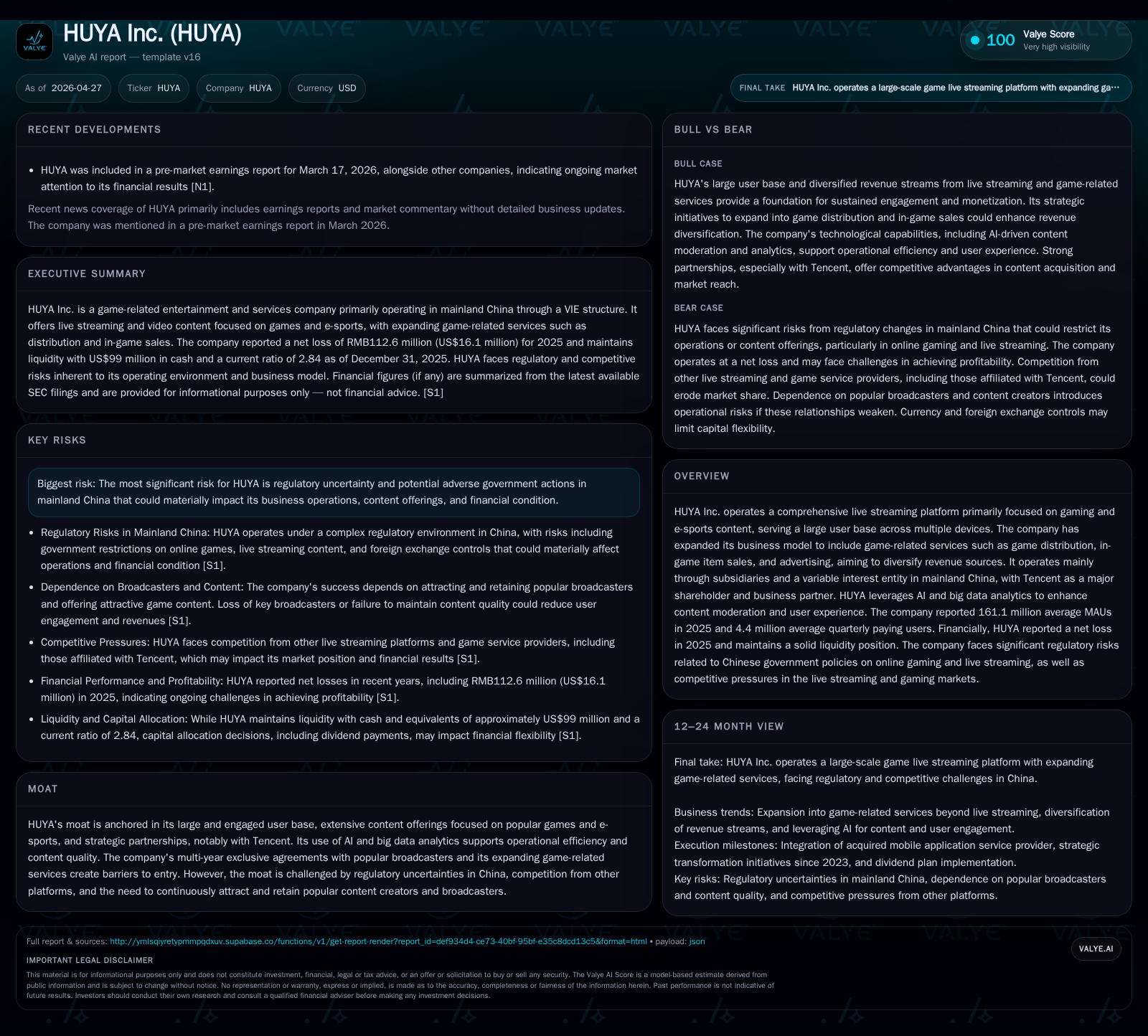
HUYA's 2025 full-year results and early 2026 filings reveal a company actively diversifying through the consolidation of Tencent’s mobile app business and launching a $50 million share repurchase. While live streaming revenue growth remains challenged by macroeconomic headwinds in China, HUYA is expanding its ecosystem with enhanced game-related services and AI-driven content moderation. The firm’s strong liquidity profile supports continued capex and shareholder returns. Regulatory uncertainty in China persists as a key risk factor. Going forward, focus will be on operational execution of expanded offerings, monetization improvements, and regulatory navigation.
Latest Quarterly Developments: Operating Highlights and Capital Moves
HUYA’s most recent filing dated April 27, 2026 ([S2]) confirms strategic priorities manifested over the preceding quarters, centering on integration of acquired assets and capital structure optimization. The December 2023 acquisition of Tencent Holdings Limited’s global mobile application service business—comprising a variable interest entity covering mobile game live streaming—has been fully consolidated retrospectively from Q1 2022 in accordance with ASC 805 ([S1]). This asset integration broadens HUYA’s footprint beyond its flagship domestic Huya Live platform to encompass global mobile platforms, enhancing cross-device user engagement.
In March 2026 ([S3]), HUYA announced a $50 million share repurchase program reflecting management’s intent to stabilize shareholder value against a backdrop of macroeconomic softness in China’s gaming sector. This buyback complements the company’s multi-year $340 million dividend distributions since 2024 ([S5], [S8]). Notably, following this update the company ceased disclosing MAU and paying user data starting in early 2026 ([S1]), transitioning away from headline metrics that have become less representative due to diversified revenue streams coming from game distribution, advertising, and ancillary services.
This evolution signals a deliberate pivot towards evaluating performance through more comprehensive financial measures rather than raw user volume—a shift aligned with the company's expanded service ecosystem.
HUYA's Multifaceted Business Model: Streaming, Game Services, and AI Integration
HUYA generates revenue primarily via live game streaming monetized through the sale of virtual items—consumable gifting items, time-based privileges, bundles—and receives revenue-sharing fees payable to broadcasters or their talent agencies ([S1], [S15], [S20]). Live streaming accounted for approximately 70% of total net revenues in 2025 (RMB4.59 billion / $657 million), down modestly from prior years due to weaker consumer spending sentiment amid the broader economic environment in mainland China ([S1], [S15]).
Complementing the core streaming business are rapidly growing game-related services including game distribution platforms, in-game item sales which surged over tenfold from RMB15.8 million in 2024 to RMB197.9 million ($28.3 million) in 2025 ([S26]), advertising provisions tied to esports content, and other interactive entertainment forms.
Technology underpins HUYA's competitive positioning. AI-powered big data analytics facilitate superior content moderation by recognizing patterns for screening purposes while also enhancing personalized user interfaces through interest profiling ([S1], [S18]). Back-end infrastructure employs hybrid cloud computing coupled with peer-to-peer streaming tech ensuring ultra-low latency video delivery—even over suboptimal networks—delivering high-resolution viewing quality (8-20M pixels Blu-ray level with HDR support) critical for an immersive esports experience.
Such technological integration fosters operational efficiency reducing bandwidth costs (down ~24% YoY) while enabling unique features like virtual streamer innovation driven by AI-generated content creation chains ([S18], [S26]). These advances are central to deepening user engagement despite intensifying competition.
Industry Context: Competitive Live-Streaming and Gaming Ecosystem Dynamics
HUYA operates at the nexus of esports, live streaming media, and gaming industries within China’s heavily regulated digital ecosystem where Tencent maintains significant influence both as a major shareholder (~10%) and content partner ([S1]). Exclusive licensing arrangements with Tencent subsidiaries govern key franchised e-sports broadcast rights such as League of Legends matches; terms have been amended recently to reduce upfront license fees from RMB450 million (initial term) to RMB230 million across 2024-25—a move likely designed to ease HUYA's cost base amidst industry headwinds ([S4], [S23]).
Competition spans multiple domestic platforms specializing in game content delivery; however, HUYA’s moat includes multi-year exclusive broadcaster contracts which create entry barriers for rivals seeking high-profile talent or streamed content rights ([S1], analysis). Content quality reliance on marquee broadcasters makes talent retention vital.
Regulatory scrutiny remains an omnipresent challenge; mainland China's government monitors online gaming licenses tightly while regulations over virtual currencies affect how users transact on HUYA’s platform ([S17]). PRC capital controls also restrict cross-border dividend flows due to VIE (Variable Interest Entity) structural constraints inherent in Chinese gaming-media firm corporate setups limiting cash repatriation flexibility ([S9], [S23]).
Growth Drivers: User Engagement, Broadcaster Partnerships, and Service Diversification
Despite macroeconomic softness depressing spending sentiment resulting in a marginal decline from 4.5 million paying users in 2024 to 4.4 million in 2025 ([S1]), quality improvements such as increased average spending per paying user were noted particularly in H2 2025 evidencing monetization efficiency gains within existing audiences.
Strategic levers fueling growth include expanding exclusive broadcaster partnerships that anchor premium content streams attracting loyal viewers; deeper integration into Tencent’s gaming portfolio yields pipeline synergies for new franchises launching within HUYA's streaming channels ([N1], analysis). Moreover, continuing rollout of innovative game-related offerings — notably dramatic growth in direct sales of virtual items — expands alternative revenue sources less dependent on viewership scale alone ([S26]).
International expansion via global mobile app services acquired from Tencent further diversifies geographic exposure beyond domestic constraints revealing scalability potential across diverse device ecosystems including PC-web interfaces alongside smart TVs previously included under mobile metrics ([S1]).
Challenges Ahead: Regulatory Risks and Market Pressures in China
The dominant risk factor is regulatory uncertainty stemming from evolving Chinese government policies targeting online gaming age limits, real-name identification requirements, anti-addiction systems for minors, as well as restrictions on offshore listings or foreign investment controls impacting access to capital markets ([S17], [S28]). These can materially disrupt licensing agreements, advertising spend levels or operational freedoms affecting live streaming media businesses.
Macroeconomic conditions exhibiting sluggish consumer discretionary spending pose cyclical demand pressures on virtual gifting which accounts for much revenue currently ([S1]). The restrictions embedded within the VIE holding structure impede free flow of dividends outward which constrains corporate financial flexibility despite internal guarantees.["..." See Item "Liquidity..." [S9]]
Competition continues intensifying domestically from both incumbent platforms extending esports coverage plus emerging interactive video formats challenging audience attention.
Forward Look: Key Milestones and Execution Risks to Monitor
Near term indicators essential for tracking progress include quarterly reports clarifying how Tencent acquisition synergies evolve operationally—specifically measuring revenue uplift attributable to integrated mobile app users outside original domestic Huya Live base ([S2], [N1]). Effectiveness of the $50 million share repurchase program announced March 2026 will be important to monitor given market volatility backdrop while sustained adherence to multi-year dividend plans will reflect capital allocation discipline balancing growth investment versus shareholder returns ([S3], [S5]).
Operational shifts away from relying solely on MAU/payership data towards holistic financial KPIs will require close attention on yield per user metrics disclosed going forward within public disclosures providing clarity on monetization strategy efficacy.
Progress deploying AI-driven personalization tools across live broadcasting operations may provide incremental improvements fostering stronger retention especially amid shifting consumer preferences ( [S18]).
Brief Financial Overview: Profitability, Liquidity, and Capital Allocation
Financially HUYA reported a net loss attributable to the group parent of RMB112.6 million ($16.1 million) for full year 2025 marking an increase versus RMB48.0 million loss in prior year reflecting ongoing investment phase plus impairment losses related predominately to select minority investees facing weak performance ([F1], [S12], [S13]). Operating losses narrowed slightly improving operating margin revised up marginally from -3.1% (2024) to -2.5% (2025) driven by better cost control including reductions in bandwidth/server fees alongside streamlined headcount salary expenses ([S14], [F1]).
Liquidity remains solid with cash & cash equivalents approximating $99 million at year-end containing adequate buffers against short-term obligations evidenced by a strong current ratio of approximately 2.84 indicating robust working capital management practices ([F1], [S4]). The company also sustains annual dividend commitments aggregating roughly $31 million planned for mid-2026 payments within an approved three-year dividend plan alongside disciplined capex expenditures totaling approximately RMB188 million ($27 million) invested principally into server infrastructure supporting scalability initiatives.["Capex" see S22]
This balanced approach exhibits prudent capital stewardship aiming not only for long-term sustainable growth but also shareholder value preservation amid industry cyclical fluctuations.
This analysis is based exclusively on publicly filed SEC disclosures up through April 27, 2026; it integrates supported quantitative data points without speculative forward-looking commentary absent explicit company guidance or developments beyond cited filings. It aims solely to elucidate business fundamentals within current market contexts without investment advice or recommendations.
Disclaimer: This is research-only, informational analysis and not investment advice. It may include AI-generated interpretation and general industry context. Always verify important details using primary sources.

Comments