
Domino’s Shifts Gears After Q1 Setback Amid Rising Costs and Franchise Dynamics
Domino’s reported a Q1 earnings miss driven by inflationary pressures and franchisee margin challenges, highlighting the resilience and risks within its franchise-supply chain model.
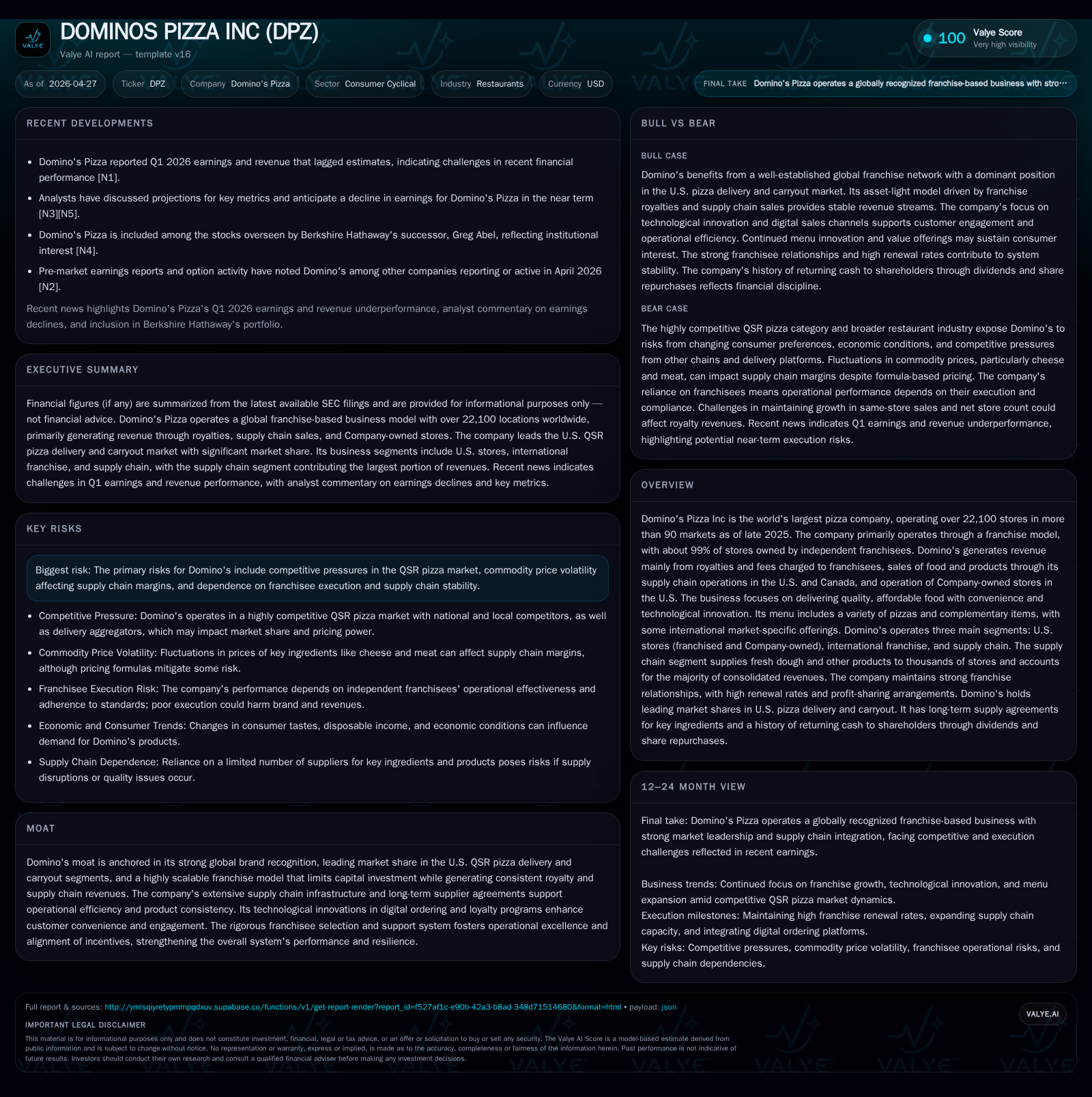
In its latest 10-Q for Q1 2026, Domino’s Pizza Inc revealed results below market expectations due to persistent commodity inflation, labor cost pressures, and operational difficulties faced by franchisees. As a primarily franchised business with vast global reach, Domino’s relies heavily on royalties and supply chain revenues that are sensitive to franchisee profitability and input costs. Despite near-term margin headwinds, the company’s asset-light model, technological leadership in digital ordering, and strong brand equity sustain its competitive moat. Growth is balanced between domestic innovation and international expansion but constrained by ongoing inflation and margin compression risks. Observers should track same-store sales trends, supply chain cost management, and franchisee financial health as key signals for recovery or further pressure.
Q1 2026 Operating Performance: Missed Estimates and Underlying Factors
Domino’s Pizza reported its first-quarter 2026 results on April 27 [S2][S3], revealing an earnings performance that fell short of analyst expectations [N1][N4]. The operating update centered on rising costs across commodities—chiefly cheese—and labor exerting pressure on franchise margins. These headwinds affected the royalty streams since royalties represent a fixed percentage of store sales. Furthermore, supply chain disruptions added complexity for franchisees managing inventory and timely deliveries.
Fundamentals of Domino’s Franchise-Centric Business Model
At the core of Domino’s operating engine lies its asset-light franchising model: approximately 99% of Domino’s over 22,100 locations worldwide are owned by independent franchisees [S1][S25]. The company generates revenue primarily from royalties—ongoing percentages tied to retail sales volumes—and fees charged under franchise agreements. This structure allows Domino's to benefit from scale without bearing heavy capital expenditures associated with physical store ownership.
Additional revenue derives from selling proprietary food products through its robust supply chain operations in the U.S. and Canada, alongside revenues from a smaller number of company-owned stores domestically. Franchisees conduct local operations including employment decisions, pricing strategies within corporate guidelines, and day-to-day store management; their success directly influences Domino's royalty income streams [S27].
This system aligns incentives: franchised stores gain operational autonomy while leveraging the Domino's brand strength and operational systems like DOM OS to optimize service delivery. The company's role also includes setting tech infrastructure standards, supply chain logistics coordination, marketing support, quality control protocols, and territorial development via international master franchises.
Supply Chain Infrastructure and Its Role in Operational Consistency
Domino’s vertical integration in food sourcing is a distinctive operational advantage [S6]. It owns and operates 22 regional dough manufacturing centers plus multiple processing facilities across North America which deliver fresh dough along with other ingredients to thousands of stores—including most Canadian franchise outlets.
This control enables uniform product quality across geographies while capturing margins from supplying ingredients to franchisees. However, recent inflation in commodity prices—especially dairy-based inputs like cheese—creates a dual-edged sword. While higher input prices increase supply chain revenue per unit sold, they compress margins both at supply chain level for Domino's and enterprise-wide when combined with labor cost increases [S1]. This limits the pass-through potential without eroding customer demand or franchised stores' viability.
The operating footprint includes leasing a substantial tractor-trailer fleet to ensure consistent delivery schedules amid logistical challenges highlighted in recent quarters. Investments continue toward enhancing productivity and capacity though immediate cost pressures remain burdensome [S6].
Competitive Positioning within the U.S. and Global Pizza Quick Service Market
Domino's maintains leading positions domestically as the largest pizza delivery player covering majority U.S. households via over 7,800 U.S.-based stores supplemented by significant carryout market share [S1]. Internationally it spans more than 90 markets leveraging master franchise arrangements fostering regional expertise.
Competition increasingly comes from diverse fronts: other major QSR pizza chains vying for share with broader menu offerings, aggressive promotions by third-party delivery aggregators capturing order flows outside direct app channels [S5]. Yet Domino's experience deploying innovative omnichannel digital ordering systems (over 85% of U.S. retail sales originating digitally last reported year) fortifies its direct customer interface.
Its recognized brand stature built over decades alongside consistent unit-level economics supports continued new store growth both domestically (via fortressing strategies increasing density) and abroad through territorial master franchises overseeing subfranchising networks [S21]. Nonetheless, persistent cost inflation strains both competitive pricing flexibility for franchisees and rebound velocity in consumer traffic post-pandemic disruptions.
Key Growth Drivers Balanced Against Inflationary Pressures and Competitive Risks
Long-term growth pillars reside in expanding digital ordering penetration through continuous platform enhancements alongside menu innovation tailored to diverse consumer preferences globally [S21]. Marketing initiatives focused on loyalty programs such as Domino's Rewards strengthen customer retention metrics while ‘fortressing’ — densifying existing markets — aims at logistical efficiency gains enhancing delivery speed.
International expansion efforts rely on cultivating experienced master franchise partners empowered to scale territories with local market knowledge under ten-year renewable agreements featuring growth clauses [S17]. Such exposures offer upside but entail geopolitical/regulatory complexities varying by country.
Conversely, visible constraints stem from ongoing inflationary environments driving labor wages higher, escalating utility/insurance expenses alongside volatile raw material prices fundamental to pizza production economics (cheese prices notably impactful). Franchisee financial health under these dynamics is critical because their net store performance governs royalty inflows; weaker unit economics risk slowing new openings or pushing refranchising activity lower [S1][N11] (recent promotional discounts indicate competitive response).
Sector competition reinforces this dynamic; alternative QSR concepts increasingly encroach upon share while evolving consumer dietary trends may limit market elasticity; however Domino’s core value proposition centered on affordability plus convenience remains resilient amid economic fluctuations.
What Investors Should Monitor Next: Guidance, Execution Metrics, and Demand Signals
Upcoming company disclosures post-Q2 filings should clarify updated guidance reflecting inflation trajectory impact on margins coupled with potential offsetting actions (price adjustments or cost efficiencies). Same-store sales data supplied by franchisees will be vital indicators of consumer demand recovery or sustained softness.
Supply chain cost trends will require close attention—tracking commodity index movements affecting product purchasing costs plus any pipeline efficiency improvements announced by management [N7]. Initiatives aimed at enhancing franchisee profitability such as incentive realignments or technology investments promise mitigants but require execution validation.
Market observers should also monitor any shifts in dividend policy or share repurchase programs as signals of capital allocation confidence amid macroeconomic headwinds [S7]. Competitive innovations from peers or emerging aggregators’ fee structures remain additional external risk variables shaping the operational landscape.
Summary Insights with Financial Snapshot from Latest Quarter
At March quarter-end (2026-03-22), Domino’s held $233 million in cash equivalents versus total debt nearing $4.9 billion resulting in net debt around $4.64 billion—reflecting continued leverage utilization consistent with prior years [F1]. The company maintains a healthy current ratio of approximately 1.6x supported by nearly $949 million current assets against $592 million current liabilities [F1].
Although liquidity coverage appears adequate for near-term obligations including scheduled quarterly interest/principal payments under multiple note series backed by securitized royalty income streams [S4], high gross leverage underscores sensitivity to earnings variability driven by retail sales fluctuations at franchised units.
Revenue composition continues skewed toward royalties from franchise operations augmented significantly by supply chain food product sales domestically—a segment representing more than half total consolidated revenues—underlining dual dependency on volume growth plus margin management amidst inflationary pressures [S6][F1].
In conclusion, while Q1 results introduce caution flags tied to cost inflation impacts on its integrated ecosystem spanning franchising through supply-chain provisioning; Domino’s entrenched market leadership position backed by technology-enabled customer engagement maintains structural resilience amid evolving industry challenges.
This analysis is based strictly on disclosed SEC filings dated April 27th 2026 [S1][S2][S3] supplemented by recent news reports [N1][N4] without offering investment advice. It reflects domain-focused interpretation blending quantitative results with strategic business model considerations.
Disclaimer: This is research-only, informational analysis and not investment advice. It may include AI-generated interpretation and general industry context. Always verify important details using primary sources.

Comments