
Sila Realty Trust Enters Merger Phase with Strong Healthcare Portfolio
The recent merger agreement signals a pivotal juncture for Sila Realty Trust, reshaping its healthcare real estate investment strategy and growth prospects.
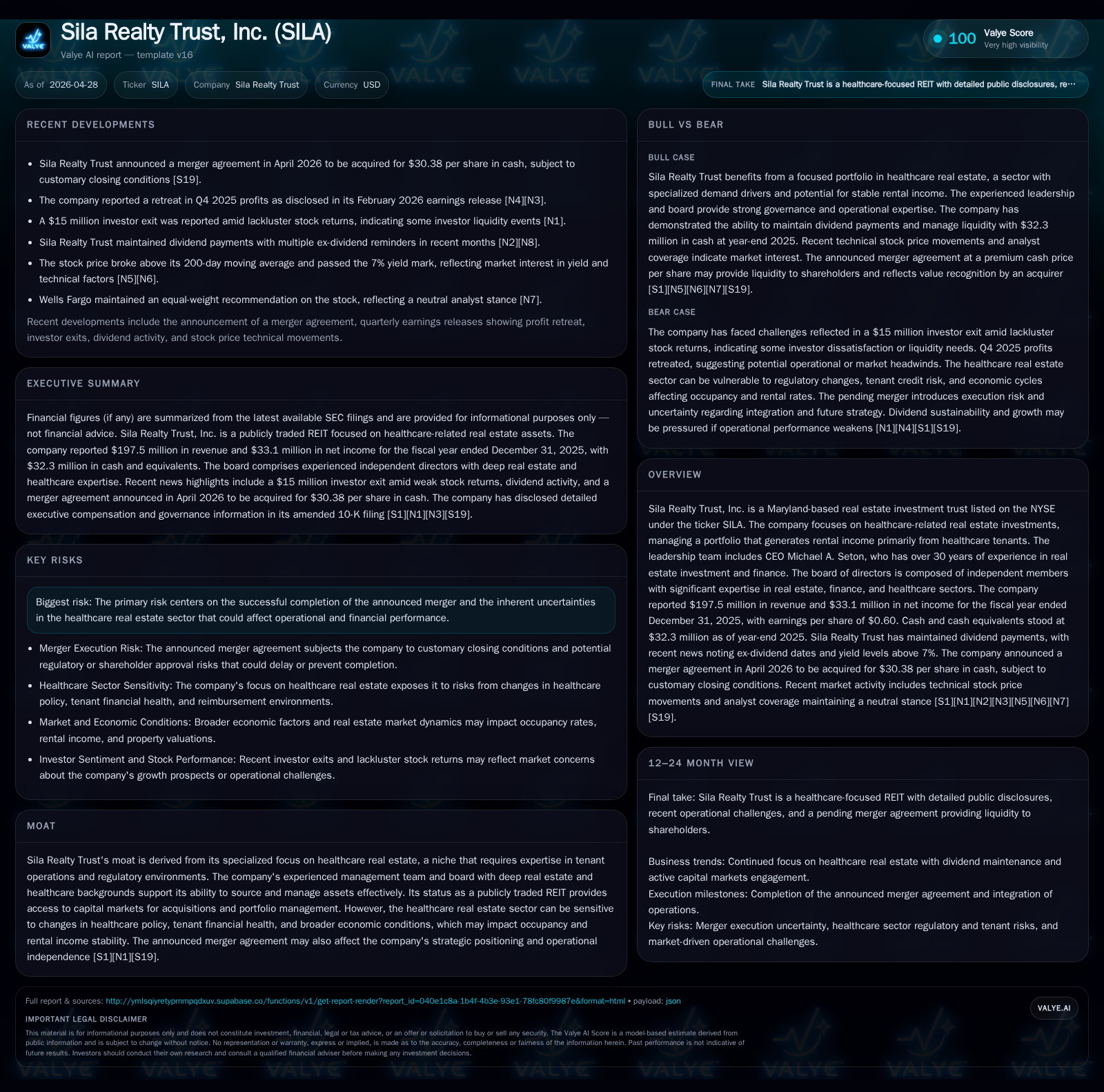
In April 2026, Sila Realty Trust entered into a definitive merger agreement with Sunshine Ultimate Parent LLC that will transform its ownership structure by early 2027. This deal comes atop a solid foundation of specialized healthcare real estate assets that generate recurring rental income from creditworthy tenants in a sector requiring regulatory expertise. Although the merger introduces execution risks and potential operational disruptions, it offers opportunities for capital deployment and scale in a niche REIT segment benefiting from demographic trends. Stakeholders will focus on shareholder approval milestones, merger closing conditions, and how the healthcare real estate specialization maintains resiliency amid economic cycles.
Latest Operating Developments: Merger Agreement and Immediate Implications
On April 19, 2026, Sila Realty Trust entered into a definitive Agreement and Plan of Merger with Sunshine Ultimate Parent LLC and its subsidiaries [S3][S6]. Under the terms of the agreement, Sila will merge into a wholly owned subsidiary of Sunshine Holding REIT LLC, effectively ceasing to exist as an independent publicly traded entity upon closing. Shareholders will receive $30.38 per common share in cash.
Key conditions include obtaining the Required Company Stockholder Approval (majority vote) and no permanent injunctions preventing the transaction [S3]. The deal features an Outside Date of January 19, 2027, after which either party can terminate if closing has not occurred. Termination rights are standard but include penalties such as reverse termination fees payable by the Parent if they fail to close after conditions are met.
During the pendency of this merger, dividend payments by Sila will be limited to two regular dividends consistent with past practices capped at $0.40 per share per quarter [S23][S25]. The company’s common stock will be delisted from the NYSE once the transaction is complete.
This merger agreement marks a strategic inflection point: it places execution risk front and center given the multiple contingencies involved—including stockholder approval and legal/regulatory clearances—but also signals an effort to leverage scale in specialized healthcare real estate investing.
Business Model Deep Dive: Healthcare Real Estate Focus and Tenant Dynamics
Sila Realty Trust’s business model centers on owning and leasing healthcare-related properties—such as medical office buildings—to tenants operating within heavily regulated sectors [S1]. The company generates revenue primarily through contractual rental income owed by healthcare operators who rely on these facilities for ongoing patient care delivery.
This specialization is not just about property ownership; it requires nuanced industry expertise because healthcare tenants face unique operational risks linked to regulatory compliance, reimbursement environments, and shifting care delivery models. Sila’s management team has over three decades of combined experience navigating these complexities [S1], enabling efficient asset sourcing and tenant relationship management.
The lease structures typically involve long-term agreements often with built-in escalations that preserve stable recurring revenues. Tenants’ creditworthiness is generally high given their essential service nature but remains sensitive to healthcare policy impacts—making due diligence crucial. This tight nexus between real estate operations and healthcare trends differentiates Sila from generalist commercial REITs.
Industry Context: Competitive Positioning within Specialty REITs
Within the REIT universe, SILA’s focus on healthcare real estate situates it within a specialty niche characterized by higher barriers to entry due to regulatory complexity [S1]. Unlike diversified office or retail REITs vulnerable to broader commercial cycles or tenant volatility, SILA benefits from relatively stable demand driven by enduring demographic trends such as population aging.
Pricing power arises because healthcare providers require compliant facilities tailored to specific operational needs—limiting direct substitutes and enhancing rent resilience. Additionally, as a listed entity on NYSE until merger completion, SILA accesses public capital markets facilitating acquisition financing and portfolio optimization.
However, this specialization also entails exposure to sector-specific risks like changes in Medicare reimbursement policies or tighter regulations potentially impairing tenant financial health or occupancy rates [N1][S1]. SILA’s competitive moat hinges on combining industry knowledge with market positioning in attractive geographies.
Growth Drivers: Capital Access, Tenant Quality, and Sector Tailwinds
Post-merger, SILA’s growth prospects hinge substantially on the ability to deploy incremental capital raised through new ownership structures toward acquiring complementary healthcare properties [S3]. Enhanced scale could improve bargaining power over suppliers or service providers within the ecosystem.
Tenant quality remains central—selecting creditworthy medical operators ensures consistent rent collections amid evolving healthcare delivery landscapes. Increasing lease renewal rates with escalations supportive of inflation further underpin cash flow growth potential reported in recent quarterly commentary [S2].
Macro tailwinds include aging populations globally driving rising demand for outpatient care facilities which are typically leased by Sila’s tenant base. This demographic stimulus creates structural demand supporting long-term occupancy stability and property valuations [N1].
Constraints and Risks: Regulatory Sensitivities and Merger Execution Challenges
The foremost constraint confronting Sila is successful closing of the announced merger under specified terms before the January 19, 2027 Outside Date [S3][S28]. Delays or failure may trigger termination fees but also create uncertainty affecting stakeholder confidence.
Additional risks accrue from possible litigation related to merger approval or shareholder disputes [S8]. Tenant reaction to ownership transitions presents operational risk through potential disruptions or retention challenges.
Regulatory shifts impacting healthcare reimbursement or facility licensing can directly affect tenant solvency—given tenants pay rent out of operating revenues—and hence influence rental income stability. Broader macroeconomic factors like rising interest rates could increase borrowing costs for acquisitions or refinancing efforts given SILA’s notable leverage profile [F1].
Forward Look: Key Milestones, Shareholder Decisions, and Market Signals
Stakeholders should closely monitor forthcoming filings such as proxy statements detailing full merger terms expected post-material definitive agreement filing [S13]. A special meeting for stockholder approval will precede closing targeted no later than January 19, 2027.
Subsequent quarterly results reports will be critical in assessing whether core operating metrics such as occupancy rates or lease renewals remain stable throughout transition phases (latest baseline available from November 2025 quarter) [S2]. Investors should also watch for any Superior Proposal disclosures that might upend current transaction plans.
Clear market signals will come via voting turnout figures and any litigation announcements affecting timing or deal viability. The company intends to maintain dividend payments at rates consistent with past practice during this period—a focal point for income-seeking shareholders [S25].
Financial Backdrop: Balance Sheet Strength and Dividend Profile
As of December 31, 2025, Sila Realty Trust reported approximately $32.3 million in cash equivalents versus total debt near $676 million; net debt approximates $644 million reflecting typical capital structure leverage levels common among specialty REITs [F1].
Liquidity appears adequate for ongoing operations plus servicing debt maturities near term but will likely depend on transaction financing post-merger closure combined with prudent capital management going forward [S2][F1].
This analysis reflects information publicly available through SEC filings up to April 28, 2026. It aims solely at understanding Sila Realty Trust's evolving business context following its recent merger announcement without providing investment advice or price opinions. Readers should consider consulting additional sources before forming judgments regarding strategy or financial positions related to this company.
Disclaimer: This is research-only, informational analysis and not investment advice. It may include AI-generated interpretation and general industry context. Always verify important details using primary sources.

Comments