
Brown & Brown Expands Specialty Distribution via Strategic Acquisitions in Q1 2026
A flurry of acquisitions and segment restructuring in early 2026 broaden Brown & Brown's specialty insurance footprint and drive revenue diversification within a competitive regulatory landscape.
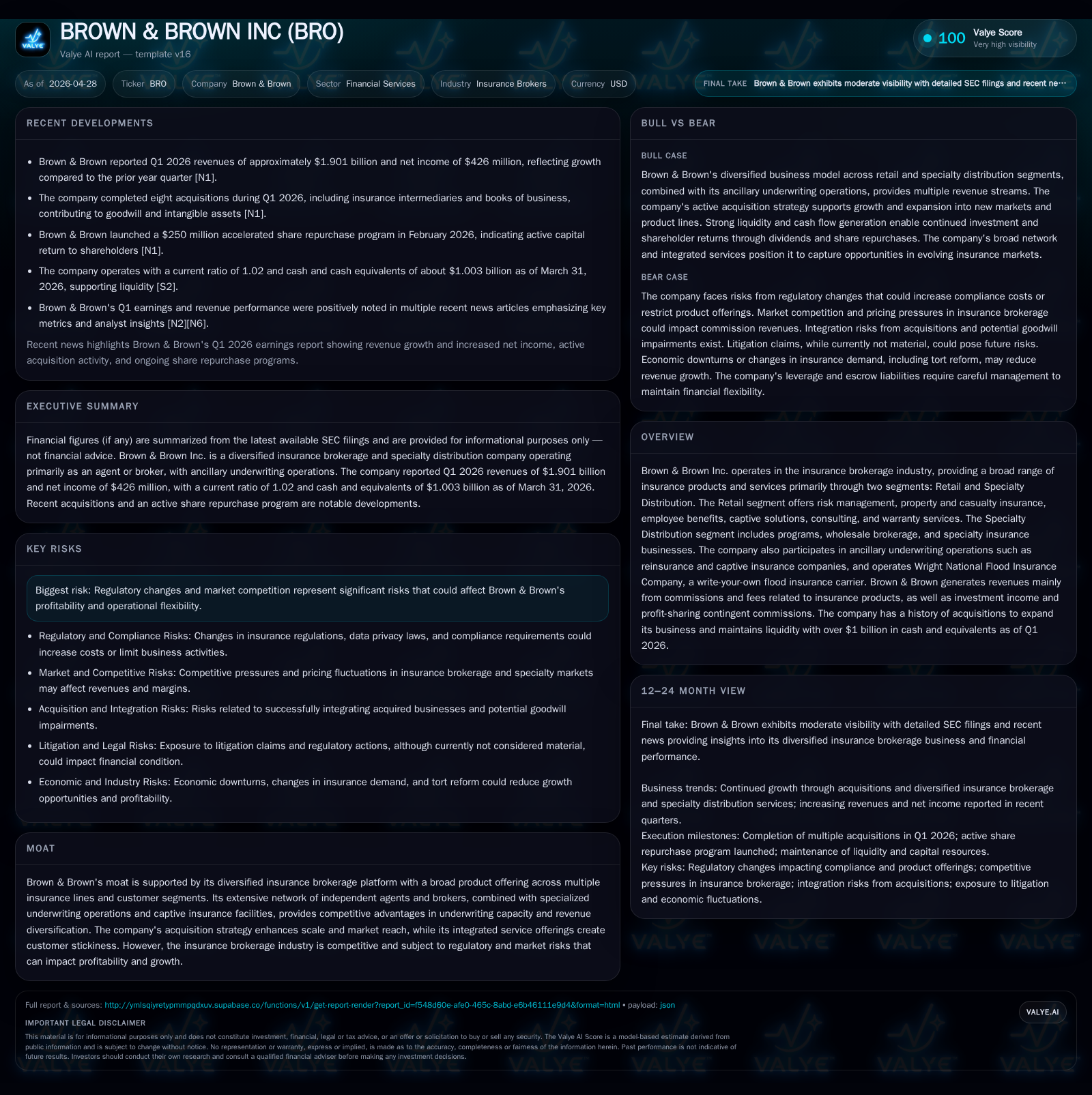
In Q1 2026, Brown & Brown executed eight acquisitions, including five insurance intermediaries and two books of business, enhancing its Specialty Distribution segment formed from a recent consolidation. This acquisition-led expansion diversifies the company's revenue streams and strengthens its market position amid evolving regulatory pressures that could raise compliance costs. The dual-segment model—Retail and Specialty Distribution—offers a broad insurance product range with anchoring revenue from commissions and fees, supplemented by captive underwriting capabilities. Growth hinges on continued tuck-in acquisitions, cross-selling synergy realization, and navigating increased regulatory scrutiny affecting pricing and compensation structures. Financially, the company maintains solid liquidity with $1 billion in cash equivalents and manageable leverage with total debt around $7 billion as of year-end 2025.
Q1 2026 Operating Highlights: Acquisition-Led Specialty Segment Growth
Brown & Brown’s latest quarterly filing detailed aggressive acquisition activity during the first quarter of 2026 comprising five insurance intermediaries’ assets along with full stock purchases of an additional intermediary and two separate books of business. These eight discrete transactions cumulatively involved approximately $25 million in consideration split between $18 million cash outlays, earn-out liabilities initially valued at $6 million, and other payables totaling $1 million [S2][S5]. Associated goodwill recognized exceeded $43 million alongside intangible assets near $12 million.
This acquisition spree complements the strategic realignment completed after the August 2025 Accession merger. The once disparate Programs and Wholesale Brokerage segments were merged into a consolidated Specialty Distribution reportable segment to better reflect scaling synergies and coherent management oversight [S2][S7]. Presenting financial results on a comparable basis since this segment reorganization enables clearer visibility into growth dynamics attributable to these specialty operations.
Notably, certain measurement period adjustments were recorded consistent with ASC Topic 805 guidance to refine purchase price allocations for transactions conducted over the past year—a signal that these deals are closely monitored for valuation accuracy [S2][S5]. The immediate outcome is a materially broader specialty product distribution capability extending beyond traditional retail brokerage channels.
Business Model and Product Breadth: The Retail and Specialty Distribution Dual Engines
Brown & Brown’s business remains anchored around two core reportable segments: Retail—which covers risk management consulting, property casualty policies, employee benefits solutions, captive insurance facilities, warranty services—and Specialty Distribution encompassing programmatic insurance offerings, wholesale brokerage operations, and specialist underwriting businesses [S1][F1].
Revenue generation primarily revolves around commissions earned from placing insurance products plus ancillary fees tied to consulting or managed services rendered. The company captures additional income from profit-sharing contingent commissions negotiated with insurers as performance incentives [S1]. This dual revenue stream creates some insulation against pure volume cyclical swings as fee contracts tend to carry longer durations or contractual protections.
A distinctive component of Brown & Brown’s model is participation in captive insurance companies alongside Wright National Flood Insurance Company—the latter functioning as a government write-your-own flood insurer expanding underwriting capacity in a niche but growing risk category [S1]. This ancillary vertical diversifies revenue sources while increasing control over underwriting results.
The range of products provides horizontal integration benefits fostering strong customer retention through end-to-end risk solution sales across commercial clients; this reduces churn risk inherent in pure brokerage relationships largely transacted on price.
Competitive Positioning and Industry Dynamics in Insurance Brokerage
Operating within one of the more fragmented U.S. brokerage landscapes, Brown & Brown offers scale-driven competitive advantages supported by its extensive network of independent agents who preserve localized customer relationships while providing broad access to insurer capacity [S1][N11].
The consolidation trend characterizing this industry is propelled by firms seeking economies of scale to offset pricing pressure driven by intensifying competition among brokers including Arthur J. Gallagher (AJG) and Marsh McLennan (MMC) [N5][N11]. Pricing power in commissions faces structural headwinds due to evolving regulatory constraints on compensation structures which could erode margins if not offset by operational efficiencies or higher-value advisory fees.
Customer switching costs remain moderate given relatively low barriers for insurers but higher for commercial clients demanding multi-line policies where bundled service complexity acts as friction against vendor changes. Technological investments designed to streamline policy administration and compliance deliver further differentiation amidst rising demands from carriers.
Regulatory oversight is intensifying especially concerning data privacy laws, compensation disclosures, anti-kickback statutes affecting broker remuneration models, thus introducing potential margin compression or strategic shifts needed for compliance [S18].
Growth Levers and Regulatory Constraints: Navigating Compliance Costs and Market Reach
The primary growth vector observed is inorganic via tuck-in acquisitions that supplement both geographic footprint and specialty product arrays [S2][N11]. Cross-segment integration following the formation of Specialty Distribution presents cross-selling opportunities supporting organic expansion beyond acquisition-derived injection.
Expansion also targets specialty programs which often involve niche underwriting expertise or market segments underserved by large mainstream carriers—these programs may command superior pricing latitude given bespoke risk profiles [S2][N11]. Investments into technology supporting compliance processes respond to regulatory cost inflation risks but also enhance service delivery capabilities thereby driving client satisfaction.
Conversely, anticipated regulatory changes could constrain growth through tighter controls on remuneration models impacting commission structures; limitations on permissible products or service delivery methodologies; augmented reporting burdens; heightened cyber-risk exposure from data management requirements—all imposing incremental cost layers yet to be fully absorbed within current profitability frameworks [S18].
Hence Brown & Brown must balance aggressive growth initiatives while evolving internal compliance infrastructure—a tradeoff common across top-tier brokers amidst uncertain regulatory trajectories.
What to Watch: Upcoming Earnings Guidance, Acquisition Pipeline, and Regulatory Updates
Investor focus should prioritize forthcoming quarterly disclosures elucidating assimilation progress for recent acquisitions including synergistic cost savings or revenue uplift metrics. Fee revenue trajectory within Specialty versus Retail segments will inform sustainable margin quality post consolidation moves [S3][N13].
Transparency around acquisition pipeline breadth—candidate volumes or deal closure pacing—will indicate how consistently management can replenish growth engines during ongoing volatile market conditions. Additionally, monitoring any SEC correspondence or legal notices regarding litigation or regulatory proceedings remains essential given industry sensitivities [S18].
Changes to compensation practices or new state/federal regulations could materially sway operating levers requiring real-time adjustment strategies shared during earnings calls or corporate updates [N13].
Financial Snapshot: Balance Sheet Strength and Capital Deployment
At March 31, 2026, Brown & Brown held cash and cash equivalents approximating $1.0 billion supported by current assets near $8.46 billion versus current liabilities about $8.32 billion yielding a current ratio slightly above 1.0—reflective of stable near-term liquidity available for working capital needs [F1][S2].
Total debt recorded at year-end 2025 rests close to $7 billion with net debt after adjusting for cash balances around $6 billion indicating moderate leverage aligned with industry norms [F1]. Capital deployment during Q1 included approximately $25 million directed towards acquisitions mainly funded via cash reserves combined with earnout liability recognition consistent with ASC accounting standards [S2][S5].
No material adverse impacts from outstanding litigation or regulatory contingencies were noted in filings underscoring manageable risk profile amid an intricate operating environment [S18]. Continued stable operating cash flow generation supports flexibility in balancing organic growth investment against further external expansion opportunities.
Disclaimer: This analysis is based solely on publicly available SEC filings as of April 27, 2026 ([S2], [S3], [S1]) along with supplemental Nasdaq news coverage () without incorporating any non-public information or forecasts. It does not constitute investment advice or recommendations.
Disclaimer: This is research-only, informational analysis and not investment advice. It may include AI-generated interpretation and general industry context. Always verify important details using primary sources.

Comments