
PLDT Inc. Strengthens Network Investment to Sustain Competitive Edge in Philippine Telecom
PLDT's latest quarterly disclosures reveal a leadership transition alongside sustained capital expenditures focused on 5G and fiber expansion amidst currency and liquidity challenges.
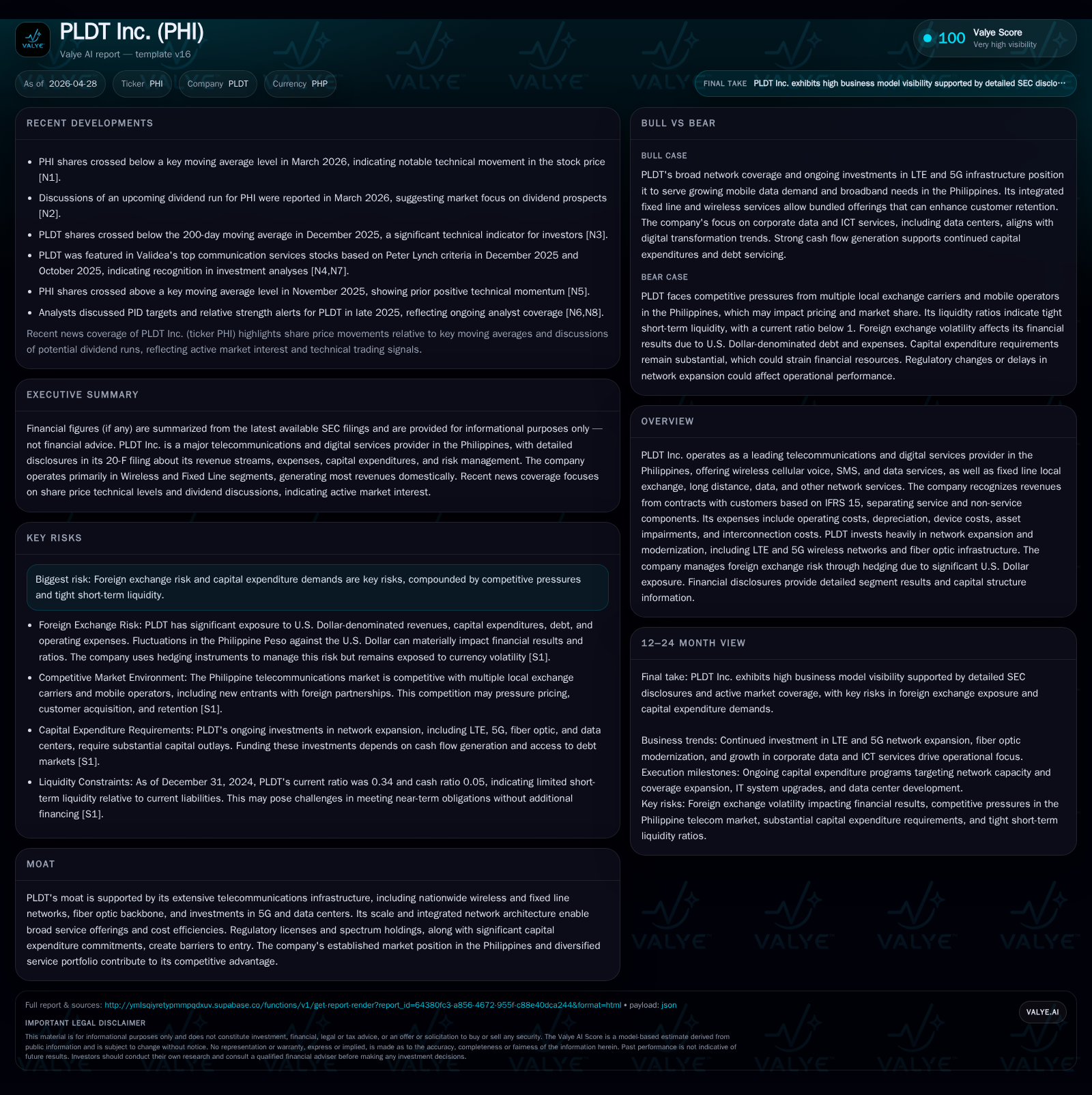
In its April 2026 interim filing, PLDT announced the separation of a senior officer, signaling possible shifts in governance or operational focus. The company continues to pursue aggressive investments in 5G wireless and fiber optic networks to maintain its dominant position in the competitive Philippine telecommunications market. Regulatory licenses, extensive infrastructure, and spectrum holdings reinforce its moat, though the business remains exposed to Philippine peso volatility against the U.S. dollar and capital intensity pressures. Monitoring subscriber growth, network rollout progress, and regulatory developments will be key to assessing execution and future growth.
Recent Operational Update: Executive Change Implications and Current Business Signals
PLDT’s most recent SEC Form 6-K filing dated April 1, 2026 [S2] primarily reports the separation of a senior company officer. While this disclosure does not provide detailed financial updates or operational metrics for Q1 2026, such personnel changes often suggest forthcoming shifts in governance or could reflect strategic recalibrations given the company’s ongoing capital-intensive expansion agenda. The absence of associated financial commentary leaves room for interpretation about near-term priorities but signals management attentiveness around leadership roles pertinent to execution oversight.
PLDT’s Integrated Telecom Business Model and Revenue Structure Under IFRS 15
As laid out in the detailed 20-F annual filing from April 2026 [S1], PLDT operates an integrated telecom business model combining wireless voice/data services with fixed line telephony and network services. Its revenue recognition framework under IFRS 15 distinguishes multiple performance obligations within customer contracts—namely separating devices (handsets/modems) delivered upfront from service components provided over contract durations typically spanning two to three years. This approach reflects bundled offerings where revenue allocation aligns with standalone selling prices of equipment versus ongoing service access.
Further analysis confirms PLDT acts as principal in these contract arrangements by controlling device inventory pre-transfer, bearing inventory risk, and setting pricing discretion for bundled services. Such control establishes strong direct customer relationships that reinforce recurring service revenue stability while capturing margins from equipment sales.
Infrastructure Scale and Regulatory Moat: Competitive Dynamics in the Philippine Market
PLDT’s competitive advantage stems from its extensive telecommunications infrastructure encompassing a nationwide fiber optic backbone coupled with comprehensive wireless and fixed line network coverage across the Philippines [S1]. Its portfolio also includes valuable spectrum licenses critical for expanded LTE/5G capacity deployment. Combined with regulatory licenses serving as barriers to entry, these factors create significant scale economies rare among local competitors.
Despite a crowded marketplace with five local exchange carriers and three major mobile operators present domestically—some aligned strategically with foreign partners offering technology synergies—the company’s entrenched infrastructure investment anchors its market leadership. The integrated network allows diversified product offerings spanning consumer mobile broadband, enterprise ICT solutions, and wholesale international gateway services.
Capital Intensive Investments in 5G, Fiber Optics, and Digital Services
PLDT’s capital expenditure strategy prioritizes modernizing existing infrastructure while expanding capacity via continuous LTE/5G rollout expansions—from active cell sites to densification projects—and scaling fiber optic networks into underserved regions [S1][S8]. Data center enhancements complement these efforts to support growing corporate digital services demand.
Funding for these investments is sourced from robust operating cash flows complemented by targeted long- and short-term debt availments—as evidenced by proceeds exceeding Php36 billion long-term debt drawn in 2025—and proceeds from strategic asset monetizations such as sale-and-leaseback transactions involving telecom towers [S4][S13]. However, this scale results in ongoing capex demands exceeding Php60 billion annually which require diligent capital allocation amid competing liquidity needs.
Key Growth Drivers: Technology Adoption, Customer Experience, and Market Penetration
Demand fundamentals supporting PLDT’s expansion include accelerating digital adoption trends within the Philippines’ rapidly growing mobile broadband user base [S1]. Increased consumption of data-intensive applications—streaming media, cloud computing—fuels usage growth underpinning revenue upside potential.
Superior network coverage enabled by continued investment in higher-capacity fiber optics and wider-reaching 5G networks provides tangible differentiation driving customer retention rates and ARPU uplift opportunities. Simultaneously, innovative bundled product offerings combining fixed broadband with wireless services create switching costs beneficial for long-term contract adherence.
Spectrum bandwidth portfolio expansion plays a pivotal role allowing technically advanced offerings such as ultra-wideband 5G which supports enterprise connectivity solutions beyond traditional residential markets.
Constraints on Growth: Currency Volatility, Capex Demands, and Competitive Pressures
Liquidity constraints surface as a limiting factor where PLDT’s reported current ratio stood at a tight 0.34 at December 2024 year-end due mainly to sizable current liabilities—comprising trade payables plus short-term portions of debt—and relatively limited current assets including cash reserves around Php10 billion [F1]. This ratio indicates elevated working capital pressures requiring careful cash flow management to avoid impairments on operational flexibility.
Additionally, competition intensifies as rival operators forge partnerships with global telecom technology providers providing both capital infusion capability and access to cutting-edge service innovations challenging market share retention for incumbent players like PLDT [S1].
Next Milestones to Monitor: Subscriber Trends, Network Performance, and Regulatory Developments
Future operating results will be shaped by the trajectory of subscriber additions particularly within wireless broadband segments essential for volume-driven service revenue gains [S2][S1]. Metrics such as average speed improvements in 5G footprints alongside geographic fiber penetration rates will indicate success in broadening network quality capabilities fundamental to premium product positioning.
Regulatory developments remain salient especially any amendments impacting spectrum cost structures or mandated service price controls that could constrain margins or cap growth initiatives. Monitoring quarterly management commentary via subsequent SEC filings will provide insights into evolving strategic responses.
Financial Snapshot: Liquidity Position, Capital Structure, and FX Hedging Strategy
While recent filings lack explicit quarter-end balance sheet updates for Q1 2026 beyond executive disclosures [S2], prior year-end data from December 31, 2024 highlights a leveraged yet investment-grade credit profile supported by Moody’s Baa2/stable outlook rating status reflecting confidence in debt servicing capability [S18][F1].
Cash plus equivalents totalled approximately Php10 billion against current liabilities nearing Php188 billion results in low short-term liquidity buffers; however operating cash flows near Php99 billion support substantial investment activity financing without immediate structural distress [F1][S4][S11]. A combination of internally generated funds plus opportunistic debt issuances alongside strategic asset sales underpin capex funding plans sufficient for ongoing fiber and wireless buildouts.
This analysis synthesizes publicly available SEC filings and factual data without offering investment recommendations or forecasts. Findings are grounded strictly on disclosed information as of April 2026; readers should consider market dynamics changes thereafter when forming independent views.
Disclaimer: This is research-only, informational analysis and not investment advice. It may include AI-generated interpretation and general industry context. Always verify important details using primary sources.

Comments