
SunOpta's Path to Integration Following Acquisition Approval
Following shareholder approval of its acquisition, SunOpta shifts focus to integration amid tariff-related cost pressures and supply chain nuances.
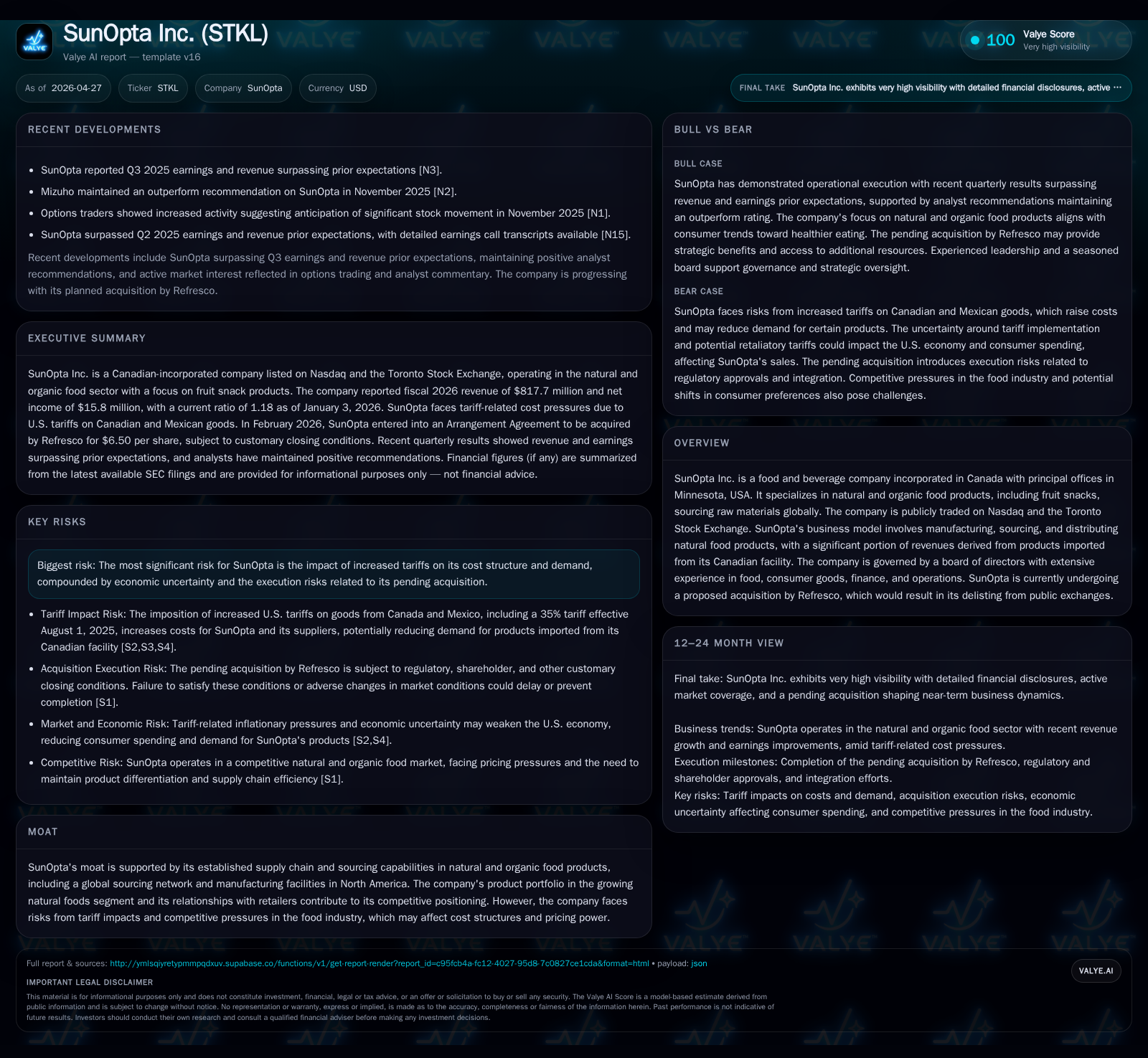
In April 2026, SunOpta secured shareholder approval for its acquisition by Refresco, marking a pivotal shift toward integration and cessation of independent reporting. The company’s natural and organic food product business operates through global sourcing and manufacturing primarily in North America, with a notable Canadian facility whose outputs face escalating U.S. tariffs. These tariffs increase landed costs and pressure margins, compounding the challenges of integration execution amid competitive retail environments. Looking ahead, milestones include closing conditions under antitrust review, regulatory approvals, and the transition off public exchanges, all occurring in the context of sustained tariff exposure and supply chain dependencies.
Acquisition Approval Refocuses Operating Priorities
On April 16, 2026, SunOpta’s shareholders overwhelmingly approved the acquisition arrangement by Refresco, with over 95 million votes in favor versus fewer than 2 million opposed [S3][S25]. This approval sets SunOpta on course to become a wholly owned subsidiary, with plans to delist its shares from both NASDAQ and the Toronto Stock Exchange [S26]. In response, the company suspended quarterly earnings guidance and conference calls to prioritize integration efforts [S26].
This shift realigns management’s near-term focus from independent operational growth toward executing integration while managing tariff-driven cost pressures embedded in the supply chain. Significant closing conditions remain including antitrust clearances under the Hart-Scott-Rodino Act and final regulatory approvals from Canadian courts [S4][S23]. These requirements introduce execution risk that could affect operational continuity during the transition.
Business Model Overview: Natural and Organic Foods Production & Distribution
SunOpta operates primarily in manufacturing natural and organic food products, especially fruit-based snacks sourced globally but heavily reliant on its Niagara, Ontario facility [S1]. The company imports these produced goods into the U.S., leveraging scale advantages across its North American manufacturing footprint. Revenues are largely generated through retailer partnerships distributing health-oriented natural products nationwide.
Value creation centers on vertically integrated sourcing combined with product formulations aligned to consumer trends favoring organic ingredients. However, global sourcing exposes SunOpta to international trade policies while consumer price sensitivity presents challenges within competitive retail markets [S1].
Supply Chain Strengths Amid Tariff-Driven Cost Pressures
SunOpta’s entrenched supply chain is anchored by its Niagara manufacturing plant producing key fruit snack products [S1][S2]. Starting March 2025, U.S. import tariffs on Canadian-origin goods not exempt under USMCA escalated from 25% to 35% by August 2025 [S2][S11][S27]. These tariffs sharply increased landed costs for SunOpta’s imports into the U.S., directly compressing margins through higher input costs.
While global procurement of raw materials and packaging provides some insulation through scale advantages, tariff measures have elevated costs without immediate pass-through ability. Additionally, inflationary pressures may reduce consumer spending on premium natural snacks amid economic uncertainty [S2]. The interplay between global sourcing benefits and tariff exposure remains a critical tension in SunOpta’s cost structure.
Industry Positioning and Retailer Dynamics
Within the fragmented natural and organic foods sector, SunOpta holds a geographically broad sourcing reach supported by North American manufacturing capabilities [S1]. Established retailer relationships facilitate shelf presence in growing health-focused categories.
However, pricing power is limited due to intensifying competition from branded incumbents expanding organic lines alongside private labels focusing on cost leadership [S1]. Tariffs exacerbate margin pressures at a time when consumers may prioritize value due to macroeconomic headwinds. Compensation practices align with market standards but maintaining margins requires ongoing efficiency improvements [S1].
Growth Outlook Amid Market and Regulatory Factors
Demand for natural and organic foods continues growing driven by consumer health trends. SunOpta’s fruit snack portfolio positions it to capture incremental volume gains via retailer penetration [S2][S4]. Selective pricing adjustments may be implemented ahead of acquisition close to partially offset tariff inflation within competitive constraints.
Nonetheless, growth prospects are tightly linked to tariff resolution—still uncertain—and broader economic conditions affecting discretionary consumer spending. The pending acquisition integration introduces execution risks that could distract management or disrupt supply continuity if not carefully managed [S4][S25].
Key Milestones: Integration Timeline and Closing Conditions
Following shareholder approval, remaining steps include obtaining Ontario court approvals, satisfying or waiving waiting periods under the HSR Act for antitrust clearance, minimizing dissenting shareholder appraisal claims (target below 5%), completing customary closing conditions such as representations/warranties accuracy, and securing other regulatory consents [S4][S23][S24]. The closing deadline is currently set for November 6, 2026—with possible extensions—establishing firm timelines for operational transition.
Post-closing, SunOpta will cease public reporting under U.S. and Canadian securities laws as it integrates into Refresco’s consolidated operations [S26]. Changes in reporting cadence and governance will serve as markers of integration progress.
Maintaining uninterrupted supply chain operations remains critical given margin sensitivities tied to tariffs during this transition period.
Financial Snapshot Reflects Moderate Leverage Amid Transition
As of January 3, 2026 (latest available), SunOpta reported approximately $251 million in net debt against cash reserves of approximately $0.17 million USD, resulting in a current ratio near 1.18 [F1]. This indicates moderate leverage that may constrain capital flexibility during integration phases when working capital demands could increase.
Disclaimer: This analysis is based solely on information contained in recent SEC filings and publicly available documents as cited; no investment advice or recommendations are offered herein. Readers should reference official disclosures for comprehensive details.
Disclaimer: This is research-only, informational analysis and not investment advice. It may include AI-generated interpretation and general industry context. Always verify important details using primary sources.

Comments