
Trinseo’s Capital Restructuring Highlights Financial Strains and Strategic Imperatives
Recent interest payment deferrals underline Trinseo's urgent capital restructuring needs amid ongoing financial challenges.
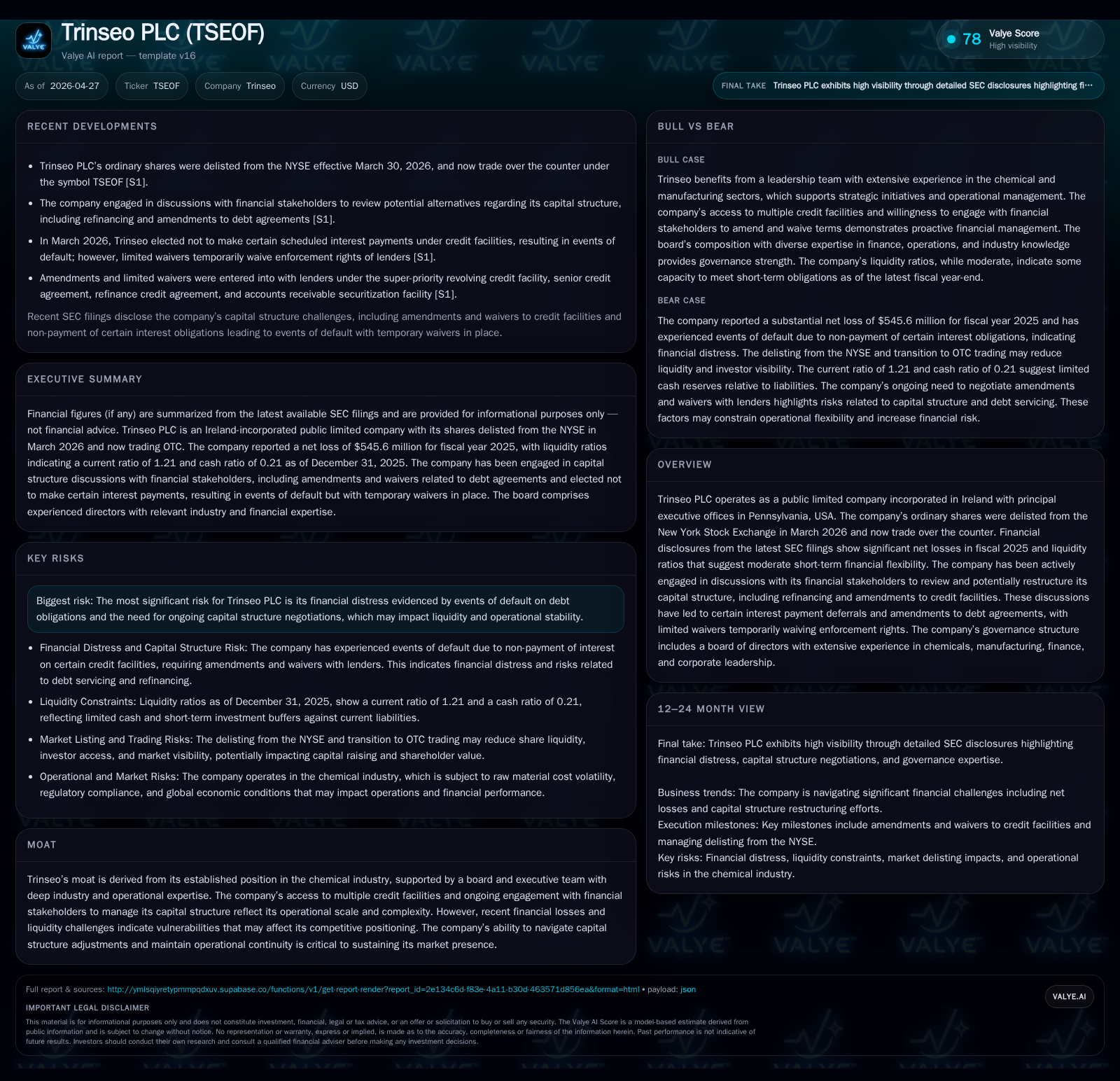
Trinseo PLC recently elected to defer approximately $38 million in scheduled interest payments across its credit facilities, marking a critical juncture in its ongoing capital structure negotiations. The company has secured temporary waivers from lenders to forestall enforcement actions, yet significant uncertainty remains regarding refinancing outcomes. Strategically, Trinseo operates within the specialty chemicals sector, with a product portfolio catering to plastics and synthetic rubber markets that demand consistent quality and innovation. However, financial distress risks constraining operational agility and competitive positioning, necessitating close monitoring of capital negotiations and operational execution.
Recent Event Filing: Interest Payment Deferrals and Capital Structure Dialogue
In its April 15, 2026 Form 8-K filing, Trinseo PLC disclosed a material development where it voluntarily elected not to make certain scheduled interest payments aggregating approximately $38 million under various credit facilities, including a key Credit Agreement dated September 8, 2023 [S3]. This deliberate non-payment followed periods in which contractually available grace periods were utilized. Subsequently, these non-payments precipitated events of default under affected debt agreements once grace periods expired.
To manage immediate default consequences, Trinseo negotiated amendments and limited waivers with lenders that temporarily waive acceleration rights and collateral remedies until April 30, 2026 [S3]. These concessions reflect lender willingness to engage constructively but also highlight significant near-term liquidity pressures. Importantly, there is no assurance that subsequent negotiations will culminate in successful refinancing or restructuring transactions.
This event filing underscores the precarious state of Trinseo's capital structure and frames the immediate strategic challenge: securing a sustainable debt framework while maintaining business operations.
Understanding Trinseo’s Business Model and Core Product Portfolio
Trinseo operates primarily as a manufacturer of differentiated chemicals serving specialty plastics, synthetic rubber (notably styrenic block copolymers), latex binders for coatings and adhesives, and various engineered materials segments [S1]. Revenue generation stems from supplying these high-technical polymer products globally to industrial customers requiring consistent performance standards.
The company's value proposition lies in product quality combined with technical expertise supporting customer applications—critical in sectors such as automotive components, consumer goods packaging, and construction materials. Pricing power exists to an extent through differentiation but remains sensitive to raw material cost fluctuations frequently linked to volatile petrochemical feedstock markets.
Customer retention tends to be supported by switching costs due to qualification processes and technical support services; however, competitive pressures necessitate continued innovation and operational reliability. Product mix evolution toward sustainable or bio-derived polymers could enhance strategic relevance but requires capital investment.
Competitive Positioning within the Global Chemical Industry
Within the specialty chemical space, Trinseo competes against diversified chemical conglomerates as well as pure-play polymer suppliers. The industry is characterized by complex supply chains reliant on global petrochemical feedstock availability and pricing amidst regulatory environments focusing increasingly on environmental compliance.
Pricing power is mitigated by commoditization risks at lower value-added segments, pushing companies toward specialization or cost leadership strategies. Trinseo’s scale confers access to multiple credit facilities reflecting operational complexity but simultaneously exacerbates vulnerability when financial metrics weaken.
Recent financial strains may impair agility in responding to market shifts or investing in capacity expansions necessary for growth. Customers in end-markets like automotive or electronics can be cyclical; thus order flows may fluctuate with macroeconomic conditions further complicating plant utilization management.
Key Growth Catalysts and Potential Operational Constraints
Growth prospects for Trinseo hinge on innovations aligned with sustainability goals—developing polymers with reduced carbon footprints or enhanced recyclability resonates strongly with downstream users increasingly constrained by regulatory mandates [S1]. Additionally, incremental improvements in manufacturing efficiency or supply chain optimization could boost margins despite input cost inflation.
Operationally, the company faces constraints arising from macroeconomic slowdowns attenuating demand across industrial end markets relevant for polymers. Raw material cost volatility exerts pressure on margins since pass-through to customers can be delayed or incomplete.
Crucially, financial obligations related to heavy indebtedness pose a cap on reinvestment capabilities—successful deleveraging or refinancing will be vital to free up resources for growth initiatives. The interplay between sustaining R&D investments while controlling cash flow underlines management’s strategic balancing act.
Monitoring Points: Capital Structure Negotiations and Operational Execution
Investors should closely monitor developments following the expiration of lender waivers at the end of April 2026. Key milestones include successful agreements regarding refinancing terms or consenting amendments that avert forced asset sales or liquidity crises [S3].
Further indicators involve management announcements around cost reduction programs impacting operating leverage and customer retention metrics that attest to stable demand amidst disruption risks. Governance expertise cited in filings suggests capability at navigating restructuring complexities but execution risks remain acute given competing stakeholder interests.
Transparency surrounding potential issuance of new indebtedness or equity dilution attempts will also be critical information points reflecting market receptivity.
Concise Financial Profile: Liquidity, Debt Levels, and Leverage
At December 31, 2025, Trinseo reported cash balances totaling approximately $146.7 million against total outstanding debt near $2.55 billion resulting in net debt roughly $2.4 billion [F1]. Operating income registered a significant loss of $254.2 million with net losses reaching $545.6 million for fiscal 2025 signaling high operational stress alongside financing costs [F1]. Recent interest payment deferrals underscore strained cash flows relative to debt servicing obligations [S3].
Maintaining operating cash flow generation capacity is indispensable for meeting capital expenditure requirements while managing deleveraging efforts.
This analysis incorporates data exclusively sourced from recent SEC filings up to April 27, 2026 ([S1], [S3]) and validated balance sheet metrics ([F1]) per Valye News policy guidelines. It contextualizes Trinseo's current financial stress amid structural industry dynamics without speculative commentary or investment recommendations.
Disclaimer: This is research-only, informational analysis and not investment advice. It may include AI-generated interpretation and general industry context. Always verify important details using primary sources.

Comments