
Capital Clean Energy Carriers Corp. Reports Fourth-Quarter 2025 Results and Strategic Leadership Update
CCEC’s Q4 2025 earnings demonstrate stable revenue visibility from long-term charters amid fleet expansion and board reshuffle.
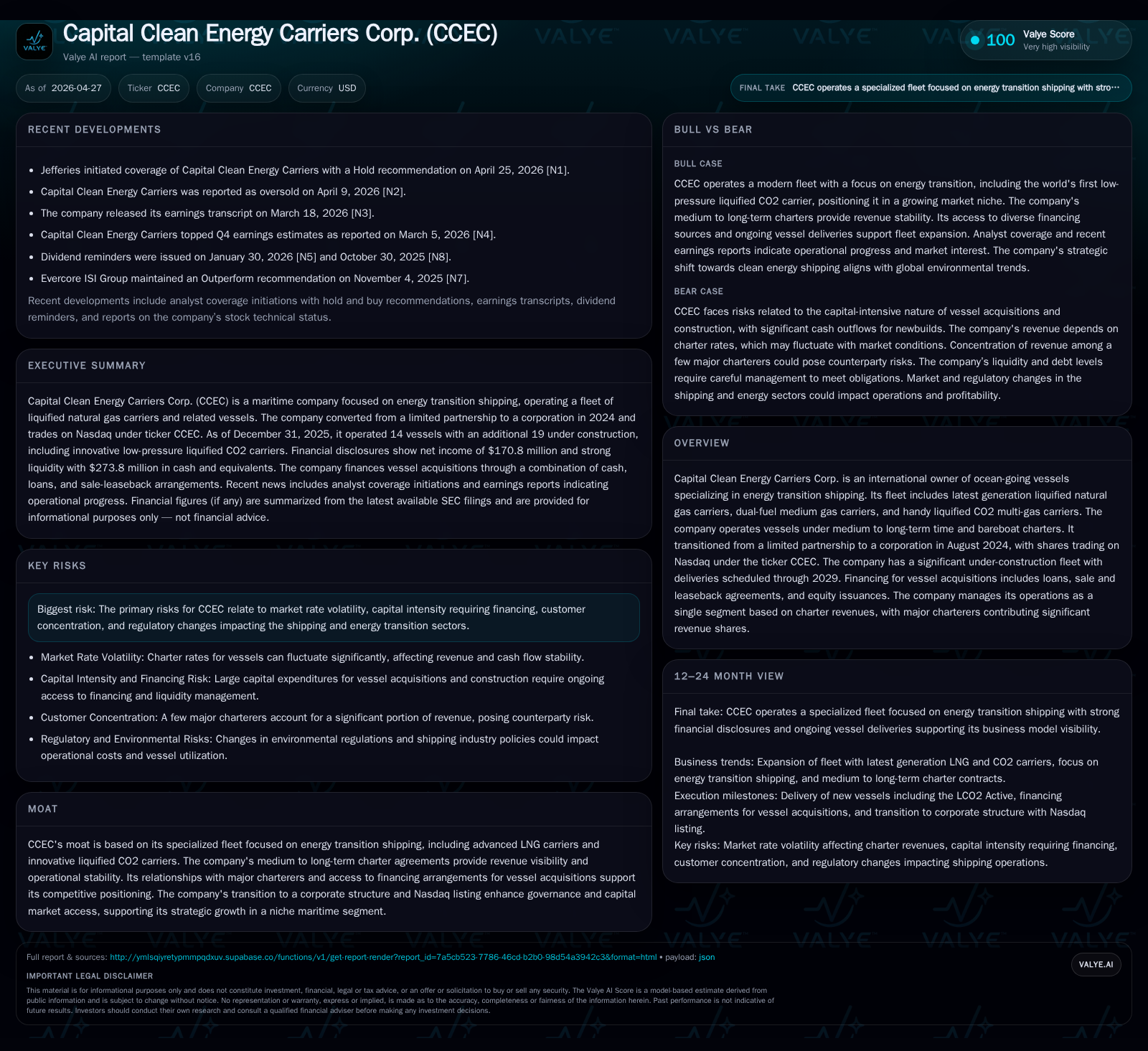
Capital Clean Energy Carriers Corp. (CCEC) released its fourth-quarter 2025 results reflecting firm operational performance supported by medium to long-term charter agreements. The company’s strategic focus on specialized LNG and liquified CO2 vessels remains intact, bolstered by a significant under-construction orderbook extending to 2029. Recent leadership changes with Martin Houston appointed Chairman and Keith Forman transitioning to Vice-Chairman further reinforce governance as CCEC advances its growth in energy transition shipping. Key challenges include capital intensity, customer concentration, and exposure to shipping market cyclicality.
Latest Quarterly Update and Leadership Changes
Capital Clean Energy Carriers Corp. reported its fourth-quarter ended December 31, 2025, financial results via a March 13, 2026 SEC Form 6-K filing [S2]. The quarter reaffirmed company stability driven by its charter-driven revenue model predominantly composed of medium-to-long-term time and bareboat charter agreements. These contracts furnish visibility into cash flows and mitigate spot market volatility risks typical for maritime shipping. Alongside the financial update, CCEC announced a key governance shift: Martin Houston has been appointed Chairman of the Board with Keith Forman transitioning to Vice-Chairman [S2]. This leadership reorganization aligns with the company’s August 2024 conversion from a limited partnership to a corporation listed on Nasdaq under ticker CCEC [S1]. It underscores enhanced governance structures capitalizing on public markets access and corporate oversight amid an evolving business strategy centered on energy transition shipping.
Business Model: Specialized Fleet and Charter Contracts
CCEC’s core business revolves around ownership and operation of ocean-going specialized vessels focused on the energy transition sector [S1]. Its fleet includes state-of-the-art liquefied natural gas carriers (LNG/C), dual-fuel medium gas carriers (MG/C), and handy-sized liquified CO2 multi-gas carriers (LCO2-HMG/C) [S1]. The company's strategy emphasizes deployment of vessels primarily under medium-to-long duration time charters or bareboat charters with blue-chip customers such as BP, Cheniere, BGT, Engie, Hapag-Lloyd, Hartree, Jera, Qatar Energy Trading, Tokyo Gas, and Geogas [S1]. Such contracts reduce exposure to volatile spot freight rates inherent in global shipping markets.
Customer relationships are concentrated but deep-rooted given asset specificity—charterers face high switching costs because vessels cater to niche cargoes requiring advanced design features compliant with stringent safety and environmental standards. This positioning offers CCEC durable pricing power especially as LNG and CO2 transport volumes become more strategic in global energy supply chains transitioning toward lower carbon fuels.
Competitive Environment in Energy Transition Shipping
The maritime shipping sector servicing LNG/C and other energy transition cargoes is capital-intensive with high barriers to entry due to technological complexity and regulatory compliance requirements [S1]. CCEC competes within a specialized cluster that includes large integrated shipping firms with extensive capital backing but also operates in a segment benefiting from growing emphasis on clean energy logistics.
Key competitive factors include fleet modernization aligned with emerging International Maritime Organization (IMO) emissions standards (e.g., IMO 2030/2050 targets), vessel fuel flexibility leveraging dual-fuel designs capable of running on LNG or other cleaner fuels, and securing medium-to-long term charter contracts sustaining cash flow certainty.
The industry experiences rate cyclicality driven by supply/demand imbalances affected by newbuilding deliveries (orderbooks), geopolitical risks influencing energy trade flows, macroeconomic cycles affecting global LNG consumption growth particularly in emerging markets like China and India [S1]. However, CCEC's focus on next-generation vessels positions it favorably against older tonnage vulnerable to obsolescence or non-compliance with tightening emissions regulations.
Growth Catalysts: Fleet Construction and Market Demand
A core growth engine for CCEC lies in its large under-construction fleet scheduled for delivery between Q2 2026 through early 2029 [S1]. The orderbook includes nine new-build latest generation LNG/C vessels complemented by six dual-fuel MG/Cs and three LCO2-HMG/C vessels [S1]. Incremental capacity will expand the company’s market participation in LPG carriage alongside growing exposure to emerging low-carbon cargo segments such as liquified CO2 transport—a niche expected to benefit from industrial decarbonization initiatives globally.
Demand underpinning this supply pipeline remains structurally supported by accelerating energy transition imperatives driving seaborne LNG trade growth due to climate policy shifts favoring natural gas as a bridge fuel [S1]. Moreover, increasing adoption of decarbonization technologies manifests in expanding requirement for transporting low-carbon gases like ammonia or CO2 for sequestration purposes—markets still nascent but indicative of prospective volume uplifts.
Key Risks and Operational Challenges
While CCEC builds scale through vessel deliveries financed variously by loans, sale-and-leaseback financings, equity issuances, and bond offerings such as the €250 million unsecured bonds sold in Greece in early 2026 [S3], the capital intensity implies continuous refinancing dependencies that expose the company to interest rate risk and credit market conditions.
Customer concentration risk is notable given reliance on several major charterers; any withdrawal or downward restructuring could materially impact revenues given the limited diversification across counterparties [S1]. Furthermore, shipping rate cyclicality stemming from fluctuating global supply-demand balances induces earnings volatility if charter renewals occur at materially lower rates.
Monitoring these elements will be critical in assessing whether CCEC can sustain its growth trajectory while managing capital-intensive expansion risks inherent in maritime energy transition shipping sectors.
Brief Financial Profile and Capital Structure Overview
At December 31, 2025, Capital Clean Energy Carriers Corp. reported cash & equivalents of approximately $274 million against total debt near $2.37 billion yielding an estimated net debt position close to $2.10 billion [F1]. Current assets stood at about $426 million versus current liabilities around $310 million producing a current ratio of approximately 1.38 indicating comfortable short-term liquidity coverage [F1].
Debt financing comprises a mix of bank credit facilities—including vessel construction loans—and sale-and-leaseback arrangements secured against fleet assets [S11][S19][S20]. Interest rates range primarily around SOFR plus margin components averaging circa 5.1% weighted average cost during recent reporting periods [S7][S12].
The €250 million unsecured bond issued earlier this year provides additional diversified funding sources complementing existing debt pools [S3], supporting acquisition financing for newbuilds within the extensive orderbook portfolio. All financing agreements contain standard shipping finance covenants mandating asset collateralizations between 110%-120%, EBITDA/net interest expense ratios above 2:1 thresholds, restricted cash/debt service reserve account requirements plus dividend distribution controls consistent with prudent leverage management [S4][S5][S7].
Compliance status was reported as maintained across all major facilities at year-end latest filings signaling effective financial discipline despite ongoing fleet expansion programs [S4][S5][S7]. This relatively conservative stance mitigates refinancing risks even amidst macroeconomic uncertainties including inflationary pressures noted within operating costs environments [S25].
This analysis is provided solely for informational purposes consistent with Valye News policy. It does not constitute investment advice or recommendations regarding Capital Clean Energy Carriers Corp.’s securities. Readers should conduct independent due diligence before making any decisions based on this report.
Disclaimer: This is research-only, informational analysis and not investment advice. It may include AI-generated interpretation and general industry context. Always verify important details using primary sources.

Comments