
USBC Completes Pivot to Fintech with Sensor Business Divestiture and Tokenized Deposit Pilot Launch
USBC finalizes sale of legacy sensor division to concentrate fully on blockchain-enabled banking with Vast Bank and Uphold partnerships.
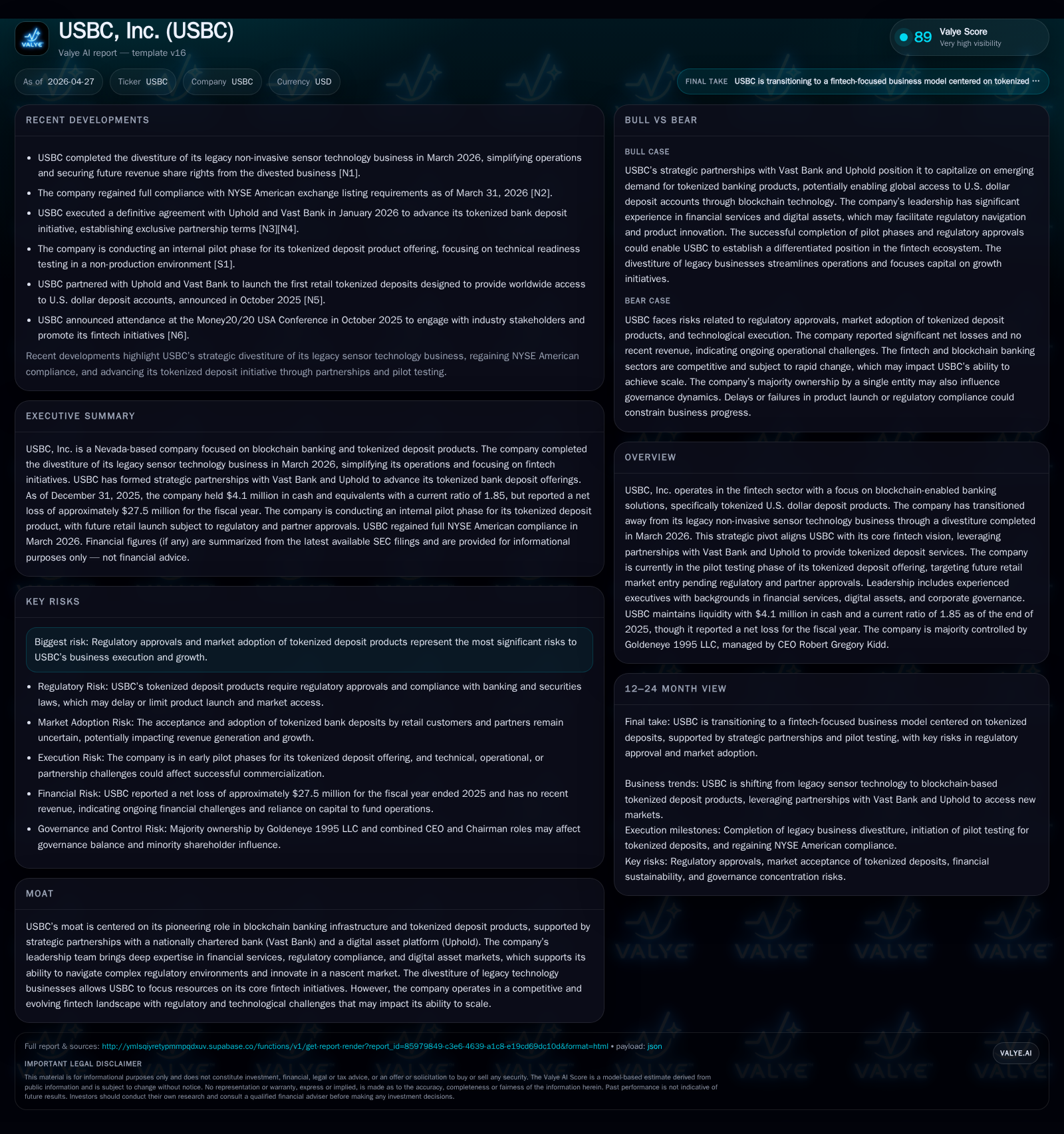
In early 2026, USBC, Inc. executed a strategic divestiture of its non-invasive sensor technology business, marking a definitive pivot towards its core blockchain fintech business — tokenized U.S. dollar deposit products. The company is currently running internal pilot tests for its tokenized deposit platform developed in collaboration with Vast Bank and Uphold, aiming for eventual retail launch subject to regulatory approvals. This refocus streamlines USBC's operational footprint, enhances capital allocation efficiency, and leverages leadership expertise to navigate fintech's evolving regulatory landscape. Although liquidity appears sufficient for near-term operations, USBC faces execution risk tied primarily to regulatory approval and market adoption in a competitive sector.
Recent Operating Update
USBC, Inc. reported a critical milestone in April 2026 by completing the divestiture of its legacy non-invasive sensor technology business [S3][S5][N1]. The transaction transferred all equity interests in the subsidiary Particle, Inc., along with associated intellectual property, to an external buyer including the former Chairman and CEO Ronald P. Erickson. Financially structured with nominal upfront consideration plus contingent revenue-sharing terms over the next five years tied to future sales of related products [S10][S23], this move strategically frees USBC from distractions outside its core fintech mission.
Simultaneously in early 2026, USBC entered into a strategic partnership with Vast Bank and Uphold HQ Inc., formalized in January 2026 [S25][S26]. This alliance underpins USBC's pioneering efforts to build a tokenized U.S. dollar deposit platform operating on blockchain technology. As per disclosures [S9], the company commenced Phase 1 of its multi-phase delivery plan by launching a closed pilot using internal users. This phase is critical for technical validation before broader rollout to retail customers pending requisite regulatory, board, and banking partner approvals.
USBC also achieved compliance restoration for NYSE American listing requirements as announced in March 2026 [S13][N2], bolstering investor access and confidence amid structural changes.
Business Model Overview
USBC's transformed business model centers on generating value through blockchain-enabled banking infrastructure rather than hardware technology. The company's primary revenue opportunity lies in offering tokenized dollar deposit products that utilize blockchain tokens backed one-for-one by U.S. dollar deposits maintained at Vast Bank — a nationally chartered depository institution [S1][S25].
The tokenized deposits aim to facilitate faster settlement times, enhanced programmability (smart contract integration), and improved accessibility compared to traditional banking products. USBC's role includes operating the token network, integrating liquidity via Uphold as exclusive market maker partner initially, and ensuring regulatory adherence around custody and compliance obligations.
Revenue streams expected include fees from issuing tokens, network transaction fees (developer services), potential interchange or account management fees through bank partners, plus residuals from legacy intellectual property under divestiture revenue-sharing arrangements [S10][S23].
Operationally, USBC outsources core banking functions to Vast Bank while focusing on the blockchain software stack and ecosystem development; this allows leaner capital deployment emphasizing technological innovation rather than physical infrastructure.
Industry Structure and Competitive Positioning
USBC operates within the emerging intersection of fintech, crypto-assets, and regulated banking services where tokenized deposit platforms remain nascent but attract increasing attention from both startups and incumbent financial institutions. The competitive landscape includes traditional banks exploring digital transformation, crypto exchanges offering stablecoin products, and fintechs developing embedded finance applications.
Strategic partnerships are crucial entry barriers given stringent banking regulations that require integration with federally chartered banks for insured deposits. USBC's alliance with Vast Bank provides national charter legitimacy while Uphold’s involvement brings established crypto market-making capabilities [S25]. This positions USBC as both a blockchain infrastructure provider and a regulated financial intermediary.
However, competition remains intense from pure-play crypto companies offering algorithmic stablecoins or centralized stablecoin issuers like Circle’s USDC; likewise from emerging CBDCs which could redefine digital money frameworks.
Growth Drivers and Constraints
Growth Drivers:
- Regulatory Approvals: Successful navigation of federal/state banking regulations will unlock public retail launch opportunities.
- Partnership Expansion: Adding financial institution or payment network partners could accelerate distribution.
- Pilot Outcomes: Validation in pilot stages will signal technical robustness attracting developer uptake and customer confidence.
- Market Demand: Rising consumer interest in programmable money complements increasing DeFi acceptance.
- Technology Evolution: Continued upgrades to blockchain efficiency and security will improve user experience.
Growth Constraints:
- Regulatory Hurdles: Ambiguities around digital asset classifications and deposit insurance limit quick scale.
- Consumer Adoption: Mass-market users may resist new digital cash forms lacking familiar interfaces or trust signals.
- Competitive Innovation: Rapid fintech innovations require ongoing investment just to maintain parity.
- Capital Limitations: With modest liquidity and history of operational losses [F1], capital constraints could slow development or marketing efforts.
What to Watch Next
Key upcoming milestones include:
- Progression through phased pilot testing leading to retail product launch timing announcements [S9].
- Regulatory filings or approval disclosures particularly from OCC/FDIC/NYDFS relevant to tokenized deposit product licensing.
- Expansion or modification of strategic partnerships potentially adding new bank or exchange collaborators.
- Quarterly SEC filings revealing cash burn rates and funding needs amid scale-up activities.
- Adoption metrics post-launch if available: user counts, transaction volumes, token issuance scale.
- Market responses to competitor advances within blockchain banking ecosystems.
Financial Profile Summary
USBC's financial condition reflects its transition phase with an operating loss amounting to approximately $17.1 million for fiscal year ended December 31, 2025 and net loss near $27.5 million [F1]. Cash holdings at year-end stood at $4.1 million with current assets at $6.8 million against current liabilities approximating $3.7 million yielding a current ratio of 1.85 indicative of short-term liquidity sufficiency [F1]. Total debt was about $4 million as of end 2024 without explicit new debt disclosed later [F1].
The divestiture of the sensor business was not anticipated to materially affect near-term financials but is expected to reduce operational complexity allowing focused R&D capital spending on the fintech side [S10]. Continuing net losses underscore the developmental nature of the enterprise; substantial scale or additional financing will be required to reach profitability once commercial launch occurs.
This analysis reflects information provided through publicly filed SEC reports up to April 2026 combined with sector-specific insight where flagged as analysis. It does not constitute investment advice or an offer to buy or sell securities.
Disclaimer: This is research-only, informational analysis and not investment advice. It may include AI-generated interpretation and general industry context. Always verify important details using primary sources.

Comments