
RedHill Biopharma Advances Talicia Joint Venture and Clinical Pipeline Amid Regulatory Progress
RedHill Biopharma transformed its Talicia franchise via strategic partnership and deepened its R&D pipeline with promising oncology and gastrointestinal candidates.
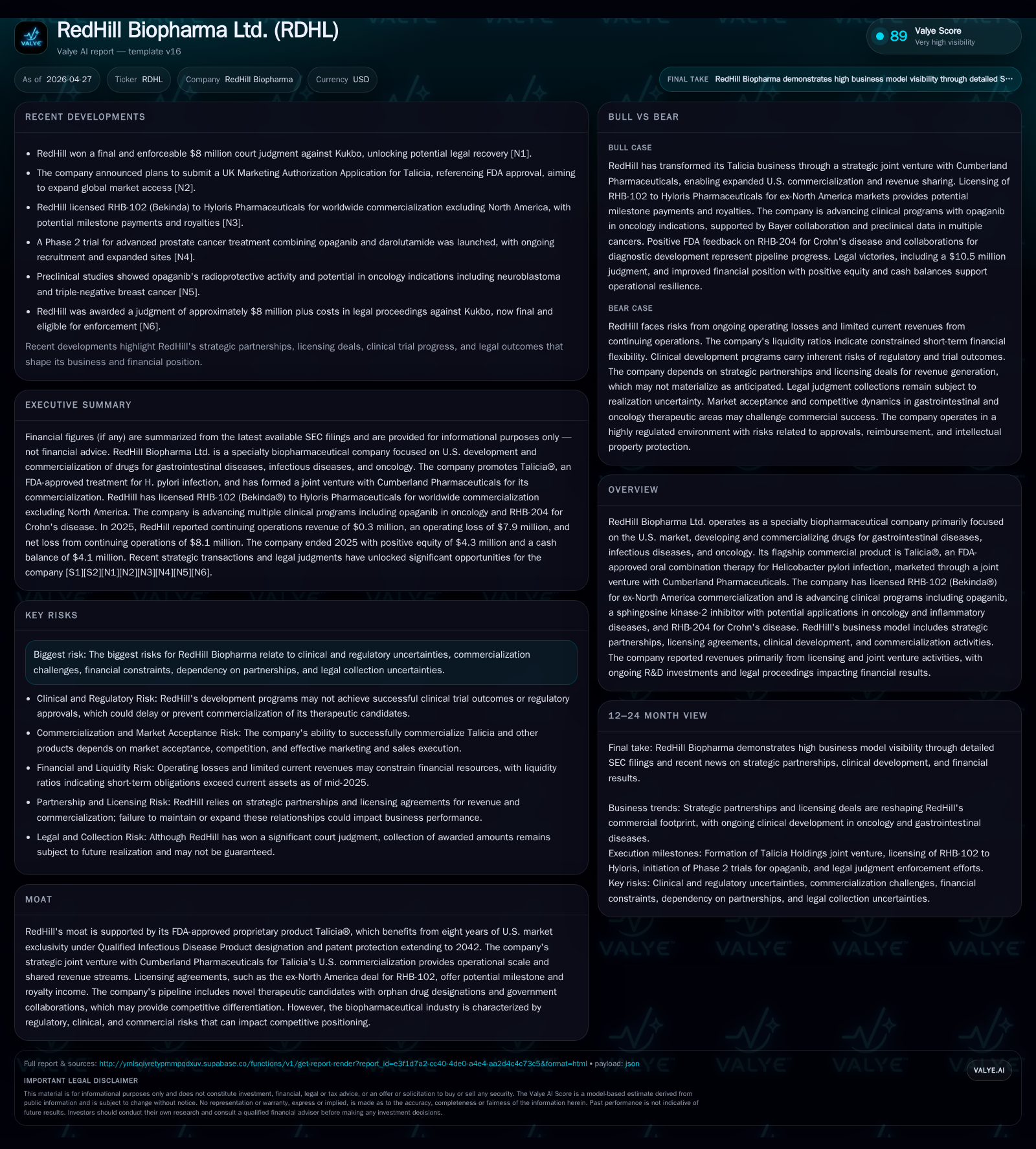
In 2025, RedHill Biopharma significantly reshaped its commercial and clinical landscape, notably through forming a co-commercialization joint venture for Talicia with Cumberland Pharmaceuticals. The deal brought not only capital but also operational scale, supporting market penetration in the U.S. and laying groundwork for international expansion. Simultaneously, RedHill sharpened focus on late-stage clinical programs including opaganib in oncology and RHB-204 in Crohn's disease, leveraging regulatory feedback and collaborative efforts. Despite ongoing operating losses and tight liquidity, the company’s strategic execution signals potential for sustained growth once key pipeline milestones are realized.
Recent Operating Update: Commercial Transformation and Clinical Focus
RedHill Biopharma reported significant operational developments in its latest quarterly filing dated April 27, 2026 [S2]. The defining event of 2025 was the formation of Talicia Holdings Inc. (THI), a jointly controlled entity created through a partnership with Cumberland Pharmaceuticals that granted Cumberland a 30% ownership stake via a $4 million equity investment.
Under this arrangement, Talicia—RedHill’s FDA-approved oral therapy for Helicobacter pylori infection—became co-commercialized in the U.S., with revenues shared equally. This deal effectively offloaded direct commercial responsibilities to THI, now classified as discontinued operations on RedHill's financials, while RedHill retains economic interest through its majority ownership [S2], [S19].
This partnership addresses previous scale limitations seen under solo commercialization by combining operational capabilities and financial resources. It also dovetails with Cumberland's pending integration into Apotex's U.S. branded business, potentially augmenting market reach further [S2].
Beyond U.S. efforts, RedHill expanded licensing agreements for Talicia in Middle Eastern markets contributing approximately $1.9 million revenue within discontinued operations during 2025, reflecting early traction outside the core U.S. territory [S2], [S19]. The company is actively preparing to submit a fast-track Marketing Authorization Application (MAA) for the UK market, underscoring its intent to broaden global adoption [S2].
Commercial gains include coverage expansion by Humana’s Medicare Part D plan adding eight million lives under access benefits and publishing new clinical data backing more convenient thrice-daily dosing aligned with FDA label updates—factors critical for prescriber adoption and patient compliance [S2].
On the R&D front, RedHill signaled a sharpened pipeline strategy centered on advancing high-potential programs backed by regulatory support and strategic collaborations. Opaganib—a first-in-class sphingosine kinase-2 inhibitor—is progressing through multiple oncology indications.
A Phase 2 combination study pairing opaganib with Bayer's darolutamide is underway in advanced metastatic castration-resistant prostate cancer (mCRPC), leveraging synergy with an established therapy in a multibillion-dollar market [S2], [S19], [S20]. Preclinical findings presented at AACR further showcase opaganib's potential to enhance chemotherapy efficacy in neuroblastoma and triple-negative breast cancer by modulating tumor immunity mechanisms [S3], [N3].
RHB-204, designed for Crohn’s disease therapy optimization, is advancing following encouraging FDA feedback regarding its regulatory path and has secured two lab collaborations focused on Mycobacterium avium paratuberculosis (MAP) killing — key since MAP is hypothesized as a driver of Crohn's pathology — along with rapid diagnostic development efforts [S2], [S19], [S20].
Additionally, RHB-102 (Bekinda), targeting gastrointestinal side effects induced by GLP-1/GIP receptor agonists widely used in diabetes and obesity treatment, was out-licensed for territories outside North America to Hyloris Pharmaceuticals. The licensing deal includes up to $60 million potential milestones plus royalties—a strategic move designed to bring liquidity while accelerating global product development [S2], [S19], [S20].
For context, GLP-1 therapies face high discontinuation rates due largely to nausea, vomiting, and diarrhea—effects that RHB-102 aims to mitigate—thus representing a structurally supportive market opportunity worth an estimated $100 billion globally by 2030 if addressed effectively [S16].
Business Model: Partnerships Fuel Market Presence and Pipeline Development
RedHill operates primarily within specialty biopharma niches targeting gastrointestinal diseases, infectious diseases, and oncology indications focused on unmet medical needs. The company combines proprietary drug development with strategic partnerships that distribute commercialization risk while enhancing market penetration.
The pivot toward co-commercialization partnerships exemplified by the Cumberland joint venture indicates an evolved model where RedHill leverages external partner strengths rather than bearing full commercialization burden alone—particularly important given the high cost structure associated with U.S pharmaceutical marketing campaigns.
Licensing arrangements such as the Bekinda deal provide non-dilutive capital inflows contingent upon developmental milestones and royalties that hedge operational burn rates against elongated drug approval timelines.
Meanwhile, internally led clinical programs such as opaganib demonstrate RedHill's commitment to first-in-class or differentiated candidates with multi-indication potential supported by government collaborations (e.g., pandemic preparedness programs) adding credibility.
However, reliance on partnerships does expose RedHill to counterparty risk around execution efficiency, milestone realization timing, and competitive pressures impacting licensing returns.
Industry Structure and Competitive Positioning
RedHill operates at the intersection of niche specialty pharma markets characterized by regulatory complexity and heightened clinical development risk balanced against high unmet need populations suitable for premium pricing strategies.
Talicia enjoys durable competitive defenses deriving from FDA-approved status augmented by Qualified Infectious Disease Product (QIDP) protections conferring eight years of U.S exclusivity plus patent life extending into 2042. This exclusivity window supports robust product positioning against generic competition within Helicobacter pylori treatment landscapes.
The competitive environment spans both branded gastroenterology therapies as well as emerging novel agents addressing symptom management in metabolic diseases affected by GLP-1 analogs. RedHill’s portfolio diversification through licensed assets like Bekinda seeks differentiation via improved patient adherence solutions compared to existing therapies such as ondansetron or antidiarrheals.
In oncology indications targeted by opaganib or RHB-107 (upamostat), RedHill confronts broader competition from large pharmaceuticals developing immunotherapies or targeted agents but aims to carve out niches based on mechanisms that simultaneously modulate inflammatory pathways while providing antiviral or anti-tumor effects—a multi-modal approach less crowded than standard cytotoxic options.
Growth Drivers and Constraints
Key growth drivers include:
- Expansion of Talicia sales via co-commercialization synergies, insurance formulary coverage expansions adding millions of lives,
- Global market entry initiatives expanding geographic reach beyond U.S.,
- R&D progression catalyzed by FDA guidance enabling efficient regulatory paths,
- Licensing monetization unlocking milestone revenues supporting continued investment,
- Clinical validation of pipeline assets especially opaganib in high-value oncology indications,
- Leveraging government-sponsored research programs providing non-dilutive funding support.
Constraints encompass:
- Limited liquidity reflected in modest year-end cash balances necessitating careful capital allocation,
- Operating losses driven by ongoing clinical development costs limiting near-term profitability,
- Dependence on strategic partners’ ability to execute commercialization plans effectively,
- Regulatory uncertainties inherent to clinical trial outcomes potentially delaying or derailing product approvals,
- Collection risks related to legal judgements despite favorable rulings,
- Intensifying competition especially in crowded GI symptom management markets requiring strong differentiation.
What to Watch Next
Upcoming milestones include:
- Market uptake trajectory under THI-cum-Cumberland joint venture post full sales launch expected to validate commercial scalability;
- Submission status and potential approval timelines of Talicia in European markets like the UK via fast-track MAA;
- Readouts from ongoing Phase 2 studies combining opaganib with darolutamide in mCRPC;
- Progression updates on RHB-204 phase advancement guided by FDA feedback including validation of MAP diagnostic collaborations;
- Achievements of defined milestones triggering payments from Hyloris under Bekinda licensing agreement;
- Developments regarding legal case enforcement outcomes from Kukbo judgment collection efforts;
- Cash flow trends including any financing activities required to extend runway or support pipeline progress;
- Any shifts in regulatory posture especially accelerated approval designations or breakthrough therapy statuses relevant to lead candidates.
Financial Profile Snapshot (Brief)
For the twelve months ended December 31, 2025 RedHill reported revenue of approximately $0.3 million excluding Talicia-discontinued operations which had separate reporting through THI economic share accounting [S15]. Operating loss widened slightly to about $7.9 million reflecting elevated investment in R&D ($2 million) and increased general/admin expenses driven partly by legal costs related to Kukbo litigation [S15]. Financial expense netted out close to breakeven.
Year-end cash balance stood at $4.1 million as reported on December 31, 2025; current ratio calculated at roughly 0.56 indicates tight near-term liquidity requiring prudent cash management or financing support [S2], [F1]. Notably positive court judgement recoverable amounting over $10 million against Kukbo adds prospective asset value though realization timing remains uncertain [N1], [S2].
Though loss-making currently due to stage of pipeline development typical in small specialty biopharma companies focusing on innovation-heavy assets, recent partnerships have materially strengthened financial foundations while distributing commercialization risks.
Disclaimer:
This analysis is provided solely for informational purposes reflecting available public disclosures as of April 2026 without offering investment advice or recommendations. Readers should conduct their own due diligence as circumstances may evolve.
Disclaimer: This is research-only, informational analysis and not investment advice. It may include AI-generated interpretation and general industry context. Always verify important details using primary sources.

Comments