
Gorman-Rupp Surpasses Estimates with Resilient Q1 Operational Execution
Q1 2026 results showcase Gorman-Rupp’s operational strength amid sector headwinds and leverage challenges.
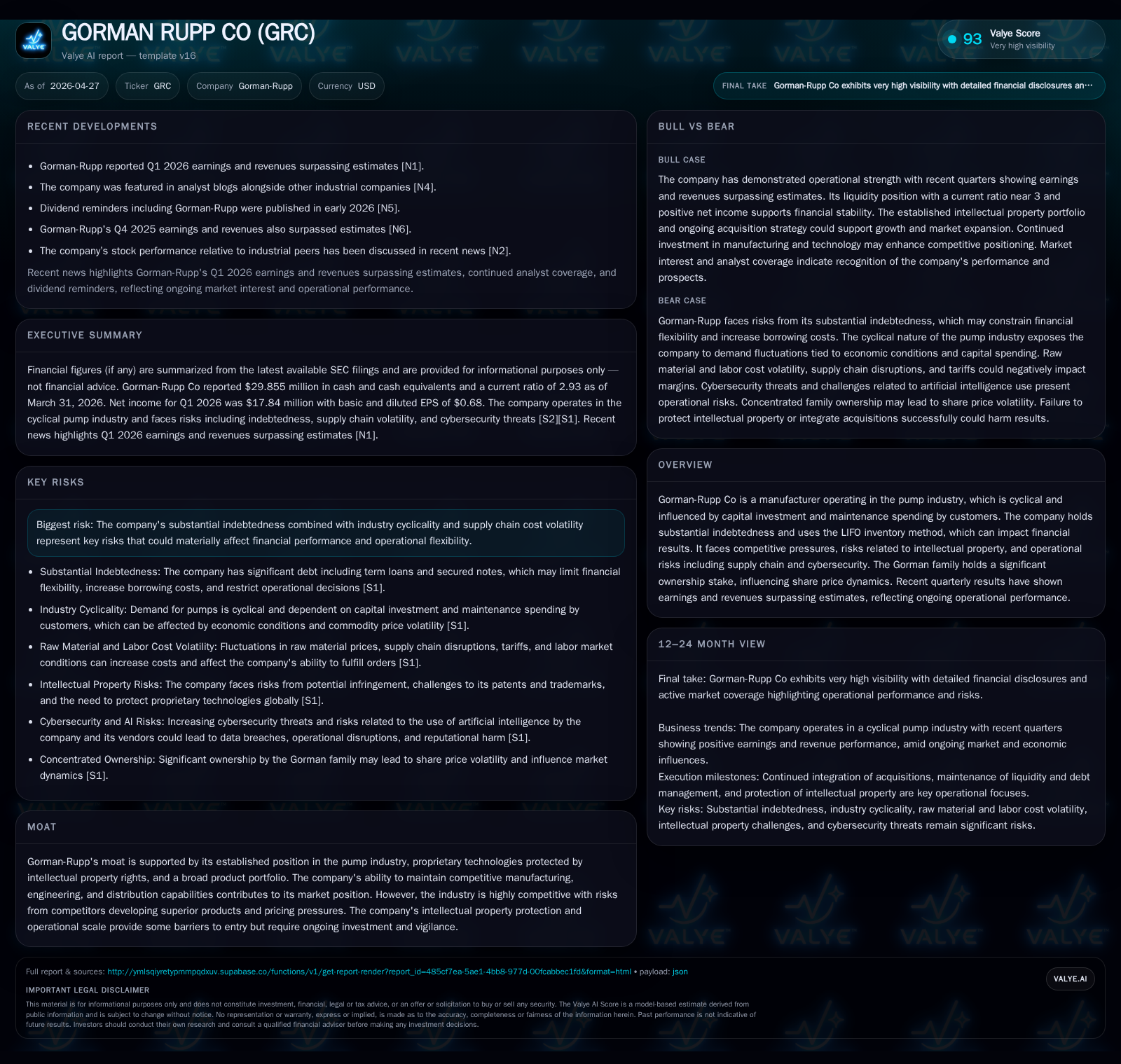
Gorman-Rupp Co reported a first quarter 2026 that exceeded both revenue and earnings expectations, demonstrating operational resilience despite the cyclical nature of the pump industry and substantial indebtedness. The company’s competitive position is underpinned by a broad product portfolio and intellectual property protections, yet it faces ongoing risks from supply chain volatility and capital intensity. Growth prospects hinge on customer capital expenditure trends and aftermarket demand, while financial health remains sensitive to leveraging dynamics and raw material costs. Upcoming execution milestones will focus on sustaining margin improvements and managing working capital efficiencies.
Q1 2026 Operating Results: Outperforming Expectations
Gorman-Rupp Co’s latest 10-Q filing dated April 27, 2026 [S2], supplemented by the April 23 news release [S3] and Nasdaq reporting [N1], reveals an encouraging start to the year with earnings and revenues surpassing market estimates. This performance signals robust demand for its pump products amidst a historically cyclical market influenced heavily by fluctuations in customer capital expenditure. The company credited operational agility in managing supply chain logistics and pricing adjustments as key contributors to the outperformance. This quarter's figures underline Gorman-Rupp’s ability to navigate industry headwinds including input cost inflation while maintaining delivery effectiveness.
Understanding Gorman-Rupp’s Business Model and Product Offering
The firm's core business revolves around designing, manufacturing, and distributing pumps widely utilized across municipal water management, industrial processing, agriculture irrigation, sewage systems, petroleum production, and construction sectors [S1]. Revenue generation stems from sales of engineered pump products supported by aftermarket parts and service offerings. The quality and reliability of their pumps are essential given customers’ reliance on uptime in mission-critical applications which confer some pricing power. The breadth of the product line mitigates the inherent cyclicality linked to any single end-market segment. Additionally, the company's engineering expertise drives differentiation through innovation embedded in proprietary pump designs protected by patents and trademarks [S1][F1]. Distribution networks enhance reach, yet switching costs for consumers remain moderate as competitors can offer comparable standard pumps.
Industry Context: Competitive Dynamics in the Pump Manufacturing Sector
Operating within a highly fragmented industrial equipment sector, Gorman-Rupp faces fierce competition characterized by pricing pressure from peers that may introduce technologically advanced or cost-efficient alternatives [S1][S17]. Rapid changes in environmental regulations impose compliance-related costs that raise barriers but also force continual innovation. Supply chain bottlenecks for raw materials such as steel alloys mandate strategic inventory management amid volatile commodity pricing [S18][S28]. Adoption cycles vary by end-use application; capital projects drive new pump orders while maintenance needs support steady aftermarket sales. Competitors’ efforts to leverage automation or digitally integrated pump systems add further challenges requiring ongoing R&D investments.
Structural Strengths and Moat Drivers: Intellectual Property and Scale
Gorman-Rupp's durable moat emanates principally from its proprietary technology portfolio — patents guarding unique pump designs — coupled with a reputation for product reliability critical in harsh operating environments [S25]. Its manufacturing scale allows relatively efficient production runs supporting competitive pricing while maintaining quality standards. Broad geographic distribution reduces dependence on any single economic region; international sales comprise about one-quarter of revenues [S19]. Moreover, established relationships across diverse customer segments create recurring aftermarket revenue streams that help cushion overall demand swings. The family ownership structure contributes to stable governance albeit potentially affecting share liquidity dynamics [S19]. Sustaining this moat requires vigilance in protecting intellectual property rights globally against infringement attempts or reverse engineering [S20].
Growth Opportunities and Emerging Challenges
Potential growth drivers include an anticipated rebound in customer capital spending in critical infrastructure sectors such as water treatment plants and oil & gas facilities [N1][S1]. Increasing environmental mandates could spur demand for specialized pumps designed for lower emissions or energy efficiencies. Aftermarket maintenance services offer a steadier revenue base less sensitive to economic cycles. However, raw material cost inflation — particularly in steel prices — constrains margin expansion potential alongside competitive pressures limiting pricing actions. Capacity utilization hinges on supplier reliability amid tight supply markets [S18]. The company has cautiously pursued acquisitions targeting complementary technologies or new geographies but integration complexities remain a challenge [S1][S20].
Risk Considerations: Debt, Cyclicality, and Operational Risks
A principal risk factor is Gorman-Rupp's significant indebtedness standing at approximately $295.75 million total debt with cash reserves near $29.85 million at March-end 2026, resulting in net debt around $265.9 million [F1]. Such leverage may restrict financial flexibility impacting capital expenditures, dividends, or ability to pursue desirable acquisitions during downcycles [S4][S5]. Debt covenants potentially impose operational constraints if earnings underperform expectations. The cyclical nature of end-markets implies uneven demand which can pressure cash flow during downturns [S1][S17]. Additional operational risks arise from supply chain disruptions given dependence on specialized components sourced globally [S17]. Cybersecurity threats present ongoing vulnerabilities to proprietary data or production controls that could disrupt manufacturing if compromised [S25]. Also notable are litigation risks tied to intellectual property enforcement actions either initiated or defended by the company [S20], requiring sustained legal expenditures.
Upcoming Catalysts and Execution Benchmarks to Monitor
Investors should closely watch order backlog developments as a leading indicator of future revenue streams provided in quarterly disclosures or earnings calls referenced in recent filings [S2][N1]. Margin improvement programs focused on cost control initiatives will be pivotal amidst persistent raw material price uncertainty. Progress integrating acquired businesses successfully into existing operations will signify management execution capability—a factor material to growth projections. Working capital optimization efforts may improve cash flow profiles enabling better servicing of debt obligations without curtailing strategic investments. The company's guidance updates (when provided) will signal management's confidence on navigating macroeconomic challenges ahead.
Financial Overview: Liquidity, Leverage, and Capital Deployment
As of March 31, 2026, Gorman-Rupp held cash and equivalents totaling approximately $29.85 million against total debt nearing $295.75 million yielding a net debt position close to $265.9 million supported by a healthy current ratio of about 2.93 reflecting sufficient short-term asset coverage over liabilities [F1]. This liquidity cushion provides adequate operating runway but continued leverage represents heightened risk particularly if economic conditions dampen demand unexpectedly or interest rates rise materially [S4][S5]. Recent quarterly earnings outperformance implies potential for generating positive operating cash flows necessary for servicing obligations without undue strain presently [S2][S3].
This analysis synthesizes publicly available SEC filings blended with market reporting to profile Gorman-Rupp Co’s current operating performance within its industry context without offering investment recommendations or projections beyond stated facts.
Disclaimer: This is research-only, informational analysis and not investment advice. It may include AI-generated interpretation and general industry context. Always verify important details using primary sources.

Comments