
Via Renewables Advances Preferred Stock Redemption Strategy Amid Stable Operating Trends
Via Renewables executed a significant preferred stock redemption in April 2026, reinforcing its capital allocation discipline amid ongoing stable operational performance.
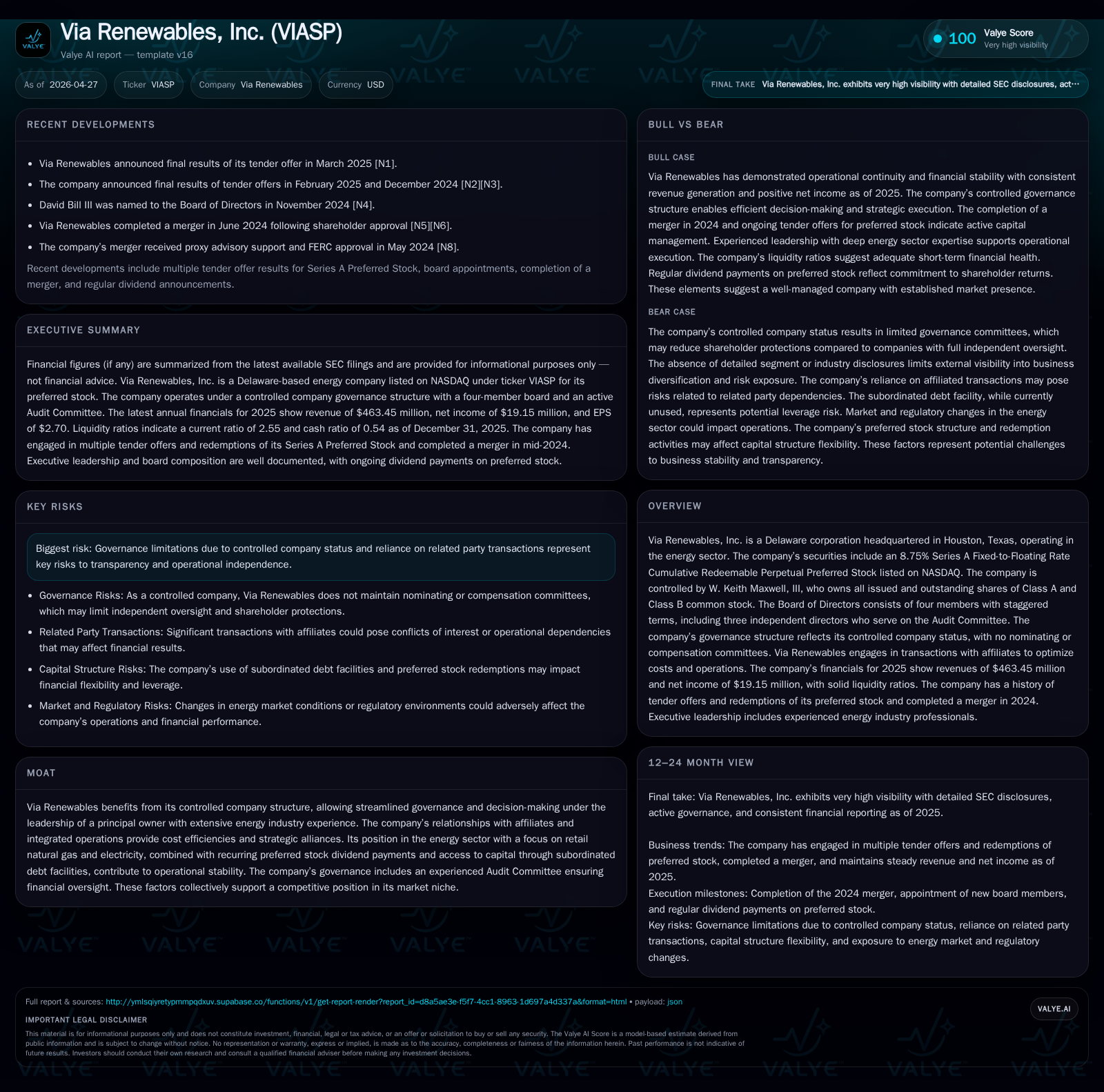
In April 2026, Via Renewables completed a partial redemption of over 209,000 shares of its Series A preferred stock, signaling proactive capital structure management. The company’s Q3 2025 operational disclosures confirm stability with no material changes in risk or operations. Via operates primarily as a retail supplier of natural gas and electricity through controlled affiliates, leveraging related-party transactions for cost efficiency but facing governance transparency limitations. The energy retail market landscape shapes Via’s niche competitive stance with growth opportunities tied to regulatory developments and contract expansions. Watch for upcoming dividend payments and refinancing activity as key execution milestones. The firm maintains a solid liquidity profile with moderate leverage supporting its preferred stock obligations.
Recent Capital Redeployment: April 2026 Preferred Stock Redemption
On April 20, 2026, Via Renewables announced the redemption of 209,437 shares of its 8.75% Series A Fixed-to-Floating Rate Cumulative Redeemable Perpetual Preferred Stock at the fixed price of $25 per share plus accrued dividends payable on May 20, 2026 [S3][N1]. This action marks another step in the company’s ongoing program to manage its capital structure by reducing outstanding perpetual preferred equity through scheduled partial redemptions. Such structured repurchases aim to optimize financing costs and reflect disciplined balance sheet stewardship rather than any immediate operational shifts or distress.
This redemption fits into a recent sequence of similar transactions executed since mid-2025, highlighting a consistent approach to capital allocation during stable cash flows. The fixed-to-floating rate mechanism inherent in these securities gives Via some interest rate adaptability over time while ensuring predictable dividend commitments during the fixed rate period.
Stable Operational Update from Q3 2025 Filing
The latest quarterly report ending September 30, 2025 confirms that Via Renewables’ core operations remain stable with no material changes or new risks impacting the business compared to prior disclosures [S2]. The company explicitly states that risk factors concerning its preferred securities are consistent with those outlined in previous annual filings. Notably, there is an absence of operational disruptions or adverse market developments cited that might threaten continuity.
This steady operating backdrop corroborates the capital redeployment moves as financially strategic maneuvers supported by ongoing business performance rather than reactive corrections.
Business Model: Retail Energy Supply through Controlled Affiliates
Via Renewables operates predominantly as a retailer supplying natural gas and electricity to end customers within jurisdictions in the United States where retail energy choice laws apply [S1]. The company’s revenues derive mainly from contractual sales to residential and commercial customers who purchase commodity energy under fixed or variable-price contracts.
A defining characteristic is Via’s status as a 'controlled company' under SEC definitions. It holds majority voting control through founder ownership (W. Keith Maxwell III), enabling cohesive strategic direction. Through affiliated entities such as Spark HoldCo LLC and associated subsidiaries active in retail energy services infrastructure, Via leverages vertically integrated functions ranging from contract origination to customer service and billing [S1].
These affiliates facilitate economies of scale, reduce overhead costs via shared services agreements, and enhance operational efficiency — all feeding into more consistent cash flow profiles that support dividend payments on preferred securities.
Governance and Affiliate Transactions Impacting Cost Efficiencies
The controlled company governance model affords Via operational agility but constrains traditional checks like nominating or compensation committees; only audit oversight by independent directors is maintained robustly [S1][F1].
Affiliate transactions form a backbone for managing delivery logistics and customer acquisition costs but introduce complexity regarding transparency and independent valuation — representing intrinsic trade-offs.
While these related-party dealings optimize expenses effectively (a moat element), they require careful scrutiny given potential conflicts or limited external oversight. This setup may weigh on valuation multiples due to perceived governance risk despite its functional benefits.
Competitive Set and Industry Position in Retail Natural Gas and Electricity
In the regulated retail energy space where Via operates, competition centers on pricing efficiency, contract flexibility, marketing reach, and customer retention tactics [S1]. Though the commodity nature of energy constrains pricing power broadly, scale advantages derived from large wholesale purchasing contracts via affiliates help dampen input cost volatility impacts.
Customer switching costs are moderate but influenced by contract terms and service quality; thus maintaining robust relationship management capabilities is critical for sustainable revenue streams.
Regulatory frameworks imposed at state levels create barriers to entry but also require compliance investments that favor incumbents like Via with established platforms.
Growth Drivers: Expansion Opportunities & Regulatory Landscape
Growth avenues for Via lie chiefly in enlarging its retail customer base geographically where deregulation advances; enhancing product offerings such as green energy options; and deepening affiliate synergies for cross-selling or bundling services [S1][N2].
The accelerating clean energy transition incentivized by regulation presents new market segments for renewable natural gas contracts or renewable electricity tariffs that Via could leverage within its existing channels.
Additionally, continued refinements in data analytics and customer engagement platforms may strengthen retention rates — an important driver given typical modest gross margin pressure due to competitive pricing dynamics.
Potential Constraints: Governance Structure and Related-Party Risks
The controlled company framework inherently restricts full board independence with implications for external investor confidence; related-party transactions further complicate transparent cost evaluations [S1]. While audit committee oversight offers some mitigation, these factors can constrain valuation expansion or liquidity in public markets.
Furthermore, regulatory shifts affecting wholesale procurement or tariff structures could impose unforeseen cost pressures given indirect exposure through affiliate arrangements.
Near-Term Watchpoints: Dividend Policy, Debt Amendments, and Execution Milestones
Investors should monitor upcoming dividend declarations on Series A preferred stock maintaining the indicated fixed-coupon schedule—recent April announcements affirm policy continuity [N2].
Attention to amendments or resets under existing credit facilities (notably subordinated promissory notes amended mid-2024) will also illuminate financial flexibility trends [S1]. Operating KPIs centered on contract additions or renewal rates will provide early insight into demand momentum.
Concise Financial Context: Capital Structure and Balance Sheet Health
As of December 31, 2025, Via Renewables held $41.76 million in cash and equivalents against total debt approximating $120 million resulting in net debt near $78.24 million [F1].
Operating income reached about $53.53 million on revenues of $463.45 million while net income totaled $19.15 million illustrating profitable core operations supporting recurring preferred stock dividend obligations.
This financial posture provides cushion for further strategic redemptions without imposing acute refinancing stress while allowing room to navigate typical industry cyclical fluctuations tied to commodity price swings.
Disclaimer: This analysis is based solely on publicly available SEC filings and recent news disclosures as cited herein. It reflects an informed assessment without providing investment advice.
Disclaimer: This is research-only, informational analysis and not investment advice. It may include AI-generated interpretation and general industry context. Always verify important details using primary sources.

Comments