
American Rebel Holdings Shrinks Share Count Amid Liquidity Pressures and Strategic Reorganization
The company’s recent reverse stock splits and equity issuances underscore critical capital challenges amid efforts to maintain Nasdaq listing requirements.
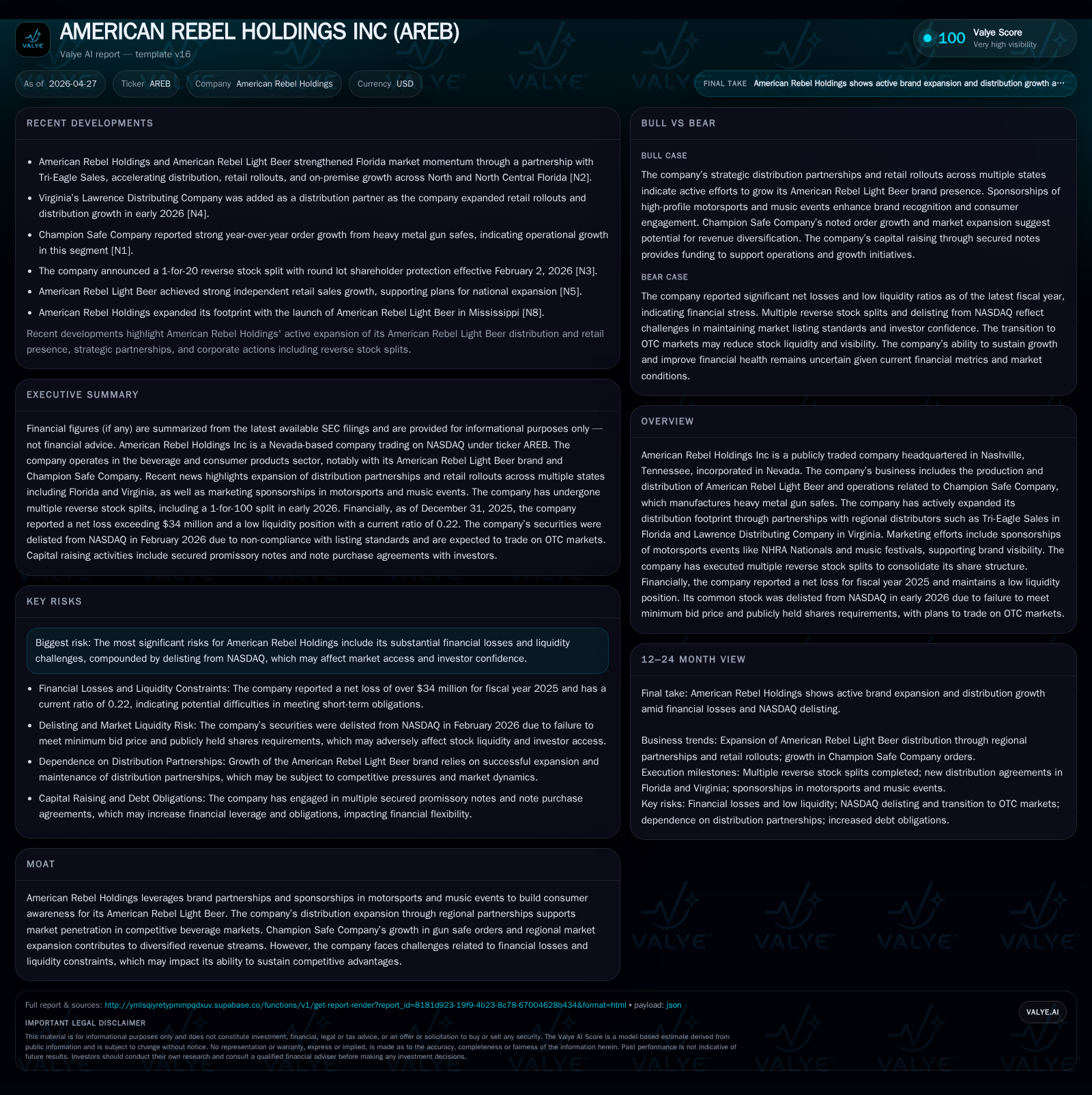
American Rebel Holdings executed a 1-for-100 reverse stock split in March 2026 followed by a significant issuance of shares to address fractional rounding. These moves come amid persistent liquidity constraints, sustained net losses, and continued non-compliance with Nasdaq’s publicly held shares requirements leading to delisting. The company operates dual businesses: American Rebel Light Beer, marketed via regional distribution partnerships and event sponsorships, and Champion Safe Company, manufacturing heavy metal gun safes. While these segments offer diversified revenue streams and brand-building opportunities, financial strain limits growth investments and risks investor confidence due to ongoing share dilution and market access issues.
Key Recent SEC Developments: Share Structure Overhaul and Capital Actions
In March 2026, American Rebel Holdings implemented a dramatic 1-for-100 reverse stock split effective March 23, reducing the total number of common shares outstanding sharply as a strategic response to continuing pressures from its NASDAQ delisting notices [S3], [S25]. This action follows earlier reverse stock splits in early 2026 (1-for-20 in February) reflecting sustained downward pressure on share price and attempts to meet minimum listing standards. The reverse split was complicated by shareholder rounding processes that required the issuance of over 3.2 million additional common shares shortly after [S3], [S25].
All these transactions were conducted through private placements exempt from registration under Section 4(a)(2) and Regulation D, indicating reliance on non-public equity issuances without general solicitation [S3], [S25]. Such maneuvers highlight efforts to manage an increasingly complex capital structure during financial stress while still attempting to satisfy NASDAQ publicly held shares rules, which remain unmet as of early Q2 2026 given lingering shortfalls in public float below the mandated threshold of 500,000 shares [S28].
The firm's multiple reverse splits over two years cumulatively aggregate to consolidation ratios exceeding NASDAQ thresholds triggering delisting proceedings [S10]. Their approach signals tactical but reactive steps to preserve tradability and shareholder value amidst severely depressed equity market conditions.
Business Model Overview: Two Distinct Revenue Streams Under One Roof
American Rebel operates an uncommon dual-business model combining beverage alcohol production with industrial manufacturing. Its principal revenue sources are:
American Rebel Light Beer: A brand positioned within the highly competitive light beer segment. Distribution is expanded through partnerships with regional distributors such as Tri-Eagle Sales (Florida) and Lawrence Distributing Company (Virginia), which supports incremental market penetration despite competitive pricing pressures [S1], [F1].
Champion Safe Company: Operating within the security manufacturing space producing heavy-duty metal gun safes. This division provides a less cyclical industrial product line defined by stringent quality demands on metal fabrication and secure locking mechanisms. Growth is driven by increasing regional orders and reputation for durability [S1].
The combination offers diversification benefits but also operational complexity. The beverage segment focuses heavily on brand positioning, volume expansion through distributor networks, and consumer promotions; meanwhile, Champion Safe targets niche industrial buyers prioritizing product quality, certification, and installation services.
Product Quality, Brand Positioning, and Distribution Strategy in Beverage and Gun Safe Operations
American Rebel Light Beer invests notably in marketing initiatives by sponsoring major motorsport events like NHRA Nationals as well as music festivals—strategic moves meant to elevate brand visibility among target demographics favorable to light beer consumption patterns [S1]. Such sponsorships aim at driving consumer engagement beyond typical retail shelf presence.
However, the category faces intense competition from mainstream breweries alongside proliferating craft brands resulting in constrained pricing power and margin pressures. The effectiveness of these marketing campaigns must also contend with limited capital availability restricting scale.
Champion Safe emphasizes product quality as its key differentiator—manufacturing heavy metal safes engineered for security that address both residential customers concerned with firearm storage safety compliance and commercial clients requiring certified vault solutions. Supply chain constraints such as raw metal availability could affect production ramp-ups; likewise manufacturing capacity limits could restrain fast scaling absent significant capex.
Competitive Dynamics and Industry Structure Implications for Market Penetration
The beverage alcohol sector represents one of the most fragmented yet mature consumer markets characterized by well-entrenched incumbents possessing significant scale advantages around procurement, distribution bargaining power, marketing budgets, and retail placement. American Rebel’s regional distribution partnerships offer credible routes-to-market but compete against multinational brewers’ dominance in channels ranging from grocery chains to convenience stores.
Switching costs among consumers tend to be low in light beer formulations; thus brand loyalty relies increasingly on emotional resonance created through lifestyle branding rather than product uniqueness alone.
In the gun safe industry arena where Champion Safe competes, customer trust hinges on certifications (e.g., UL ratings) combined with perceived build robustness—elements that constitute forms of switching costs deterring buyers from substituting easily between manufacturers once safety standards are met. However, cost sensitivity remains present for many end-users implying pricing discipline is required alongside product innovation.
Growth Catalysts and Headwinds: Balancing Expansion with Financial Viability
Catalysts for top-line growth include successful geographic expansion via new distributor agreements, particularly leveraging Wil Fischer Distributing partnership announced in late 2025 targeting Missouri markets [S23]. Similarly, aggressive "distributor first" strategies aim to obtain retail authorizations that can multiply point-of-sale exposure significantly.
Event sponsorships also serve as growth accelerators by enhancing brand awareness which potentially converts into higher volumetric sales.
On the Champion Safe front, rising demand fueled by regional market penetration coupled with product development investments can drive incremental revenues but may require working capital support.
Conversely, liquidity shortages evidenced by minimal cash reserves ($147K end-2025) coupled with a deficient current ratio (0.22) limit capacity to invest adequately in marketing or production capacity enhancements [F1]. Delisting from NASDAQ exacerbates financing difficulties by restricting access to traditional capital markets or increasing cost of equity raising.
Frequent equity dilutions via convertible preferred stock exchanges or unregistered issuances might impair existing shareholder value despite their necessity for working capital replenishment.
Upcoming Milestones and Risk Factors to Monitor
Key milestones revolve around:
- The company curing NASDAQ public float deficiencies after supplemental share issuances designed to satisfy minimum publicly held shares criteria guaranteeing potential relisting eligibility [S28].
- Execution progress on distributor rollouts especially integration effectiveness with partners like Wil Fischer Distributing impacting sales pipeline quality.
- Regulatory approvals if any related to product certifications impacting Champion Safe acceptance.
- Additional financing rounds or debt refinancing activities which would signal management’s ability to navigate short-term liquidity crunches effectively.
- Monitoring further share count adjustments or equity offerings critical given pattern established over Q1-Q2 2026 exposing ongoing dilution risk.
Investors should scrutinize execution against stated timelines for these deliverables as delays or failures may prompt adverse valuation effects or business disruption due to weakened trust or supplier/customer hesitancy.
Brief Financial Snapshot: Liquidity Constraints and Capital Structure Status
As of December 31, 2025 data available from latest filings indicates American Rebel Holdings maintained a perilously low cash balance of just $147,586 alongside current assets totaling approximately $5.64 million overshadowed heavily by current liabilities nearing $25.97 million resulting in a current ratio near 0.22 – signifying considerable short-term liquidity stress [F1].
Operating results reflected a substantial operating loss amounting to roughly -$14.76 million for FY25 accompanied by an even greater net loss exceeding -$34 million illustrating pronounced profitability challenges undermining internal cash generation capacity [F1].
Total recorded debt stood near $3.88 million based on best available figures from prior periods; however direct confirmation of present debt levels was not detailed thereby warranting caution about hidden leverage exposures [F1].
These critical imbalances necessitate frequent recapitalization exercises evidenced via multiple stock conversions from preferred instruments into common stock during early 2026 along with reverse splits aimed at restoring trading eligibility rather than pure strategic growth considerations [S4], [S26], [S28]. Maintaining operational continuity under such financial duress represents a central challenge moving forward demanding prudent cost control alongside sharpening focus on revenue base expansions through executed partnerships.
This analysis is based exclusively on publicly available SEC filings dated through April 27, 2026, including annual reports (10-K/A), current reports (8-K), company disclosures relating to exchange transactions and capital market actions concerning American Rebel Holdings Inc. It does not constitute investment advice or recommendations.
Disclaimer: This is research-only, informational analysis and not investment advice. It may include AI-generated interpretation and general industry context. Always verify important details using primary sources.

Comments