
Qfin Struggles With Earnings Misses Despite Strong Liquidity
Qfin’s recent quarterly filings reveal operational earnings and revenue shortfalls amid a structurally complex business model reliant on contractual control.
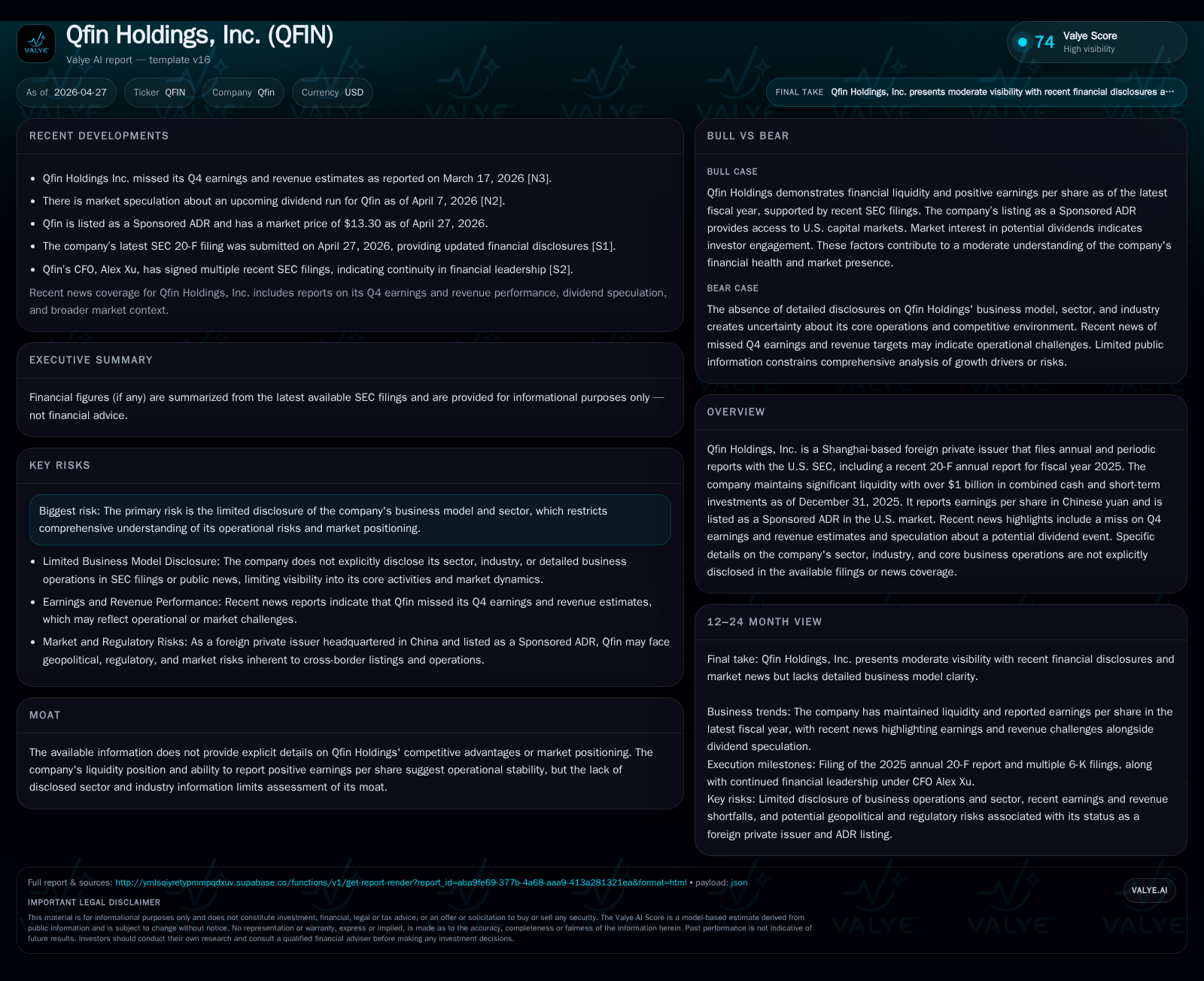
Qfin Holdings reported Q4 2025 earnings and revenue below analyst estimates in its March 2026 filings, signaling near-term operational challenges. Despite these setbacks, the company maintains a robust liquidity position with over $670 million in cash and equivalents as of year-end 2025. The firm’s contractual VIE structure introduces control and enforcement risks that complicate its operational resilience and market positioning. Ongoing dividend speculation underscores management’s confidence in financial flexibility, though growth catalysts remain opaque given limited disclosure of product or sector focus.
Recent Quarterly Operating Update: Earnings Shortfall and Market Reaction
In March 2026, Qfin Holdings submitted its latest quarterly update via Form 6-K revealing that fourth quarter earnings and revenues fell short of market expectations [S2][N1]. This earnings miss stems from operational headwinds that tempered top-line expansion and squeezed margins. The company’s discretion-laden contractual revenue streams reported weaker than forecast results, eliciting investor concern reflected in after-hours market reactions [N1][N2]. While no detailed segmental disclosures clarify specific pressure points, the outlined misses warrant caution around the near-term trajectory absent clear turnaround signals.
Business Model Dynamics: Understanding Qfin’s Contractual Control over VIEs
Qfin’s core operational framework relies on Variable Interest Entity (VIE) contracts rather than direct equity ownership within China [S1]. This model involves a series of exclusive business cooperation agreements granting Qfin control rights over VIEs’ economic interests without formal shareholding. While this construct circumvents Chinese foreign investment restrictions, it carries notable enforcement risk if VIE shareholders fail to comply or dispute arises. Lack of direct governance via board control limits the firm’s ability to effect swift management changes or operational pivots within the VIEs.
These contractual controls depend heavily on PRC legal mechanisms for enforcement, involving arbitration or litigation with uncertain outcomes. The risk resides in counterparties’ potential uncooperativeness or adverse actions shifting control away from Qfin. This structural vulnerability casts a persistent shadow over operational stability despite apparent profitability [S1].
Industry Context: Competitive Landscape and Regulatory Influences
Though Qfin does not explicitly disclose its industry sector, indicators suggest it operates within fintech or technology-enabled services typical for firms using VIE models based in Shanghai [S1]. Its operating environment is complicated by evolving U.S.-China relations imposing investment restrictions, export controls, and heightened scrutiny over Chinese ADRs [S1]. The U.S. Department of Commerce’s BIS rules limiting access to advanced semiconductor technologies illustrate the broader backdrop of regulatory pressures potentially constraining innovation or capital access.
Within this context, competition likely involves both domestic Chinese peers navigating similar regulatory landscapes and international players limited by geopolitical frictions. Cybersecurity emerges as a vital area; Qfin highlights comprehensive internal measures overseen by an established security executive framework aimed at safeguarding data integrity and network operations – a necessary competitive barrier given rising cyber threats [S1].
Growth Drivers Outlook: Dividend Speculation and Market Penetration Potential
Recent media outlets have speculated about an imminent dividend announcement by Qfin, fueled by the company’s substantial liquidity pool from accumulated profits [N5]. This prospect signals management’s intent to return capital to shareholders potentially reflecting confidence in cash flow generation and financial flexibility.
However, deploying significant cash for dividends may constrain reinvestment in growth initiatives unless balanced prudently. Given limited disclosures on product launches or client acquisition momentum in filings, visible organic growth drivers remain unclear [S1][N1]. The potential for dividend distributions must therefore be weighed against longer-term market penetration strategies which are presently opaque.
Challenges and Constraints: Operational Risks and Policy Uncertainties
A critical constraint stems from the undisclosed sector exposure combined with dependence on VIE contractual arrangements that heighten counterparty risk and enforcement complexity [S1]. Additionally, China's governmental currency conversion controls restrict immediate repatriation or overseas utilization of net revenues generated domestically – potentially limiting global deployment options for capital.
Interest rate shifts affect returns on invested proceeds held in fixed or floating rate instruments presenting valuation variability risks as noted in the annual report [S1]. Moreover, ongoing geopolitical tensions manifest through U.S. investment curbs on Chinese companies create regulatory uncertainty impacting shareholder appetite and potential future fundraising.
These external factors intersect with internal risk management priorities focusing heavily on cybersecurity protection frameworks designed to prevent data breaches or transmission failures—an operational necessity safeguarding both client trust and regulatory compliance [S1].
Watch Points: Upcoming Milestones, Guidance, and Demand Signals
Investors should monitor forthcoming announcements tied to scheduled board meetings and public release dates for next quarterly results as disclosed in early March filings [S3][S2]. These events will provide updates on performance trends post-Q4 challenges.
Clarity regarding dividend declaration timing and size will be critical to assess capital allocation philosophy relative to growth investment needs [N5]. Additionally, any commentary from management around evolving regulatory impacts or strategic repositioning could offer insights into mitigating operational risks linked to the VIE model. Absence of clear demand-side data suggests tracking bookings, platform metrics (if disclosed), or renewal rates would be prudent should such indicators become available.
Financial Snapshot: Liquidity Strength Amid Margin Pressures
Qfin maintains a robust liquidity position highlighted by approximately $671 million in cash and cash equivalents complemented by current assets of roughly $7.08 billion against current liabilities near $2.91 billion as of December 31, 2025—yielding a strong current ratio of 2.43 supportive of short-term solvency [F1]. Total debt stands relatively low versus cash at approximately RMB247 million as last recorded end-2024 ensuring minimal leverage burden.
Despite these strengths on the balance sheet front, operating income reported at just under $955 million indicates operational scale but juxtaposes against recent quarterly earnings misses underscoring margin pressures likely emanating from competitive pricing or increased compliance costs [F1][S2]. Net income details from latest filings are not current but previous figures suggest positive albeit volatile profitability trends.
The healthy cash reserves underpin speculative dividend feasibility while providing buffer against policy-induced capital flow disruptions—critical for maintaining investor confidence amid broader structural risks.
This analysis aims to illuminate Qfin Holdings' near-term operating challenges alongside its entrenched structural vulnerabilities due to reliance on contractual VIE arrangements within a fraught regulatory landscape. While financial liquidity stands out as a key asset supporting strategic options including dividends, lack of clear growth visibility invites cautious monitoring around upcoming disclosures for meaningful demand signals or directional guidance.
This report does not constitute investment advice or recommendations but provides an informed perspective grounded in publicly filed disclosures and relevant market context.
Disclaimer: This is research-only, informational analysis and not investment advice. It may include AI-generated interpretation and general industry context. Always verify important details using primary sources.

Comments