
Check-Cap Advances Merger Synergies with MBody AI Amid Nascent Commercial Expansion
Recent quarterly disclosures demonstrate commercial traction ahead of Check-Cap’s merger with MBody AI, highlighting strategic growth amid regulatory and financial risks.
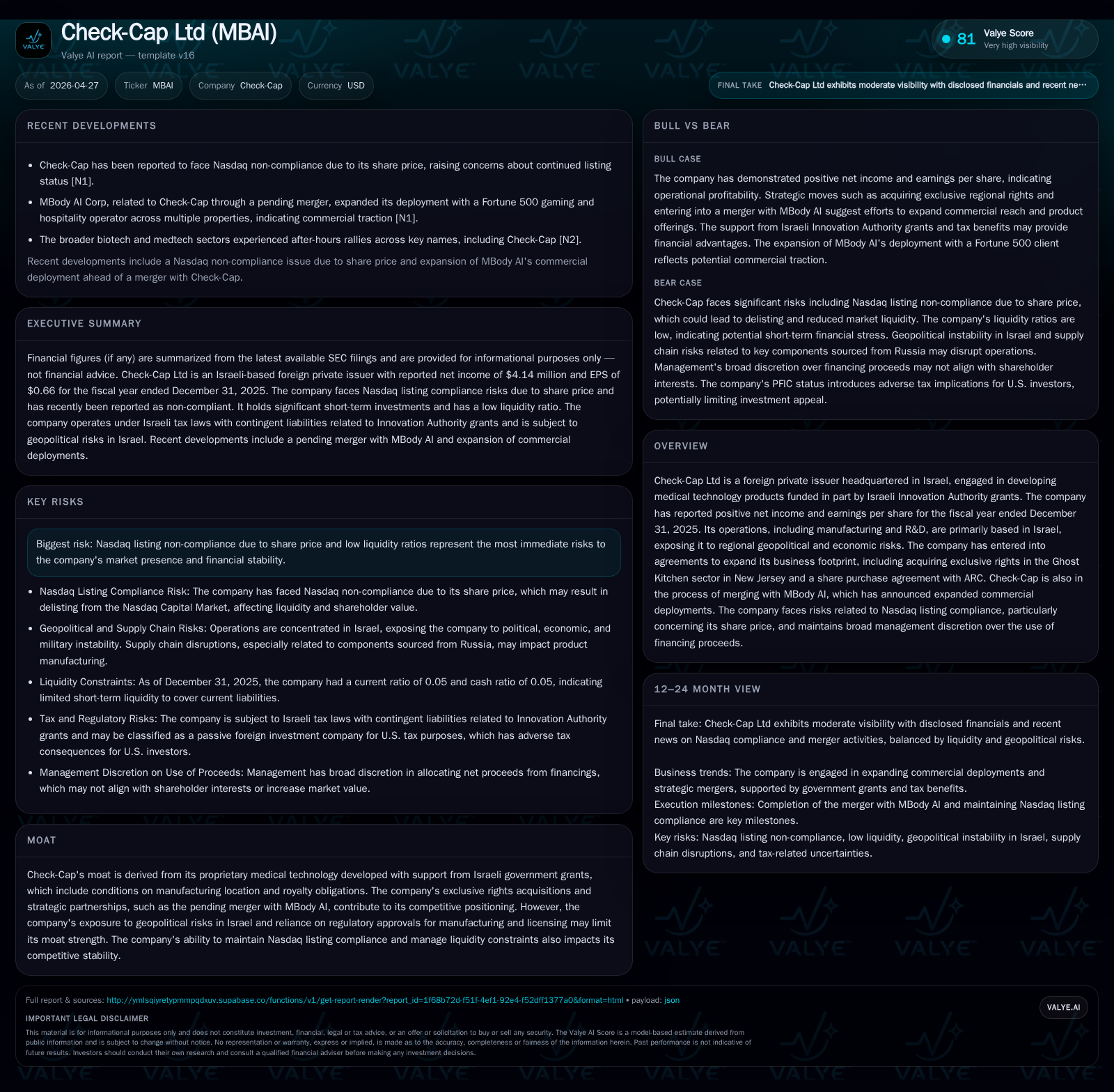
Check-Cap Ltd’s latest quarterly filing reveals that MBody AI has broadened a deployment with a major Fortune 500 gaming and hospitality client across multiple properties, signaling tangible sales momentum prior to the planned merger. The company continues to pivot from its core proprietary medical imaging technology into complementary sectors, including ghost kitchen licensing in New Jersey and strategic capital arrangements. While these developments represent clear growth levers, Check-Cap faces immediate Nasdaq listing compliance risks alongside liquidity challenges exacerbated by geopolitical exposure in Israel. Upcoming merger milestones and regulatory reviews remain critical near-term monitor points.
Catalyst in Q1 2026: MBody AI Partnership Expansion
On March 26, 2026, Check-Cap Ltd reported that MBody AI Corp had expanded an existing deployment with a Fortune 500 gaming and hospitality operator across multiple properties [S2]. This operational disclosure marks a significant commercial milestone evidencing continued traction ahead of the planned merger between Check-Cap and MBody AI. The scaling of this engagement demonstrates nascent revenue generation capabilities for the combined entity beyond legacy medical device offerings. Given the competitive dynamics in AI-powered wellness technology integration for lifestyle sectors such as hospitality and gaming, this multi-property rollout underscores MBody AI’s executional progress amidst the broader transformation of Check-Cap's business profile.
This announcement serves as a tangible precursor to imminent corporate restructuring as Check-Cap prepares for the merger's completion anticipated in H1 2026. It highlights a shift from pure tech development toward market-facing deployments capable of validating growth assumptions embedded in investor narratives around synergies between Check-Cap’s established medtech platform and MBody AI's emerging commercial foothold.
Business Model Foundations: Proprietary Medical Tech and Emerging Offerings
Check-Cap historically generates revenue through its proprietary medical imaging platform designed for colon cancer screening without sedation or radiation exposure [S1]. The core technology was developed leveraging grants from the Israeli Innovation Authority (IIA), which fund up to 50% of approved R&D expenditures but come with constraints including mandatory local manufacturing commitments and royalty obligations—estimated at 3-4% of product sales until full repayment of grants plus interest [S1][F1]. These conditions create both advantages through innovation subsidies and structural limitations given manufacturing restrictions largely anchored to Israeli facilities.
To diversify beyond its initial medtech niche, Check-Cap acquired exclusive rights via an asset purchase agreement with Parea LLC for ghost kitchen area representation across New Jersey [S1]. This move introduces a non-traditional revenue channel unrelated directly to healthcare technology but indicative of strategic breadth aimed at leveraging delivery sector growth trends. The company issued shares as consideration, reflecting a capital-intensive expansion into emerging digital food services licensing.
Complementing these initiatives is the forthcoming integration of MBody AI’s capabilities targeting wellness technology applications within consumer-facing sectors such as hospitality. This creates a layered business model combining legacy medical tech intellectual property with scalable AI solutions addressing new verticals.
Market and Industry Position: Competitive Moat and Regulatory Terrain
Check-Cap’s moat is rooted primarily in its proprietary imaging technology protected by government-sponsored R&D investments that impose tight IP control but also restrict operational flexibility due to manufacturing location stipulations [S1][F1]. While this protected niche provides differentiation within colorectal screening alternatives, overall scale remains limited by high regulatory barriers typical of medtech devices requiring strict approvals.
Geopolitical risk factors compound competitive challenges given that principal R&D, manufacturing sites, and certain suppliers are concentrated in Israel—a region characterized by periodic political instability impacting supply continuity [S1][S24]. Notably, one critical isotope used in their C-Scan product originates from Russia; ongoing sanctions and export controls risk disrupting supply chains.
From a market standpoint, exposure to Nasdaq listing rules presents additional pressure. The company currently faces potential non-compliance related to minimum share price thresholds that expose it to delisting risks if unremedied [N1][S1]. Combined with historically low liquidity—shown by an end-2025 current ratio of approximately 0.05 reflecting current assets versus liabilities disparity—the company must navigate capital markets carefully.
Growth Levers: Merger Momentum, Strategic Acquisitions, and Licensing Agreements
The primary growth driver centers on closing the merger with MBody AI, anticipated in the first half of 2026 following submission of Nasdaq listing applications by MBody AI earlier in February 2026 [S3]. This step represents a critical regulatory hurdle potentially unlocking streamlined access to US public markets under NASDAQ standards for the combined enterprise.
Additionally, Check-Cap executed a purchase agreement with ARC Group International Ltd in December 2025 whereby ARC committed to acquire up to $30 million of ordinary shares over three years via advance notices subject to ownership caps (~9.99%), providing immediate capital raising optionality without fixed debt or dilutive public offerings [S1][S22]. This structure offers flexible funding that could finance working capital needs or strategic investments post-merger.
Licensing deals such as the exclusive ghost kitchen area representative rights highlight efforts to build complementary businesses benefitting from increasing delivery market penetration, which could serve as non-correlated revenue buffers alongside medical technology sales.
Risks Modalities: Nasdaq Listing Compliance and Geopolitical Exposure
Immediate concerns revolve around maintaining compliance with Nasdaq continued listing criteria amid share price volatility threatening delisting status [N1]. Persistent low trading volumes exacerbate liquidity challenges reducing share price support mechanisms and complicating equity financing strategies.
Concurrently, regional geopolitical tensions weigh heavily on operational stability given Check-Cap’s Israeli-centric manufacturing footprint vulnerable to disruptions caused by armed conflicts or terrorism affecting workforce availability or supplier operations [S1][S24]. The reliance on Russian-sourced isotopes adds supply chain risk exacerbated by international sanctions potentially causing product redesign delays or sourcing cost inflation.
Inflationary pressures globally threaten increased production costs for raw materials, labor, and services essential for sustaining product rollouts. Combined macroeconomic uncertainty creates an environment where securing rational-priced financing may prove difficult or dilutive.
Monitor Points: Upcoming Milestones and Capital Raising Developments
Critical near-term watch items include:
- Finalization timing of the Check-Cap / MBody AI merger conditional on regulatory reviews related to Nasdaq listing application progress [S3][S6].
- Progression of ARC equity purchase tranches which provide liquidity runway but depend on favorable market conditions and regulatory shareholder approval thresholds if ownership limits are exceeded [S1][S22].
- Updates on patent filings or compliance matters tied to IIA grant conditions affecting transferability or manufacturing modifications that could impact production economics [S1].
- Market reaction surrounding announcements addressing Nasdaq compliance issues; resolutions here may alleviate delisting risks.
Tracking large-customer deployments analogous to the multi-property gaming/hospitality operator engagement will also be key gauging scaled adoption post-merger announcement.
Financial Overview: Profitability Status and Liquidity Constraints
However, the balance sheet reveals substantial liquidity strain reflected by end-2025 cash & equivalents totaling approximately $2,000 USD against current liabilities exceeding $4 million resulting in an acute working capital deficit (current ratio ~0.05) suggesting potential near-term funding requirements absent inflows from agreements such as ARC’s equity purchases or transaction closings related to strategic mergers [F1][S1].
This financial profile positions management toward measured capital allocation prioritizing essential R&D continuation and meeting regulatory milestones while balancing dilution risks associated with equity raises.
This analysis is based solely on publicly available filings as cited; it does not constitute investment advice or recommendations.
Disclaimer: This is research-only, informational analysis and not investment advice. It may include AI-generated interpretation and general industry context. Always verify important details using primary sources.

Comments