
Terns Pharmaceuticals Advances CML Treatment with FDA Breakthrough Therapy Designation Amid Merck Acquisition
FDA grants Breakthrough Therapy Designation to TERN-701, enhancing Terns’ clinical-stage pipeline and strategic value ahead of Merck’s acquisition.
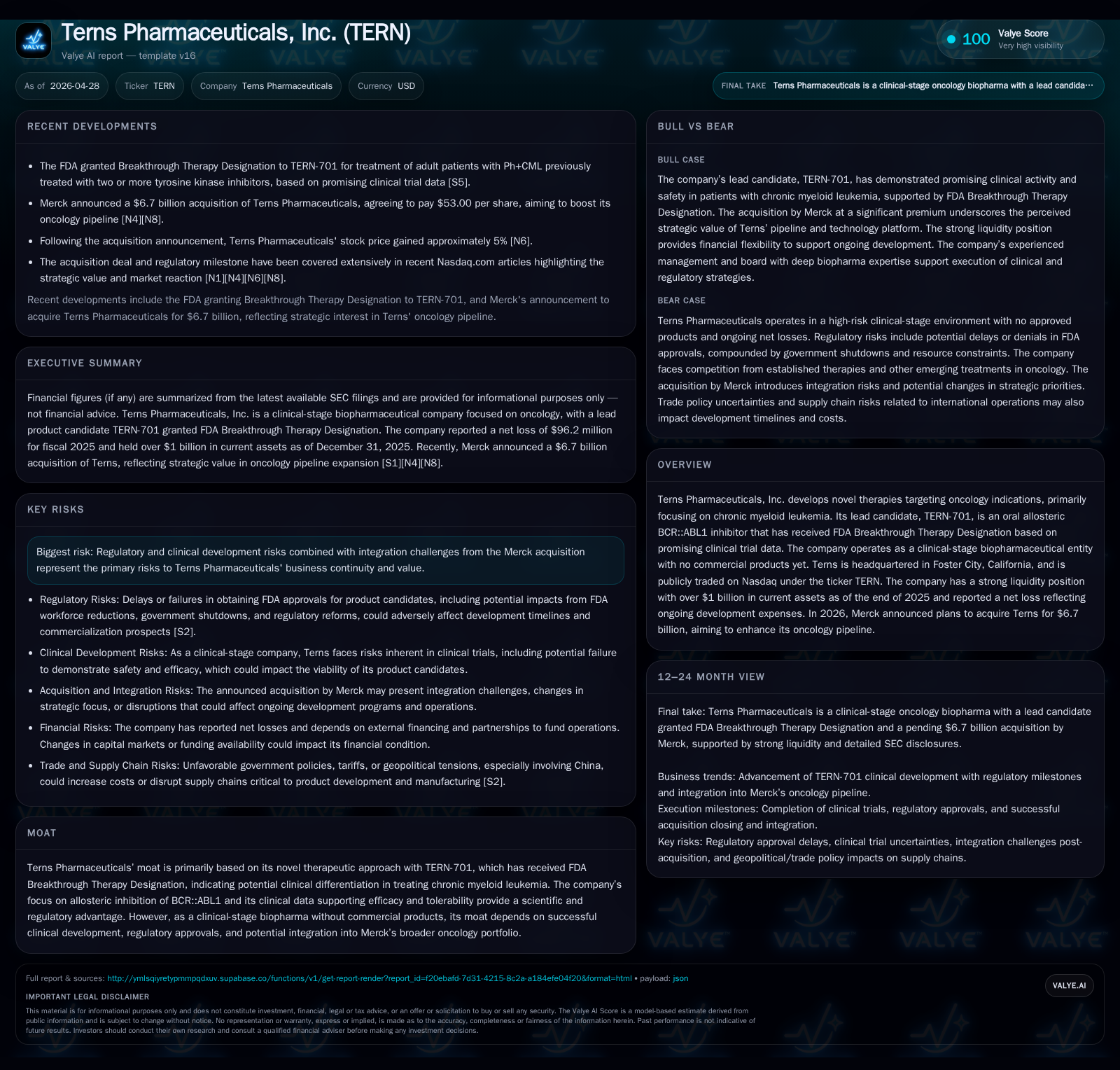
On April 27, 2026, Terns Pharmaceuticals announced that the FDA granted Breakthrough Therapy Designation (BTD) to its investigational oral allosteric BCR::ABL1 inhibitor, TERN-701, for adult patients with chromosome-positive chronic myeloid leukemia (Ph+CML) in the chronic phase without the T315I mutation who have failed two or more tyrosine kinase inhibitors. This milestone, disclosed via an 8-K filing, underscores promising Phase 1/2 data demonstrating notable molecular responses and tolerability. The designation accelerates TERN-701’s development pathway at a critical juncture preceding Merck’s planned $6.7 billion acquisition of Terns, positioning the company for integration within a larger oncology portfolio. While regulatory and clinical risks remain amid FDA workforce challenges, robust cash reserves support ongoing R&D investments [S3][F1].
FDA Breakthrough Therapy Designation Highlights Clinical Progress
On April 27, 2026, Terns Pharmaceuticals disclosed via an SEC Form 8-K that the FDA granted Breakthrough Therapy Designation (BTD) to TERN-701 for treating adult patients with chromosome-positive chronic myeloid leukemia (Ph+CML) in the chronic phase who lack the T315I mutation and have experienced failure or intolerance to two or more prior tyrosine kinase inhibitors (TKIs) [S3]. This designation recognizes preliminary clinical evidence suggesting substantial improvement over existing therapies in this difficult-to-treat population.
BTD offers an accelerated development and review pathway including intensified FDA guidance and eligibility for rolling submissions and priority review. This regulatory recognition validates TERN-701’s therapeutic promise and supports expedited progress toward potential approval.
Business Model: Clinical-Stage Development of Novel Allosteric Inhibitors
Terns focuses on developing oral small-molecule therapeutics targeting hematologic malignancies. Its lead candidate, TERN-701, is a novel allosteric inhibitor of the BCR::ABL1 kinase—an oncogenic driver in Ph+CML—differentiated from traditional ATP-competitive TKIs by binding distinct regulatory sites to modulate kinase activity selectively [S1][S3][F1].
This mechanism aims to overcome resistance mutations commonly encountered in refractory patients. The company’s value proposition rests on proprietary intellectual property around this novel modality combined with advancing clinical assets such as the CARDINAL Phase 1/2 trial showing encouraging molecular response rates at week 24 among heavily pretreated patients including those exposed to previous allosteric agents [S3][S8].
As a clinical-stage biotechnology firm without approved products or revenues, Terns invests heavily in research and development activities.
Industry Context and Competitive Positioning
The CML treatment landscape has long been led by ATP-competitive TKIs such as imatinib and later-generation agents addressing resistance mechanisms. Allosteric inhibitors like TERN-701 represent an emerging class offering differentiated efficacy against resistant variants [S1][S2].
While patent protection provides exclusivity over its chemical entity and mechanism, competition remains intense from entrenched branded therapies with physician familiarity and reimbursement advantages.
Pricing power will depend on demonstrating superior response durability or safety benefits over both branded competitors and generics within evolving clinical guidelines. Regulatory risks include delays linked to recent FDA workforce reductions stemming from government-wide reorganization efforts potentially impacting review timelines [S2], though BTD status helps mitigate these uncertainties.
Growth Drivers: Clinical Advancement and Strategic Acquisition Synergies
Key near-term growth catalysts include progression through pivotal late-stage trials with anticipated Phase III data readouts, possible indication expansions beyond non-T315I mutated cohorts, and leveraging accelerated approval pathways enabled by BTD designation [S3].
The announced acquisition by Merck offers expanded commercialization reach globally alongside enhanced regulatory expertise facilitating New Drug Application filings and market access strategies [N10]. Synergies are expected in operational scale-up for launch readiness including patient access programs.
Successful trial enrollment milestones combined with robust post-marketing surveillance planning will be critical as the company transitions toward potential commercialization.
Risks: Regulatory Timing and Post-Merger Integration Challenges
Despite positive momentum, risks persist notably around regulatory review timing due to FDA staffing constraints highlighted in recent quarterly disclosures [S2]. Such factors could delay critical feedback or approvals affecting development timelines.
Post-acquisition integration poses execution risks related to aligning therapeutic focus within Merck’s expansive oncology portfolio. Maintaining innovation velocity while managing cultural integration will be essential to preserve pipeline value.
Financial Position Supports Ongoing Development
As of December 31, 2025, Terns reported cash and equivalents of approximately $524.7 million against modest current liabilities near $16.4 million—resulting in a strong current ratio exceeding 62—indicating robust liquidity to fund ongoing R&D activities without immediate financial constraints [F1].
Operating losses totaled approximately $96.2 million for full-year 2025 reflecting intensive investment typical of early-stage biopharmaceutical companies progressing candidates through clinical development [F1].
Investor Considerations: Monitoring Clinical Milestones and Acquisition Progress
Key items for investors to watch include:
- Updates on CARDINAL trial progression including transition toward Phase III,
- Regulatory interactions utilizing BTD benefits,
- Timing of New Drug Application submissions,
- Developments regarding completion of Merck acquisition including regulatory clearance,
- Indicators of effective integration post-merger ensuring continued pipeline advancement.
Close tracking of these operational indicators will provide insight into both clinical validation pacing and strategic execution success.
This analysis synthesizes publicly filed disclosures alongside sector context without endorsing investment decisions. Investors should consult additional sources when evaluating equity securities or pharmaceutical pipelines.
Disclaimer: This is research-only, informational analysis and not investment advice. It may include AI-generated interpretation and general industry context. Always verify important details using primary sources.

Comments