
Albertsons Advances Digital Growth While Managing High Leverage and Regulatory Pressure
Latest quarterly filing reveals steady retail sales growth and digital momentum amid evolving pharmacy regulations and capital management challenges.
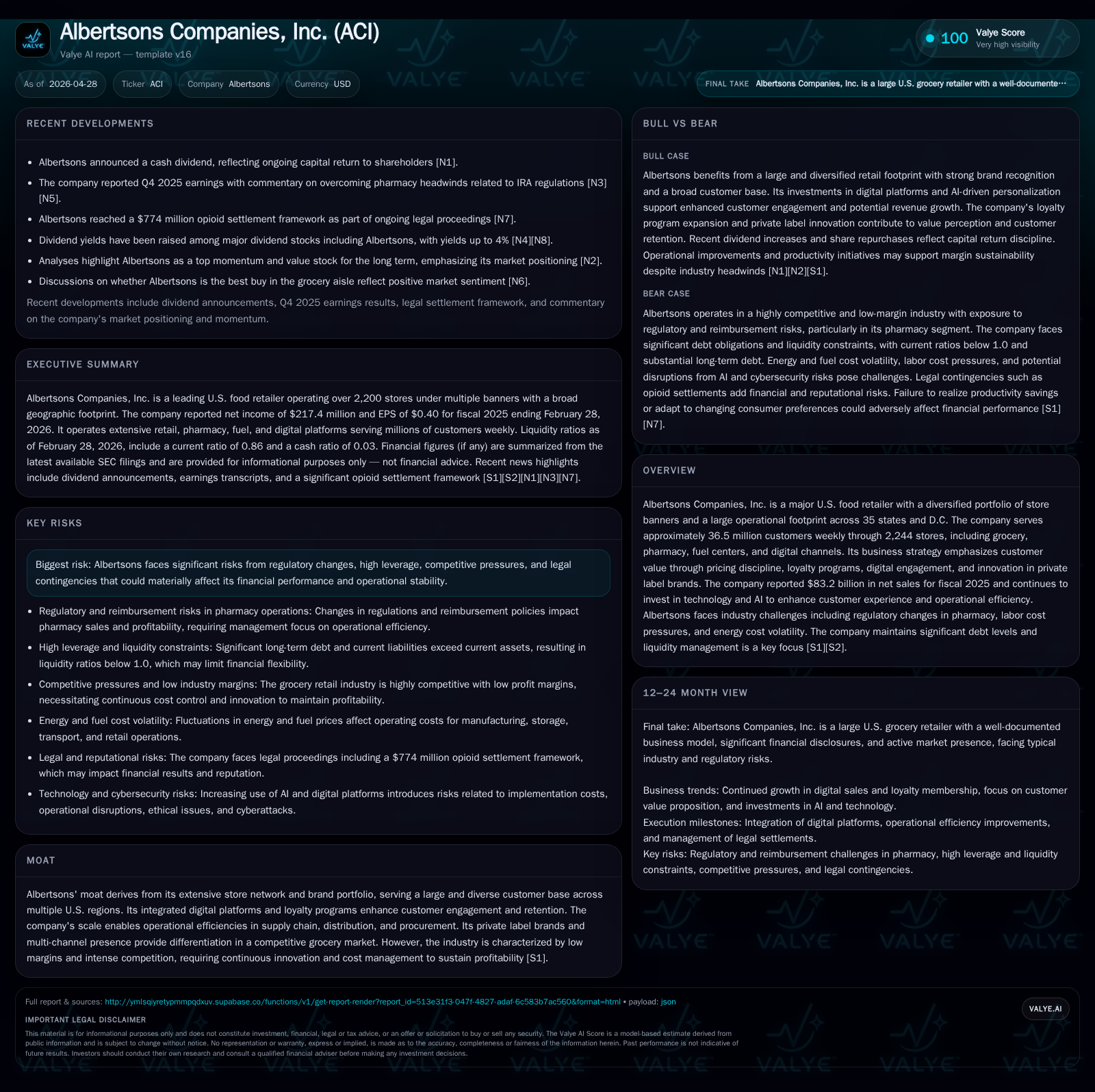
Albertsons Companies, Inc. reported a 2.0% increase in identical store sales (excluding fuel) for the quarter ended November 29, 2025, driven by a 21% surge in digital sales and expansion of its loyalty program to over 51 million members. The company is leveraging AI-driven personalization and supply chain tools to enhance customer engagement and operational efficiency, but continues to navigate significant headwinds from pharmacy regulatory shifts and a heavy debt load exceeding $8.6 billion. Recent refinancing actions and increased share repurchase authorizations demonstrate active capital deployment amidst persistent margin pressures.
Latest Quarterly Operating Update
Albertsons Companies, Inc.'s third-quarter fiscal 2025 results, filed on January 7, 2026, provide fresh insight into the company's operational momentum amid a challenging grocery retail environment [S2]. The retailer posted retail segment sales of approximately $18.9 billion for the quarter ended November 29, 2025, increasing modestly from $18.6 billion year-over-year. This translated into net sales and other revenue totaling about $19.1 billion for the period.
Core identical store sales rose by 2.0%, excluding fuel—a metric representing established store performance—underscoring stable consumer demand despite macroeconomic dynamics. Digital channels continue to be a notable driver: digital sales surged by an impressive 21% year-over-year as Albertsons expanded curbside pickup (Drive Up & Go) and home delivery offerings. Loyalty program membership grew by 12%, reaching a substantial base of over 51 million members; program simplification and enhanced reward redemption underpinned this growth, signaling deepening customer engagement.
However, the pharmacy business faced headwinds due to evolving reimbursement policies and regulatory scrutiny that have pressured margins despite operational improvements [S2][N3]. This segment remains a critical contributor but requires continued strategic focus to manage external risks.
From a capital structure standpoint, Albertsons executed a key refinancing maneuver by fully redeeming $750 million of senior unsecured notes due in March 2026 ahead of maturity [S2]. This proactive liability management aims to mitigate near-term refinancing risks within an elevated indebtedness profile.
Business Model Overview
Albertsons operates as one of the largest food retailers in the United States with a diversified portfolio comprising over two thousand stores across multiple well-recognized banners such as Safeway, Vons, Jewel-Osco, Shaw’s, ACME, and many others [S1]. The company's revenue predominantly stems from grocery sales encompassing perishables like fresh produce and meat, non-perishable packaged foods, pharmacy services, fuel centers, and ancillary products sold via proprietary coffee shops within its stores.
A critical element of Albertsons’ business model is its multi-channel approach integrating physical retail with robust digital platforms encompassing eCommerce, loyalty programs, pharmacy services, and mobile app engagement. The company emphasizes customer value proposition through disciplined pricing strategies reinforced by promotional planning informed by advanced analytics and AI applications [S1].
Private label brands (“Own Brands”) play a significant role in differentiating Albertsons within the competitive landscape by offering higher-margin alternatives tailored to customer preferences.
The pharmacies embedded within many locations add another revenue stream though currently are affected by policy volatility related to reimbursement frameworks from payers including Medicare Part D changes [S1][N3]. Fuel centers contribute non-food transactional revenues but are subject to fluctuations in energy markets.
Industry Structure and Competitive Position
The U.S. grocery sector is characterized by intense competition among national chains (Kroger), discounters (Walmart), warehouse clubs (Costco), specialty retailers (Whole Foods/Amazon), regional players, and expanding online grocers. Albertsons holds a substantial footprint with nearly 36.5 million weekly customers across 35 states plus D.C., granting it scale economies particularly in procurement, distribution logistics via its network of dedicated distribution centers, manufacturing capabilities for private brands, and marketing reach [S1].
Its portfolio breadth—more than twenty banners—allows localized brand equity leverage while maintaining centrally managed operations for cost efficiency.
Digital capabilities increasingly shape competitive advantage in customer acquisition/retention; Albertsons’ AI-driven personalized marketing approach aims to boost basket sizes and purchase frequency leveraging loyalty data [S1]. Its Media Collective—a platform enabling targeted advertising—represents an emerging business line aligned with data monetization trends seen across retail sectors.
Nonetheless, grocers operate on thin margins compounded by labor cost inflation pressures (especially wages/benefits in store operations), energy cost volatility impacting fuel center profitability, fluctuating food commodity costs affecting product pricing levers, and regulatory complexity around pharmacy operations.
Growth Drivers and Constraints
Drivers:
- Continued expansion of digital retail channels driving online penetration beyond traditional brick-and-mortar shopping;
- Growth of loyalty program membership enhancing data analytics effectiveness for personalized promotions;
- Investment in AI-enabled supply chain technologies such as Gateway forecasting tools that improve inventory management accuracy leading to lower waste/costs;
- Private label brand innovation delivering higher margins relative to national brands;
- Store remodels (94 completed in fiscal 2025) improving shopping experience and competing against modern formats;
- Incremental new store openings that selectively expand market presence.
Constraints:
- Meaningful leverage with total debt exceeding $8.6 billion as of February end creates financial rigidity requiring cautious liquidity management—the current ratio stood at roughly 0.86 against current liabilities near $7.8 billion [F1][S2];
- Pharmacy segment revenue impacted by regulatory modifications notably under the Inflation Reduction Act affecting drug pricing and Medicare reimbursements [N3];
- Intense competition from discounters putting downward pressure on pricing power;
- Labor cost inflation impacting store-level margins;
- Energy price volatility influencing fuel center profitability,
- Need for continuous technology investment both digital customer experiences and backend systems that require capex above $1.8 billion recently [S1];
- Legal contingencies such as opioid settlement frameworks potentially straining operating cash flow [N6].
What To Watch Next
Observers should monitor several key developments to gauge Albertsons' trajectory:
- Performance updates on identical store sales growth excluding fuel considering ongoing macroeconomic uncertainties;
- Trends in digital sales acceleration along with adoption metrics for its AI-enabled shopping assistant platform mentioned as evolving during fiscal 2025 [S1];
- Execution outcomes regarding pharmacy profitability mitigation amid regulatory pressures especially post Inflation Reduction Act impacts;
- Capital allocation shifts including share repurchase activities following the April 14 increase of repurchase authorization to $2 billion total alongside raised quarterly dividends [$0.17/share] indicating confidence but also balancing leverage concerns [S3][N1];
- Refinancing activity or modifications related to debt maturities beyond recent $750 million note retirement;
- Progress on productivity initiatives referenced under transformational productivity efforts aiming at cost containment while investing in customer experience enhancements;
- Any further legal or regulatory developments around opioid settlements affecting contingent liabilities [N6].
Financial Profile Summary
Albertsons maintains an elevated leverage profile as highlighted by total debt approximating $8.63 billion against modest cash & equivalents near $199 million as of February 28, 2026 [F1]. Net debt thus situates close to $8.43 billion indicating reliance on operating cash flows for interest coverage rather than liquid assets buffer.
Liquidity remains tightly managed given a current ratio below unity (~0.86), emphasizing the importance of careful receivables/inventory turnover optimization combined with refinancing discipline observed through recent note redemptions prior to maturity [F1][S2].
This analysis integrates SEC filings through the latest quarterly report dated January 7, 2026 ([S2]), supplemental event filings on April 14 ([S3]), and the comprehensive annual filing dated April 27 ([S1]) alongside recent news transcripts ([N3]). It does not constitute investment advice but provides an informed perspective grounded in publicly disclosed operating facts.
Disclaimer: This is research-only, informational analysis and not investment advice. It may include AI-generated interpretation and general industry context. Always verify important details using primary sources.

Comments