
Public Storage Advances Growth Through Strategic Expansion and Digital Marketing in Q1 2026
Public Storage's Q1 2026 results highlight strong rental income growth driven by new facility developments, aggressive pricing, and enhanced digital marketing efforts.
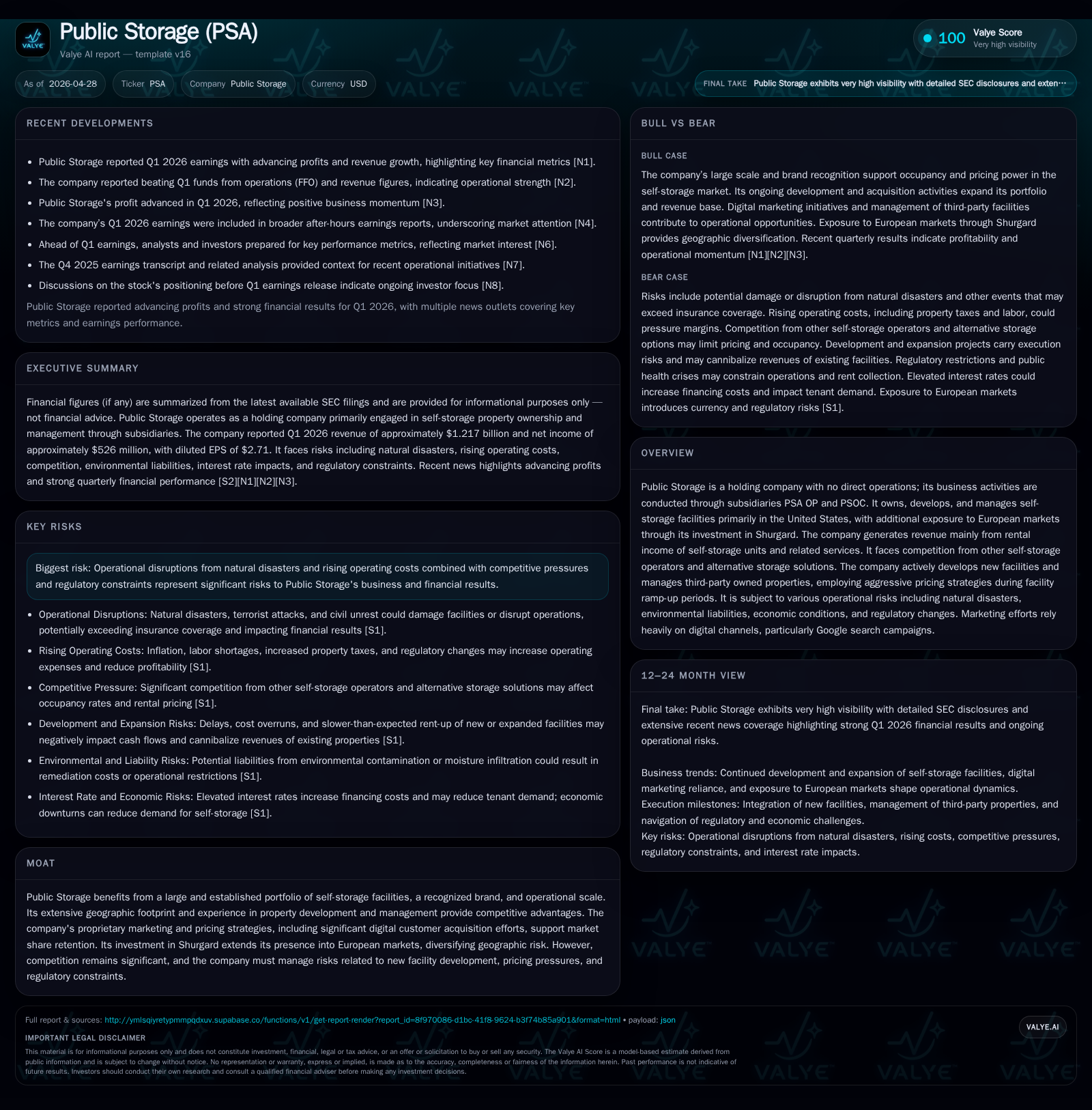
In Q1 2026, Public Storage (PSA) posted operational gains reflecting its strategy to leverage aggressive pricing during facility ramp-ups alongside expanded digital marketing campaigns to sustain tenant acquisition momentum. The company’s integrated business model, anchored by subsidiaries PSA OP and PSOC, underpins steady cash flow generation from self-storage rental units in the U.S. and Europe through Shurgard. Despite inflationary cost pressures and regulatory challenges, Public Storage's portfolio scale and geographic diversification remain key competitive advantages supporting growth from new developments and acquisitions.
Q1 2026 Operating Results: Key Highlights from the Latest Filing
Public Storage’s Q1 2026 report filed on April 27 reveals continued momentum in occupancy rates and rental revenue growth driven predominantly by the ramp-up of new facilities. The company maintained aggressive pricing strategies during these early phases to optimize unit yields amid heightened demand [S2]. Notably, the digital marketing initiatives—heavily reliant on Google search campaigns—have bolstered tenant acquisition cost-effectiveness as leasing velocity improved compared to the prior quarter [N2][N3]. Operating expenses exhibit moderate increases reflecting inflationary pressures particularly in maintenance and payroll categories, yet the firm’s scale allows some absorption of these cost escalations without severely impacting profitability.
An event filing concurrent with the quarterly report highlighted a planned issuance of senior notes to fund ongoing acquisitions and development projects supporting growth initiatives in both U.S. core markets and European ventures [S3][S22]. These financial measures underpin PSA’s strategic expansion thrust amid a competitive landscape.
Integrated Business Model Anchored on Self-Storage Rental Operations
Public Storage operates primarily through two subsidiaries: PSA Operating Partnership (PSA OP) and Public Storage Operating Company (PSOC). These entities own and manage a comprehensive portfolio of self-storage facilities across major U.S. metros while also extending international exposure via the publicly traded Shurgard entity in Europe [S1]. Revenue derives mainly from rental income on leased units supplemented by ancillary services such as tenant insurance upsells.
The company’s business model benefits from granular control over property operations enabling tactical pricing adjustments especially during facility ramp-up periods when initial occupancy scales up rapidly. This operational control ensures maximized revenue capture as properties mature into stabilized cash flow contributors. Geographic diversification via the Shurgard investment also mitigates risks inherent to localized economic cycles or regulatory shifts.
Competitive Advantages in Portfolio Scale and Digital Customer Acquisition
Public Storage commands significant scale with thousands of facilities nationwide serving millions of customers through a well-known brand. This footprint creates natural barriers to entry for smaller operators who struggle to achieve comparable economies or marketing reach [S1][N3]. Proprietary pricing algorithms facilitate dynamic rate optimizations that maintain profitability even amid competitive rate pressures.
Aggressive digital marketing investments have materially enhanced customer acquisition efficiencies; PSA leverages Google search campaigns as its primary lead source which translates into high-quality traffic capable of driving occupancy improvements and sustaining market share gains in dense urban regions where competition intensifies [N2]. Switching costs remain moderate but tend to favor PSA’s branded network given location convenience and service reliability.
Industry Dynamics: Pricing Power, Supply Constraints, and Regulatory Risks
The self-storage industry faces structural supply constraints due to stringent municipal zoning regulations that restrict new facility approvals particularly in high-demand urban cores. This limitation helps underpin durable pricing power for existing operators like Public Storage but caps rapid expansion potential [S1]. Inflationary headwinds impinge upon operating costs with notable upward pressure observed across property taxes—California representing a critical hotspot—and utility expenses.
Additional risks stem from natural disasters common in certain operational regions; insurance coverage gaps combined with portions of self-insured exposures place emphasis on risk mitigation preparedness [S1]. Regulatory changes related to environmental standards or real estate taxation reforms could further elevate operating expenses undermining net operating income if not passed through via rents.
Growth Catalysts: New Facility Developments and Strategic Geographic Expansion
Public Storage advances growth through an active development pipeline targeting incremental capacity primarily in high-barrier-to-entry regions. The company leverages operational expertise to expedite lease-up phases maximizing early-stage price premiums while defending against competitor encroachments [S2][S3]. Recent acquisition activity including the pending merger with National Storage Affiliates Trust (NSA) significantly boosts scale complementary to organic development efforts [N12][S4].
In Europe, the substantial stake in Shurgard broadens international exposure enhancing revenue resilience against U.S.-centric risks while tapping macro trends favoring urban self-storage solutions across multiple countries.
Challenges to Future Momentum: Cost Inflation and Market Saturation Risks
While revenue metrics show positive tenure, margin pressures may intensify as elevated labor wages, higher energy costs, rising property tax assessments—particularly if local assessors adopt new valuation approaches—and insurance premium inflation converge [S1][S2]. The partial self-insurance position exposes Public Storage to potential unpredictable liability costs increasing earnings volatility.
Market saturation is a nuanced risk primarily relevant in some mature metro areas where incremental supply entries could erode pricing leverage over time. Tenant retention rates must remain robust given relatively low switching barriers though brand loyalty partially offset this vulnerability.
Financial Position Insights: Addressing Liquidity and Debt Levels in Current Market Conditions
As of March 31, 2026, Public Storage reported liquidity comprising approximately $135 million cash and equivalents versus total debt outstanding near $9.77 billion yielding net leverage around $9.63 billion [F1]. This capital structure reflects prudent balance sheet management amidst sizeable capital deployment for development projects.
Recent debt issuances at favorable rates support refinancing efforts while preserving flexibility to fund acquisition synergies such as the NSA transaction alongside continued enhancements of core assets [S22][S2]. Ongoing free cash flow generation capacity coupled with scale economies provide foundation for managing debt service obligations without excessive liquidity strain.
Investor Watch Points: Upcoming Milestones and Market Signals
Key near-term indicators include quarterly leasing momentum post ramp-up which will reveal sustainability of aggressive pricing policies; integration progress from recent acquisition deals including operational performance alignment; efficiency metrics tied to digital marketing ROI; as well as responses to potential regulatory alterations impacting property tax burdens or environmental compliance costs [S2][N3]. Additionally, monitoring inflation trajectory on operating expenses against rental income growth will be critical to assess margin durability.
Overall, Public Storage’s strategic expansion coupled with disciplined execution underpin a cautiously optimistic outlook amid evolving industry dynamics.
Disclaimer: This is research-only, informational analysis and not investment advice. It may include AI-generated interpretation and general industry context. Always verify important details using primary sources.

Comments