
Steel Dynamics Boosts Capacity While Weathering Industry Headwinds in Q1 2026
Q1 2026 results highlight Steel Dynamics’ record shipments and aluminum segment ramp-up amid ongoing commodity price challenges.
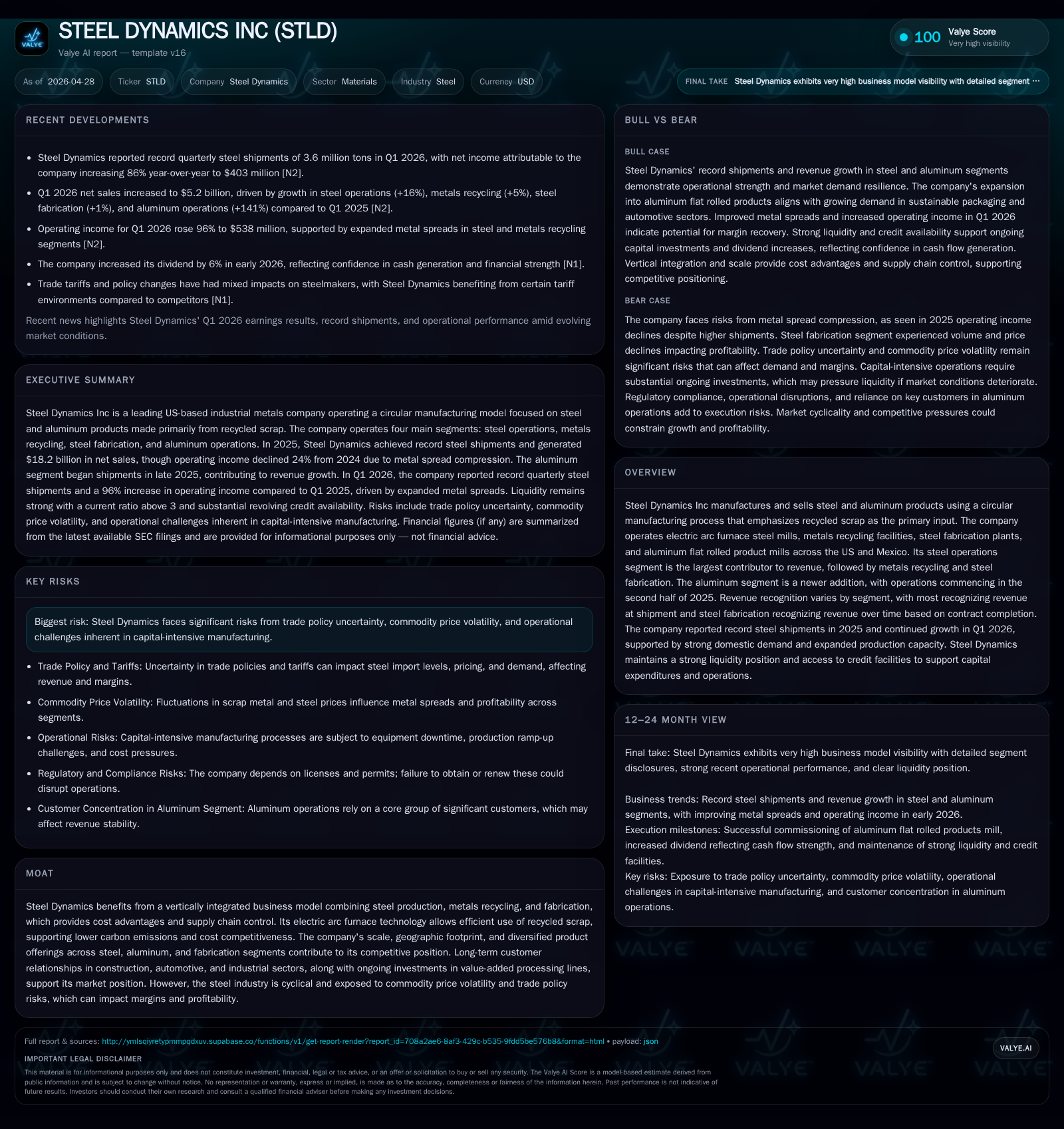
Steel Dynamics posted record quarterly steel shipments of 3.6 million tons in Q1 2026, continuing momentum from its full-year 2025 steel volume record. The newly commissioned aluminum flat rolled products mill, operational since mid-2025, added a fresh revenue stream in early 2026. While strong domestic steel demand supported shipment growth, compression of metal spreads and input cost volatility tempered margin expansion. The company’s vertically integrated model leveraging electric arc furnace technology and metals recycling underpins cost advantages despite cyclical industry headwinds and trade policy risks.
Q1 2026 Operational Update: Record Volumes and New Aluminum Production
In the quarter ending March 31, 2026, Steel Dynamics achieved record quarterly steel shipments totaling approximately 3.6 million tons. This milestone follows the company's record steel shipments of 13.7 million tons for full-year 2025 [S2][S3]. The sustained high volume attests to strong underlying domestic demand for steel products across key sectors such as construction and automotive. Concurrently, the aluminum operations segment—commissioned in the latter half of 2025—added new production streams supplying flat rolled aluminum products qualified for industrial, beverage can, and automotive use [S1][S2]. This diversification marks an important strategic inflection point for Steel Dynamics as it ramps aluminum output to complement its traditional steel portfolio.
Cost structures reflect the predominance of recycled scrap and scrap substitutes as primary raw materials within consolidated costs of goods sold; these inputs dominate direct variable costs alongside steel substrates and alloys [S2]. Utilities costs (electricity, natural gas), maintenance, labor compensation, transportation logistics, and depreciation also materially contribute to overall manufacturing expenses. To manage price exposure to volatile commodity markets—particularly nonferrous metals like aluminum and copper—Steel Dynamics actively employs exchange traded futures contracts strictly for hedging purposes rather than speculation. This risk management approach mitigates input cost swings that could otherwise erode margins [S2].
Business Model: Circular Manufacturing and Vertical Integration in Steel & Aluminum
Steel Dynamics operates a circular manufacturing model leveraging electric arc furnace (EAF) technology that primarily consumes recycled scrap metals as feedstock. This core capability enables lower carbon footprint production alongside cost efficiency by reducing reliance on raw ore mining inputs [S1]. The vertically integrated structure includes metals recycling facilities supplying ferrous and nonferrous scrap internally to the steel mills and aluminum operations.
Downstream steel fabrication plants specialize in producing joists, decking products, and coated or value-added processed steel items commanding pricing premiums. Revenue recognition varies by segment—with shipment-based revenue recognition standard for steel operations but contract-completion percentage methods applied primarily in steel fabrication [S1]. The recent addition of an aluminum flat rolled products mill broadens the customer base into more countercyclical end markets such as sustainable beverage can manufacturing while also serving automotive and industrial sectors [S1]. This integration across processing stages yields a supply chain advantage that dampens external raw material price swings and enables nimble capacity shifting.
Industry Context: Competitive Poise Amid Commodity Price Volatility and Regulatory Risks
The steel industry’s underlying cyclicality combined with pronounced volatility in metal prices compresses operating spreads despite robust shipment volumes [S1]. Pricing power varies by product grade and customer-driven premium specifications but is challenged by aggressive import dynamics influenced by trade policy uncertainties [S1][N11]. Steel Dynamics benefits from geographic scale across US and Mexican operations that diversify regulatory exposures yet still face input cost inflation via energy prices—particularly electricity and natural gas utilities integral to EAF processes.
Proactive hedging of metal inventories tempers some commodity risk but residual exposure persists given market fluctuations. Regulatory factors including potential tariffs or trade policy shifts inject additional uncertainty impacting competitive positioning versus foreign producers potentially subject to different compliance regimes [N11]. These headwinds necessitate operational robustness supported by lean manufacturing practices.
Growth Catalysts: Capacity Expansion, Domestic Demand Stability, and Value-Added Processing
Key growth drivers include continuing capacity utilization ramp-ups within established steel segments following prior capital investments. The nascent aluminum segment represents a strategic growth vector targeting higher recycled content flat rolled products preferred in countercyclical but sustainability-driven markets like beverage cans—a durable end-use case less tied directly to economic cycles [S1].
Further enhancing firm valuation prospects are value-added processing lines offering differentiation through coatings or fabricated dimensions attracting premium pricing versus commoditized steel sales. Stable domestic construction activity coupled with automotive sector demand strengthens shipment tonnage potential against a backdrop of moderated imports. Ongoing investments in processing technology underscore management’s intent to improve margin profiles via mix uplift [S3].
Constraints: Cyclicality, Input Cost Pressures, and Trade Policy Uncertainty
Despite operational strengths, Steel Dynamics faces inherent industry cyclicality limiting margin expansion consistency. Scrap pricing volatility influences direct raw material input costs while nonferrous metal price swings—though partially hedged—can erode profitability during adverse commodity cycles [S2]. Trade policy developments remain an unresolved risk; potential tariff reinstatements or changing import rules could inflate domestic raw material costs or pressure selling prices through import competition [S1][N11].
Additionally, energy cost inflation affects utility-heavy EAF steelmaking facilities impacting fixed overhead absorption under varying utilization levels. Capacity constraints may emerge if upstream scrap availability tightens amidst growing industry-wide demand backgrounds. Therefore, disciplined operational execution is essential to maintain resiliency.
Key Metrics to Watch: Spread Trends, Shipment Volumes, and Margin Recovery Potential
Investors should closely monitor metal spread trends reflecting the delta between finished goods selling prices versus underlying scrap or substitute raw material costs as leading indicators of margin pressure or recovery [S2][N1]. Shipment volumes by segment—in particular continued ramp-up momentum within the aluminum product lines—will signal effective commercial penetration of new markets.
Operational efficiency metrics including cost per ton produced relative to prior periods will reveal execution quality amidst market disruption. Company commentary during earnings calls provides forward guidance clarifying demand momentum or pricing trajectory expected to shape near-term financial results [N1]. Monitoring quarterly updates remains critical given volatile inputs affecting short-term performance.
Current Financial Position: Robust Liquidity and Manageable Leverage
As of March 31, 2026, Steel Dynamics reported cash and equivalents totaling approximately $556.5 million with current assets at about $6.8 billion against current liabilities near $2.17 billion yielding a current ratio exceeding 3x—a sign of ample near-term liquidity [F1][S2]. Total debt stood around $4.29 billion at year-end December 31, 2025 with net debt after accounting for cash estimated roughly at $3.7 billion indicating moderate leverage levels supportive of ongoing capital deployment [F1][S4][S5].
The company maintains a $1.2 billion senior unsecured revolving credit facility maturing July 2028 with room for incremental expansion subject to conditions supporting working capital needs alongside capital expenditure programs focused heavily on aluminum capacity expansion [S4][S5]. Financial covenants covering interest coverage ratios (minimum of 2.5x required) were comfortably met with trailing twelve months EBITDA coverage above thirteen times at year-end indicating strong debt service ability [S5][F1].
Capital expenditures continue targeted investments primarily within metals recycling augmentation alongside plant upgrades in steel processing operations aligned with strategic growth plans [S14]. Dividend increases reflective of confidence in free cash flow generation accompanied share repurchase authorizations underpinning shareholder returns flexibility even amid market challenges [S20][S11].
This analysis is based solely on information publicly provided through Securities and Exchange Commission filings as well as recent company disclosures up to April 27, 2026. It does not constitute investment advice but aims to provide an informed perspective on Steel Dynamics' operating performance and strategic positioning within the evolving industrial metals landscape.
Disclaimer: This is research-only, informational analysis and not investment advice. It may include AI-generated interpretation and general industry context. Always verify important details using primary sources.

Comments