
Getty Images Faces Financial Headwinds While Innovating Content Licensing
Recent litigation costs and leverage weigh on Getty Images as it invests in AI and platform innovation to sustain growth.
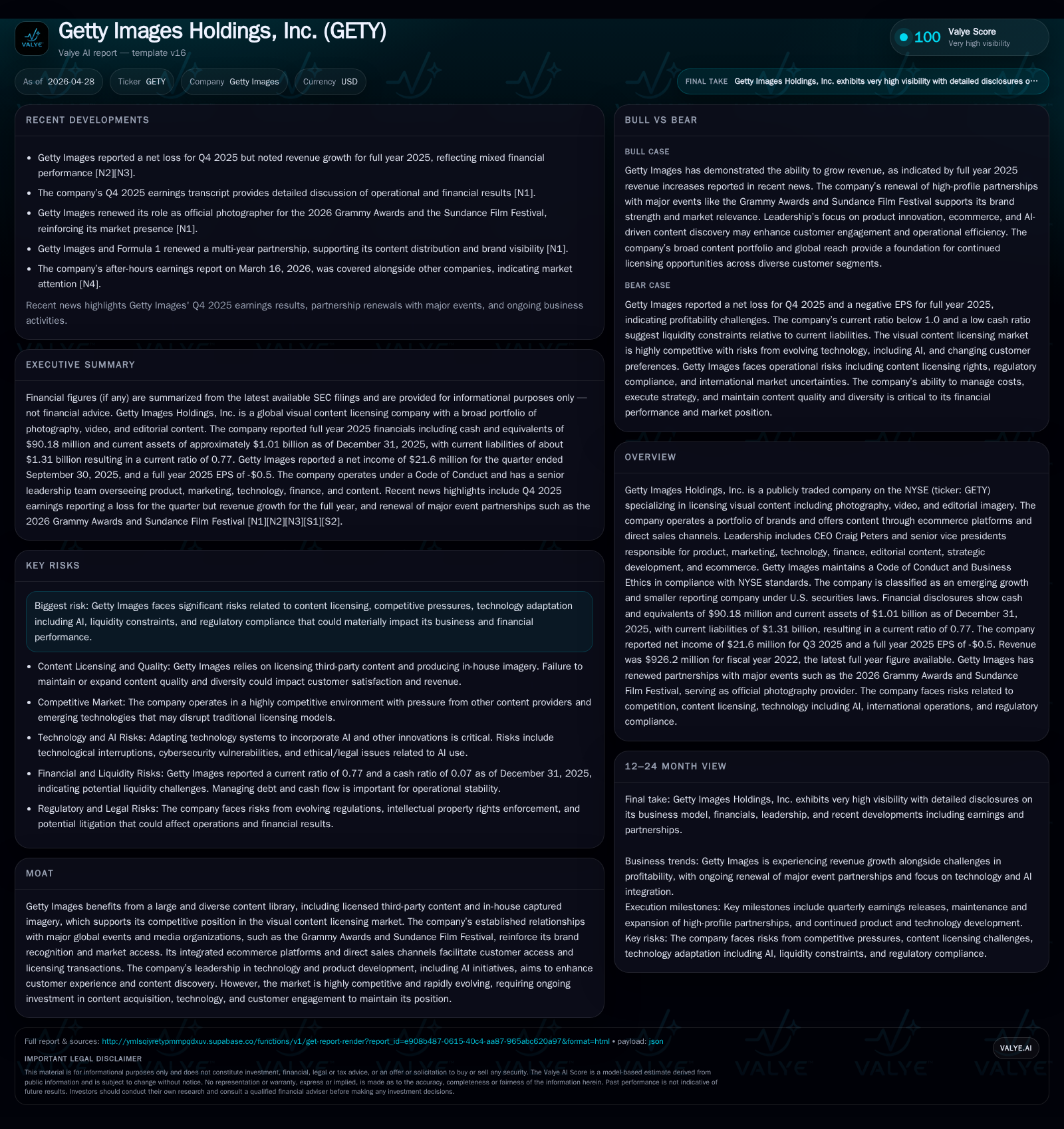
Getty Images disclosed in its April 2026 8-K a maintained reserve for a significant litigation judgment from 2023, planning to use its undrawn revolving credit facility to fund the payment. This development intensifies near-term liquidity and financial risk amid ongoing investment in AI-driven product enhancements and premium content partnerships. The company’s business model centers on licensing diverse visual content via ecommerce and direct sales channels, leveraging a vast library and strong event affiliations. However, high leverage, competitive pressures, and regulatory risks present challenges to growth. Monitoring debt management, AI rollout execution, and license renewal progress will be crucial ahead.
Recent Operating Developments Highlight Litigation Impact and Strategic Response
Getty Images updated investors on April 17, 2026, through an 8-K filing detailing the maintenance of a litigation reserve covering a loss recorded in 2023 under ASC 450 accounting standards for contingencies [S3]. This legal judgment stems from a case filed in the Southern District of New York involving Alta Partners and CRCM Institutional Master Fund. To address the payment of this judgment and associated interest charges, the company plans to draw down from its previously undrawn revolving credit facility operated by wholly owned subsidiary Getty Images, Inc. [S3].
This development signals increased near-term liquidity pressure following stable operational conditions reported in the preceding Q3 10-Q dated November 10, 2025 [S2]. While the underlying operations continue without material changes to risk factors or business disclosures [S2], this additional financial burden introduces uncertainty regarding cash flow allocation priorities and capital structure flexibility.
The litigation reserve also highlights the criticality of effective risk management given Getty's publicly traded status on the NYSE coupled with regulatory scrutiny [S1]. Management's disclosure that the reserve fully covers all known obligations reflects prudence but simultaneously underscores potential constraints on discretionary spending.
Getty Images’ Business Model: Licensing, Content Diversity, and Technology Integration
Getty Images generates revenue primarily through licensing its extensive portfolio of visual content encompassing photography, video footage, and editorial imagery [S1]. The company operates multiple storefront brands tailored to segmented customer bases – notably Getty Images caters to enterprise clients demanding premium content; iStock serves smaller businesses or individual creators via microstock licensing; while Unsplash offers freemium models bolstering reach among digital natives [S1].
Revenues flow through integrated ecommerce platforms combined with direct sales channels enabling flexible licensing terms such as rights-managed or royalty-free models [S1]. This omnichannel approach offers convenience while addressing diverse use cases across media agencies, marketers, publishers, and corporate customers.
Strategically critical is Getty’s possession of a large proprietary content library augmented by licensed third-party imagery from external contributors [S1; F1]. This accumulation fosters a moat rooted in content exclusivity and depth unmatched by many digital-native competitors. Leadership roles explicitly reinforcing AI technology deployment confirm ongoing commitment to enhancing product discovery algorithms and licensing workflow optimization [S1]. Such investments seek not only process efficiencies but also improved user experience and higher client retention rates.
Industry Structure: Competitive Dynamics in Visual Content Licensing
The industry hosting Getty Images is fragmented yet fiercely competitive. Numerous players supply visual media content ranging from traditional stock photo agencies like Shutterstock to emergent firms leveraging machine-generated imagery empowered by generative AI models [S1; N1]. These innovations introduce pricing pressures especially at lower segments where freely accessible or low-cost images proliferate.
Nonetheless, Getty maintains differentiation through long-standing partnerships with prestigious editorial events (Grammy Awards, Sundance Film Festival) that grant access to exclusive content sets unavailable elsewhere [S1]. This advantage buttresses brand trustworthiness essential for high-stakes commercial usage scenarios where legal compliance and quality assurance cannot be compromised.
Regulatory oversight concerning copyright adherence plus ethical challenges surrounding AI-created images also shape industry dynamics [S1]. These factors create barriers for new entrants lacking robust governance frameworks or established reputations.
Growth Drivers: AI Implementation, Platform Innovation, and Brand Partnerships
Growth opportunities for Getty hinge heavily on technology-led differentiation alongside expanding collaborations with marquee event proprietors. The company's initiatives employing AI aim at refining the efficiency of image search engines by leveraging natural language processing and computer vision enhancements that aid customers in rapid content discovery [S1]. Beyond customer-facing features, AI assists creators by streamlining content production workflows—potentially boosting volume and variety available on platform brands.
Platform innovations targeting ecommerce scalability underpin efforts to convert unique visitors into licensees more effectively while accommodating growing digital media consumption patterns globally [N1]. Strategic partnerships extending premium rights with global entertainment properties serve dual purposes: securing unique assets that drive traffic while reinforcing market credibility.
Customer retention benefits from continuous improvements in subscription-based licensing offerings paired with touchpoints fostering ecosystem lock-in. As digital marketing budgets increasingly allocate spend toward high-quality visual storytelling assets, Getty's ability to capture share depends on its technological adaptability counteracting commoditization trends.
Constraints on Growth: Litigation Costs, High Leverage, and Accelerating Competition
Getty faces significant headwinds driven by a heavy debt load weighing on its financial flexibility. Total debt stood near $1.27 billion as of December 31, 2025 with net debt approximated at $1.18 billion considering cash reserves around $90 million resulting in a constrained current ratio of roughly 0.77 [F1].
The planned drawdown against an undrawn revolver to satisfy the litigation judgment amplifies refinancing considerations as the company approaches upcoming maturities amidst volatile credit markets [S3]. Interest expenses linked to relatively high-yield senior secured notes issued recently at fixed double-digit coupons further stress earnings absorption capacity [S2; S3].
Operationally, margin pressure persists due to intensifying competition from cost-efficient AI-based image providers eroding traditional pricing power especially in microstock segments [N1; S1]. Declining switching costs augment customer churn risk absent continuous value-adds or exclusive offerings.
Regulatory compliance burden grows with evolving intellectual property standards particularly addressing artificial intelligence-generated works alongside privacy concerns impacting editorial content usage internationally [S1]. Failure to manage these elements could jeopardize license renewals or restrict entry into lucrative markets.
Key Milestones and What Investors Should Monitor Next
Key near-term milestones revolve around successfully executing capital structure adjustments including potential refinancing or structured debt repayments which would improve leverage profiles outlined in forthcoming quarterly filings [S2; N2]. In parallel, management commentary during earnings calls will be critical for elucidating strategies deployed post-litigation reserve drawdown.
Monitoring tangible progress in rolling out advanced AI-enabled features within both enterprise client workflows as well as consumer-facing ecommerce platforms serves as an important demand indicator. Adoption metrics tied to higher price point licenses or incremental share-of-wallet gains from existing customers provide concrete signals of sustainable growth potential.
Renewal outcomes for licenses associated with globally recognized events like Sundance or Grammys remain relevant due to their outsized branding impact plus contribution to differentiated content stockpile accessibility. Finally, tracking customer acquisition costs versus lifetime value metrics aligned with evolving subscription models reveals scalability underpinnings.
Financial Profile in Context: Liquidity, Debt Management, and Reserve Strategies
As of the end of calendar year 2025 per latest audited data inclusive of Amendment No. 1 filing (10-K/A), Getty Images held approximately $90 million in cash equivalents against total debt nearing $1.27 billion – yielding net debt levels close to $1.18 billion [F1]. Current assets totaled approximately $1.01 billion compared with current liabilities exceeding $1.31 billion favoring creditor claims over liquid asset coverage reflected by a current ratio of about 0.77 signaling short-term liquidity compression risk [F1].
The newly disclosed plan articulated in April’s Form 8-K specifies drawing down a portion of an undrawn revolver facility managed by Getty Images Inc., designed partly to finance payment of prevailing legal judgments accumulated under ASC 450 standards since 2023 implicating realized cash flow impacts beyond previous forecasts [S3]. These developments necessitate prioritizing cash preservation tactics potentially constraining discretionary R&D investments even as AI product initiatives remain strategic growth pillars.
This analysis was prepared using information available as of late April 2026 according to Securities and Exchange Commission filings (Forms 10-K/A, 10-Q & recent 8-Ks) supplemented by credible earnings call transcripts and third-party news sources cited herein. It aims solely to evaluate operating conditions without providing investment advice or recommendations.
Disclaimer: This is research-only, informational analysis and not investment advice. It may include AI-generated interpretation and general industry context. Always verify important details using primary sources.

Comments