
Dynex Capital Advances with Bold Share Repurchase and Strategic RMBS Accumulation
Dynex Capital deployed $6 billion in agency mortgage securities while launching a sizable share repurchase program amid high leverage and strong liquidity.
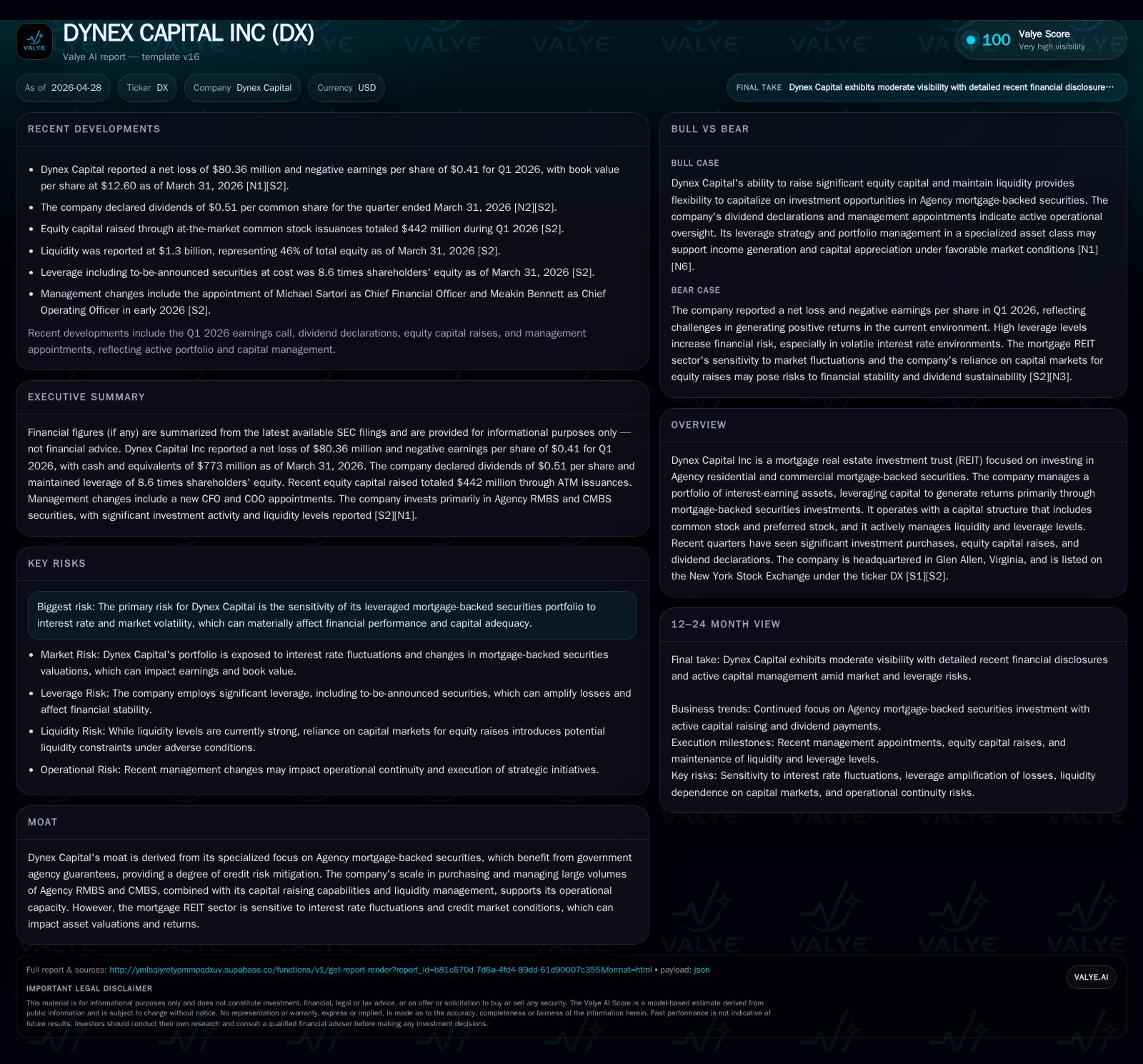
In its Q1 2026 filings, Dynex Capital demonstrated aggressive portfolio expansion through $6 billion of net Agency RMBS and CMBS purchases, funded by $442 million raised via ATM equity issuances. The company’s Board approved a renewed share repurchase plan authorizing up to $350 million in stock buybacks. Despite recent quarterly losses attributed to interest rate volatility, Dynex maintains robust liquidity near $1.3 billion and an 8.6x leverage multiple, reinforcing its strategy to capitalize on government-backed mortgage securities markets. Investors should monitor execution of buybacks, book value trends, and the interplay between interest rates and leveraged asset returns.
Latest Operating Highlights Signal Strategic Portfolio Aggressiveness
Dynex Capital’s Q1 2026 10-Q filing reveals a notably assertive approach to portfolio management underpinned by significant investment inflows into agency mortgage securities. The company completed net purchases totaling approximately $6 billion across Agency residential mortgage-backed securities (RMBS) and commercial mortgage-backed securities (CMBS) during the quarter [S2][S5]. This outsized purchase volume coexists with a cash and liquidity position near $1.3 billion—around 46% of shareholders’ equity—indicating ample ready capital to support ongoing trading activity [S2]. Meanwhile, leverage expanded appreciably to a ratio of 8.6 times equity when factoring in to-be-announced (TBA) securities at cost, illustrating Dynex's willingness to deploy greater borrowed funds to amplify returns despite prevailing market volatility [S2].
Concurrent with these purchasing activities, Dynex executed equity capital raises totaling $442 million via at-the-market (ATM) programs, providing fresh common stock proceeds that underpin its asset acquisition momentum [S5]. Complementing this growth posture is the April 2026 Board approval of a broad share repurchase authorization permitting up to $300 million in common stock and $50 million in preferred stock buybacks over the next two years [S3][S19], signaling confidence in valuation and proactive capital management.
Despite reporting a comprehensive loss of $(0.42) per common share due primarily to mark-to-market impairments related to rising interest rates [S5], management’s simultaneous push for portfolio accretion combined with liquidity preservation underscores a strategically opportunistic stance amidst cyclical challenges.
Business Model: Agency Mortgage Securities Focus and Risk Mitigation
Dynex operates as a specialized mortgage REIT concentrated almost exclusively on Agency residential and commercial MBS—securities backed or guaranteed by U.S. government agencies such as Ginnie Mae or government-sponsored enterprises like Fannie Mae and Freddie Mac [S1]. This focus materially reduces credit risk exposure because principal and interest payments are secured by full faith government guarantees absent borrower default risk typically seen in non-agency MBS.
The firm’s revenue generation primarily stems from interest margin spreads derived from purchasing these Agency securities using both shareholder equity and debt leverage [S1]. Profitability depends on carefully managing these spreads relative to financing costs while navigating the inherent sensitivity of fixed-income instruments to changes in interest rates. While this model offers structural benefits via credit stability, it is highly vulnerable to market-wide shifts in rates that affect bond prices, hedging efficacy, and book value fluctuations.
Dynex leverages its scale advantage by controlling large volumes of highly liquid agency RMBS/CMBS positions allowing for nimble trading or repositioning when strategic [S1]. The use of TBA contracts further facilitates effective forward-buying strategies within the agency MBS ecosystem.
Competitive Positioning in a Niche Agency MBS Market
Within the mortgage REIT industry landscape, firms focusing on Agency MBS like Dynex occupy a niche characterized by intense scrutiny around balance sheet efficiency, leverage policies, asset quality, and risk hedging sophistication [S1]. The Agency MBS market benefits from relatively deep liquidity compared with non-agency counterparts, reducing transaction frictions for sizable portfolio adjustments.
Competitive dynamics revolve around obtaining an edge via cost-effective financing access—often facilitated through secured borrowings—and precise management of spread differentials versus funding costs under volatile rate regimes [S1]. Dynex’s track record of large monthly purchases affirms its operational capability to source premium agency collateral swiftly amid peers chasing similar yield objectives.
Regulatory considerations impose capital adequacy rules that influence leverage ceilings—a key competitive boundary within which Dynex operates conservatively by maintaining leverage levels near but below double-digit multiples [S2]. This positioning mitigates forced deleveraging risks while enabling ample runway for accretive investment activity.
Drivers and Constraints on Growth: Interest Rates, Leverage, and Equity Supply
Growth chiefly hinges on three interlinked factors: stable or narrowing spreads supporting reinvestment returns; ability to access incremental equity capital via ATMs fostering portfolio scaling; and prudent balance sheet leverage management providing amplification without excessive risk escalation [S2][S5][F1]. Dynex’s recent quarters demonstrate a reliable capacity to issue dilutive but value-supportive common shares backed by attractive dividend yields (~$0.51 quarterly per share), which appeal to income-seeking investor demand underpinning its capital mobility [S3][S19].
Conversely, cyclical constraints manifest principally through rising interest rate environments compressing book value growth as mark-to-market losses accrue on fixed income assets [S5]. These headwinds place pressure on net economic returns even amid portfolio growth initiatives given duration mismatches or imperfect hedging outcomes.
Leverage policies capped around 8.5-9x shareholders’ equity serve as guardrails balancing return enhancement vs solvency preservation—a crucial factor limiting exposure expansion during uncertain macro conditions [S2]. Liquidity above 40% of equity cushions against margin calls or forced sales.
Capital Allocation Moves: Dividends, Equity Raises, and Share Repurchases
Capital deployment reflects measured balancing between rewarding shareholders directly through quarterly dividends ($0.51 per common share declared in Q1), ongoing ATM-driven common stock issuance fueling investment capacity ($442 million raised recently), and proactive liquidity recycling via newly instituted sizeable share repurchases ($350 million authorized through April 2028) [S3][S5][S19].
These complementary moves signal management's intent to optimize capital structure dynamically: sustain dividend continuity as hallmark income focus; fuel growth with fresh equity rather than solely incremental debt; and opportunistically repurchase shares when market prices present perceived misvaluation or supportive entry points.
This tripartite approach helps align investor interests while maintaining operational flexibility amid fluctuating market conditions.
Upcoming Catalysts and Execution Markers to Monitor
Key near-term monitoring points include tracking Q2 book value per share trends post-interest-rate developments—the principal barometer for embedded economic gains or losses given asset mark-to-market sensitivities [N1][S2]. Execution cadence and volume absorption under the new repurchase program will offer real-time clues on board-level conviction about underlying valuation mispricings or tactical capital reinvestment priorities [S3].
Further surveillance should focus on continued efficacy of ATM issuance programs sustaining seamless capital access without adverse market impact alongside distribution shifts between residential versus commercial agency MBS portfolios reflecting risk appetite nuances or yield optimization efforts.
Current Financial Snapshot Supporting Operational Narrative
The latest quarterly results tally a comprehensive loss approximating $(0.42) per common share driven largely by adverse mark-to-market accounting reflecting higher interest rates depressing bond values [S5]. Despite this near-term setback, cash & equivalents stand robustly at roughly $773 million as of March 31, 2026 reinforcing immediate liquidity strength supporting daily operations [F1]. Total reported outstanding debt is negligible relative to cash (~$5.9 million last reported), underscoring an effectively net cash position in liquid terms despite securitized leverage embedded within mortgage holdings [F1].
Dividend declarations remain consistent at $0.51 per common share demonstrating commitment toward steady shareholder yield profiles even through volatile interim earnings cycles [S5][S19]. Leverage including TBAs at an elevated but controlled 8.6x multiple balances aggressive capital deployment while reserving headroom for contingencies.
This financial profile provides measured backing for the stated operational strategy focused on accretive growth amid inevitable sector cyclicality typical of Agency MBS-centric mortgage REITs.
This analysis is based solely on publicly available SEC filings as indicated; it does not constitute an investment recommendation or advice. Readers should conduct independent due diligence before making financial decisions related to Dynex Capital Inc or its securities.
Disclaimer: This is research-only, informational analysis and not investment advice. It may include AI-generated interpretation and general industry context. Always verify important details using primary sources.

Comments