
Silicom Ltd. Files Quarterly Update Highlighting Design Wins and Inventory Strategy
Silicom’s latest quarterly disclosures emphasize new FPGA Smart NIC design wins and strategic inventory positioning as drivers of its near-term growth outlook.
In its recent April 2026 6-K filings, Silicom Ltd. announced a significant FPGA Smart NIC design win with a European secure communications customer, projecting approximately $3 million annual revenue. The company also reported elevated inventory levels aimed at supporting rising order fulfillment. Silicom’s product portfolio focuses on high-performance networking hardware tailored to cloud, data center, and edge computing environments, serving Tier-1 customers such as major cloud players and service providers. While the company navigates customer concentration risks and foreign currency exposure, its solid liquidity position and ongoing R&D investment sustain its competitive positioning in an evolving industry driven by disaggregation and AI acceleration trends.
Latest Quarterly Operating Highlights: Design Wins and Inventory Dynamics
Silicom Ltd.'s April 2026 SEC interim filings spotlight a pivotal design win: a $3 million annual FPGA-based Smart NIC contract secured with a European leader in secure communications [S2][S3]. This contract underscores Silicom’s competitive foothold within security-sensitive sectors that demand high-throughput, low-latency networking solutions fortified by programmable hardware acceleration. These FPGA Smart NICs cater to niche workloads such as cryptography offloading and real-time packet processing critical for national security applications.
Simultaneously, the company reported a notable inventory increase to $52.65 million at year-end 2025 from $41.06 million the prior year [S1][S5]. This buildup reflects strategic stockpiling to meet burgeoning customer orders aligned with their recently won contracts; however, it also introduces risk related to potential obsolescence or delayed turnover given the fast-evolving nature of networking hardware.
The inventory expansion coincides with cash flows turning negative in operations during 2025 ($2.16 million used), partly due to working capital tied in stocking components [S5]. Trade payables similarly increased significantly, indicating supplier support for this procurement push.
Silicom’s Business Model: Product Portfolio and Customer Relationships
At its core, Silicom designs, manufactures, markets, and supports advanced networking infrastructure components principally serving cloud data centers, telecom operators, and edge computing deployments worldwide [S1][S8]. Their products include high-speed server adapters capable of offloading compute-intensive network functions from CPUs; AI-accelerated NICs optimized for inference workloads; FPGA smart cards enabling customization; white-label switches; edge CPE devices; and emerging Post Quantum Cryptography hardware accelerators addressing long-term security demands.
Revenue generation hinges on B2B relationships primarily with Tier-1 cloud platforms, telecommunications providers, global service companies, and OEMs who integrate Silicom’s specialized hardware into scalable infrastructure stacks [S1]. A smaller fraction is sold through independent non-exclusive distributors.
High product quality combined with silicon-level acceleration confers critical competitive differentiation amid commoditization pressures elsewhere in server adapter markets. Furthermore, embedded programmability via FPGAs supports client-specific software-defined networking needs enhancing switching costs.
However, reliance on a few major customers exposes Silicom to significant concentration risk; their top three customers contributed about 28% of sales in 2025 [S16]. Such dependency may constrain pricing leverage but underscores the importance of maintaining strong integration partnerships.
Industry Context: Competitive Landscape and Market Segmentation
Silicom operates within the intensely competitive computer peripheral segment specializing in network interface cards (NICs) and data infrastructure components integral to distributed computing ecosystems [S1]. The sector faces formidable OEM competition alongside emergent vendors focused on disaggregated hardware approaches.
A dominant industry trend is decoupling - separating hardware procurement from software solutions - driven by demands for flexible multi-vendor environments supporting SD-WANs and NFV deployments common among cloud hyperscalers and telcos [S20]. This paradigm shift aligns well with Silicom’s innovation focus but pressures legacy appliance suppliers.
Supply chain complexity also remains relevant as semiconductors underpinning FPGA chips and NIC controllers are subject to global shortages or cost volatility. Being Israeli-based adds regulatory layers particularly involving export controls on cryptographic technologies.
Silicom’s strategy leverages technological innovation in AI inference acceleration NICs and early Post Quantum Cryptography accelerators aiming to capture growth pockets within evolving network security landscapes.
Growth Catalysts: Emerging Technologies and Customer Demand Drivers
Demand drivers supporting Silicom’s growth narrative include the rapid progression of AI workloads necessitating hardware-accelerated networking solutions capable of supporting massive parallel inference computations at the edge or data center [S1][S20].
Furthermore, design wins like the recent European FPGA Smart NIC deal validate momentum in security-hardened infrastructure segments where standard NICs fall short on performance or programmability requirements [S2][S3].
Adoption of NFV continues expanding among service providers who prefer vendor-neutral hardware platforms capable of hosting multiple virtualized network functions simultaneously—an area where Silicom’s FPGA-enabled cards provide an advantage through custom accelerations.
Incremental penetration into Post Quantum Cryptography accelerators also targets long-term regulatory compliance markets anticipating quantum-resistant encryption mandates.
These trends are supported operationally by stable R&D spending remaining above $20 million annually (around one-third of revenues), reflecting commitment to sustaining technology leadership despite transient profitability challenges [S1][S17].
Operational Risks and Constraints: Customer Concentration and Currency Exposure
Key operational risks stem from substantial revenue concentration where top clients represent about a quarter to a third of total sales annually—a source of potential volatility if any suffer financial difficulties or alter procurement strategies abruptly [S16].
Foreign currency fluctuations pose additional challenges because while revenues are predominantly USD-denominated (functional reporting currency), costs largely incur in Israeli Shekels (NIS) or Danish Kroner (DKK) due to geographic operational footprint [S1][F1][S27]. Variations in exchange rates influence payroll expenses (notably R&D headcount remuneration) and raw material purchase costs impacting margins.
Inventory levels elevated for order fulfillment introduce risks relating to write-downs from obsolescence if technology cycles accelerate faster than anticipated demand conversion rates [S4][S5]. However, write-down percentages improved slightly in 2025 compared to prior years indicating better inventory management controls.
Mitigation factors include prior government R&D grants partially offsetting development costs as well as healthy cash reserves ($35.2 million) ensuring balance sheet flexibility during market uncertainties [F1][S17].
What to Watch Next: Milestones, Earnings Guidance, and Market Signals
Attention turns toward Silicom’s upcoming June 3rd Annual General Meeting that may present strategic updates or governance shifts influencing investor confidence [S2]. Subsequent quarterly earnings could disclose early revenue recognition from newly announced design wins especially the European Smart NIC contract tracking toward full-year run rate realization.
Critical execution markers involve demonstrating effective inventory turnover without excessive burn spreads as well as managing customer concentration—potential shifts indicating diversification or reliance intensification will be informative.
Market watchers should also monitor broader sector dynamics around supply chain stability especially semiconductor availability entwined with geopolitical developments that could affect export compliance requirements critical for Israeli tech firms like Silicom.
Supporting Financial Overview: Liquidity, Margin Trends, and Profitability
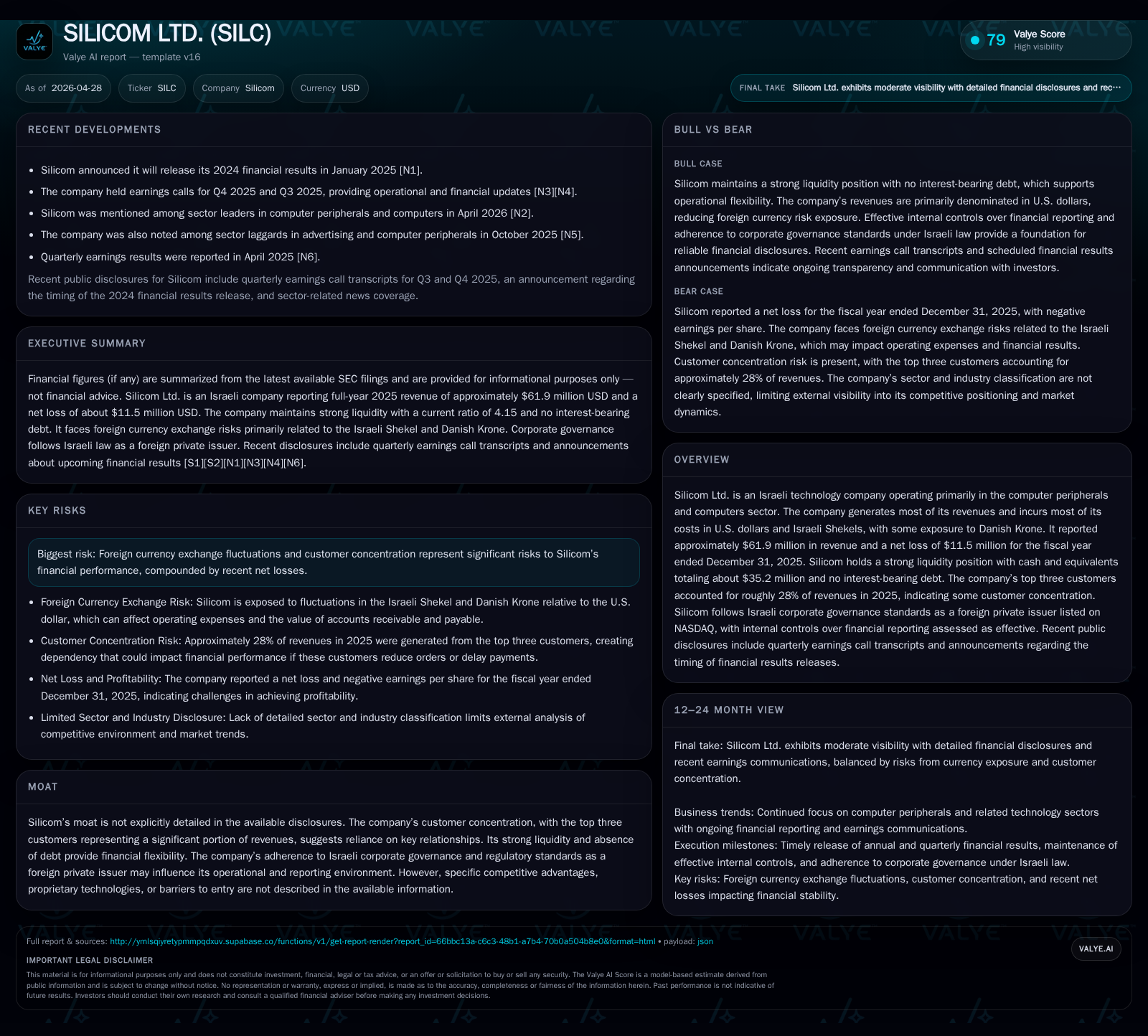
Silicom reported FY2025 revenues of approximately $61.9 million representing a modest recovery (+6.6%) over $58.1 million in FY2024 after steep declines triggered by prior inventory corrections across customers’ supply chains [F1][S4].
Gross margin improved to 30.6%, up from 28.6% the previous year reflecting beneficial product mix shifts favoring higher-margin accelerated hardware offerings despite incurring inventory write-down adjustments reducing overall profit impact somewhat [S4].
Operating loss narrowed but remained at approximately $12.3 million driven by sustained R&D spending near $20 million (32% of sales) aimed at future-proofing platform capabilities against rising competition across AI NICs & crypto acceleration markets [F1][S4].[F1]
Liquidity remains robust with $35.2 million cash equivalents on hand plus no interest-bearing debt lowering financial risk significantly amid capital intensive scaling efforts [F1].[F1]
In summary, Silicom maintains financial resilience while investing aggressively into specialized networking hardware innovations targeting growth markets shaped by evolving cloud architectures, disaggregated telecom infrastructures, AI acceleration necessities and cyber-secure communications demand dynamics.
Disclaimer: This analysis is for informational purposes only and does not constitute investment advice or recommendations.
Disclaimer: This is research-only, informational analysis and not investment advice. It may include AI-generated interpretation and general industry context. Always verify important details using primary sources.

Comments