
Bed Bath & Beyond Leverages Strategic Acquisitions to Bolster Market Reach
The company narrows Q1 losses while advancing merger integration and capital strategies amid market challenges.
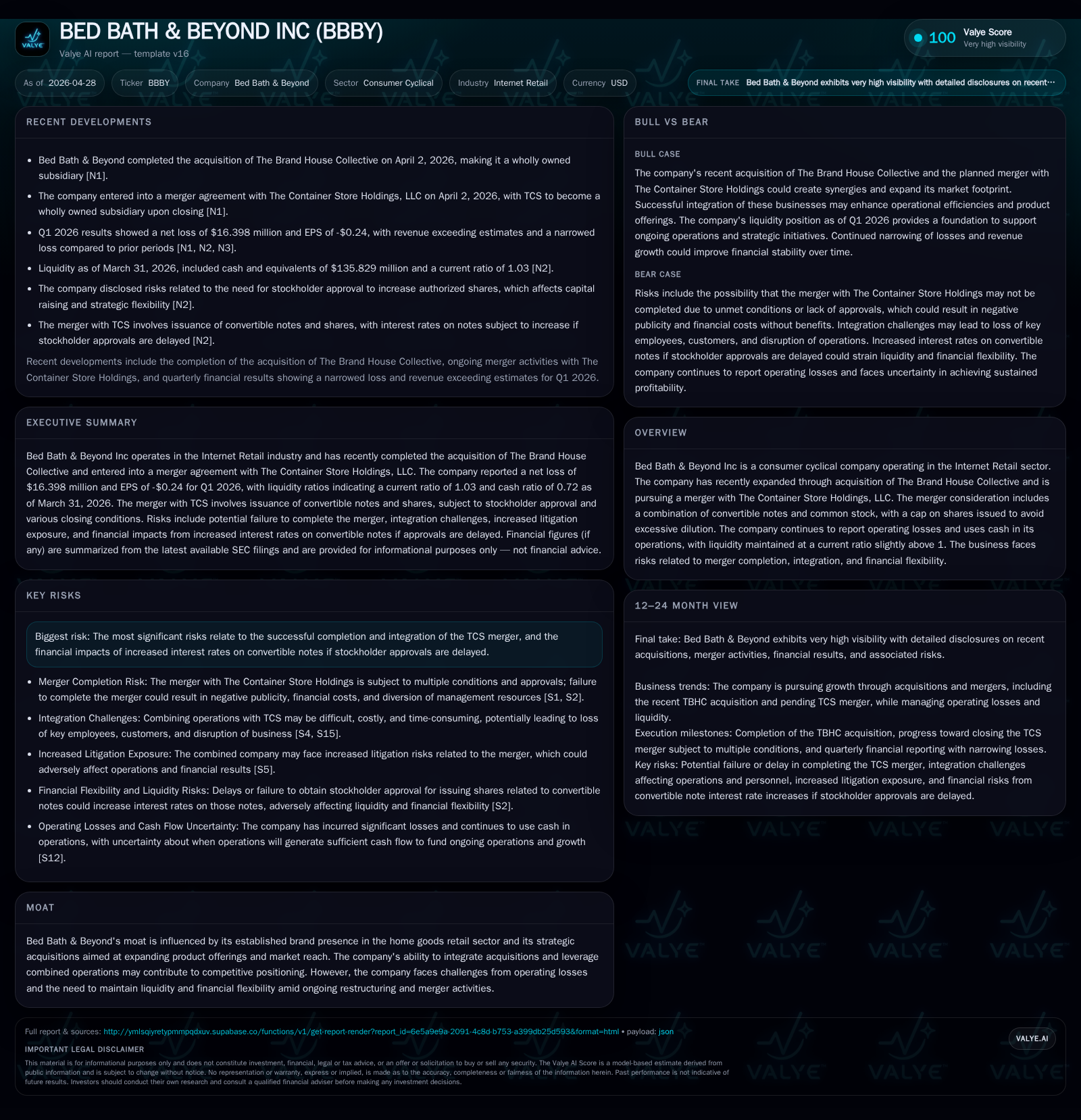
Bed Bath & Beyond reported a narrowed operating loss and revenue beating estimates in its Q1 2026 filing, reflecting early signs of operational stabilization. The recent completion of The Brand House Collective acquisition and the pending merger with The Container Store are central to its strategy to expand product offerings and market presence. However, risks surrounding merger completion, integration challenges, and financing flexibility remain significant near-term hurdles. The company maintains a tight liquidity position while navigating shareholder votes critical for capital structure adjustments.
Latest Operating Update: Q1 2026 Performance Highlights
Bed Bath & Beyond's 10-Q filed April 27, 2026, reveals a reduction in quarterly operating losses versus prior periods alongside revenues that outperformed analyst expectations [S2][N2][N5]. The narrowing loss reflects both cost controls and modest sales improvement despite ongoing headwinds in consumer spending on discretionary home goods. Importantly, the company reported a current ratio of 1.03 with $136 million in cash and equivalents as of March 31, 2026, indicating sufficient liquidity to sustain operations during its restructuring phase [F1]. Concurrent event filings reinforce transparency with investors regarding progress on strategic initiatives including significant merger developments [S3].
Business Model and Revenue Drivers in Evolving Consumer Retail
Bed Bath & Beyond operates primarily as an internet retail platform specializing in home goods, leveraging a broad product assortment aimed at middle-to-upper income consumers seeking quality household items [S1]. The business model generates revenue through direct online sales augmented by acquisitions that add niche brands and specialized inventory. Most recently, the purchase of The Brand House Collective broadened BBBY’s product mix into lifestyle brands targeting connoisseurs of design-oriented home furnishings [S13]. This acquisition complements the baseline internet retail model by creating higher engagement and greater monetization potential within an evolving digitally enabled purchasing environment where brand loyalty and convenience are critical.
Customer retention is tied to BBBY's extensive assortment combined with strategic cross-channel capabilities, though the sector faces margin pressures due to competitive pricing dynamics and fulfillment logistics costs inherent in home goods distribution [N3]. Effective integration of acquired entities into the ecommerce ecosystem is pivotal to sustaining revenues while improving profitability over time.
Competitive Positioning within Home Goods Internet Retail
Within the fragmented home goods retail industry, BBBY contends with powerful competitors ranging from Amazon’s marketplace dominance to specialized brick-and-mortar chains transitioning online. Pricing power remains challenged as commoditization intensifies; however, BBBY's established brand recognition offers an advantage in attracting repeat customers seeking trusted quality amidst myriad choices [S1][N1].
The company also faces supply chain complexities common in furniture and decor categories such as lead-time variability and import dependencies that can inhibit inventory responsiveness—a key factor in consumer satisfaction. Platform integration efforts seek to harmonize user experience across digital and physical touchpoints but require significant investment.
Strategic Acquisition and Merger Initiatives Influence Market Reach
In April 2026, BBBY completed its acquisition of The Brand House Collective (TBHC), acquiring additional lifestyle brands expected to yield incremental revenue streams while enhancing BBBY’s design-oriented offering [S13][S25]. This move aligns with their broader strategy to diversify product lines beyond traditional mass-market categories.
More consequential is the pending merger agreement with The Container Store Holdings (TCS), announced in early April, intended to create a combined entity with expanded distribution scale and complementary market segments [S27]. The transaction consideration includes issuance of $54 million senior convertible notes alongside common stock subject to a shareholder-approved cap to manage dilution risk [S2][S3]. These convertible instruments feature escalating coupon rates contingent on timely stockholder approval—an unusual structural element placing emphasis on governance milestones for financial cost containment.
While synergies from consolidation could improve procurement economics and cross-selling opportunities, integration risk looms given differing operational models between BBBY’s ecommerce roots and TCS’s specialty retail footprint.
Growth Prospects and Constraints Amid Integration and Capital Needs
The core growth thesis rests on leveraging combined scale from TBHC acquisition plus TCS merger to deepen penetration within home organization and lifestyle categories. Operational efficiencies expected include streamlined supply chain management, marketing coordination, and consolidated IT platforms enabling better customer analytics [N3][S2]. However, these gains may be offset short-term by ongoing losses pressured by restructuring expenses and elevated interest costs linked to convertible note servicing.
Capital constraints are underscored by dependence on shareholder vote outcomes regarding authorized share increases required for financing flexibility under New York Stock Exchange rules [S2].
Risks Around Merger Completion and Financial Flexibility
Merger completion remains conditional on multiple regulatory approvals including lender consents for TCS loans, absence of prohibitive legal orders, and shareholder votes [S21][S26]. Failure or delays increase risk of escalating interest rates on convertible notes—from initial 5% up to potentially 12%—adversely impacting liquidity and financial flexibility.
Additional risks stem from possible litigation challenging merger terms or fiduciary duties which might result in costly defensive actions diverting management focus. The company will also face goodwill impairment testing post-merger that could introduce non-cash charges if expected synergies fall short [S21]. Furthermore, disruption among customers or partners due to merger uncertainty could hamper revenue flow temporarily.
Near-Term Catalysts: Shareholder Votes and Operational Milestones
A key upcoming event is the stockholder meeting scheduled for mid-2026 where approval of the Share Increase Amendment will determine BBBY’s ability to issue shares beyond current limits critical for servicing convertible securities tied to TCS merger consideration [S2][N2]. Positive vote outcomes will alleviate refinancing pressure while enabling strategic initiatives requiring capital allocation.
Operationally, progress toward full systems integration of TBHC assets alongside initial steps toward absorbing TCS business will serve as important markers watched closely by investors for validating synergy forecasts.
Brief Financial Summary: Liquidity and Capital Structure Snapshot
Bed Bath & Beyond ended Q1 2026 with cash & equivalents totaling approximately $136 million against current liabilities near $190 million yielding a current ratio just above unity at 1.03—reflecting tight albeit adequate working capital coverage [F1]. Total debt stands relatively low around $34 million based on best available estimates though leverage metrics are impacted by ongoing operating losses.
Operating cash flow remains negative driven by restructuring outlays but liquidity levels generally support near-term obligations including interest payments on convertible notes should delays in shareholder approval prolong elevated coupon conditions [F1][S11].
Disclaimer: This is research-only, informational analysis and not investment advice. It may include AI-generated interpretation and general industry context. Always verify important details using primary sources.

Comments