
Cincinnati Financial Corp Reports Strength in Q1 Results Anchored by Underwriting Discipline
Cincinnati Financial delivered robust first-quarter 2026 results driven by disciplined underwriting and solid liquidity management.
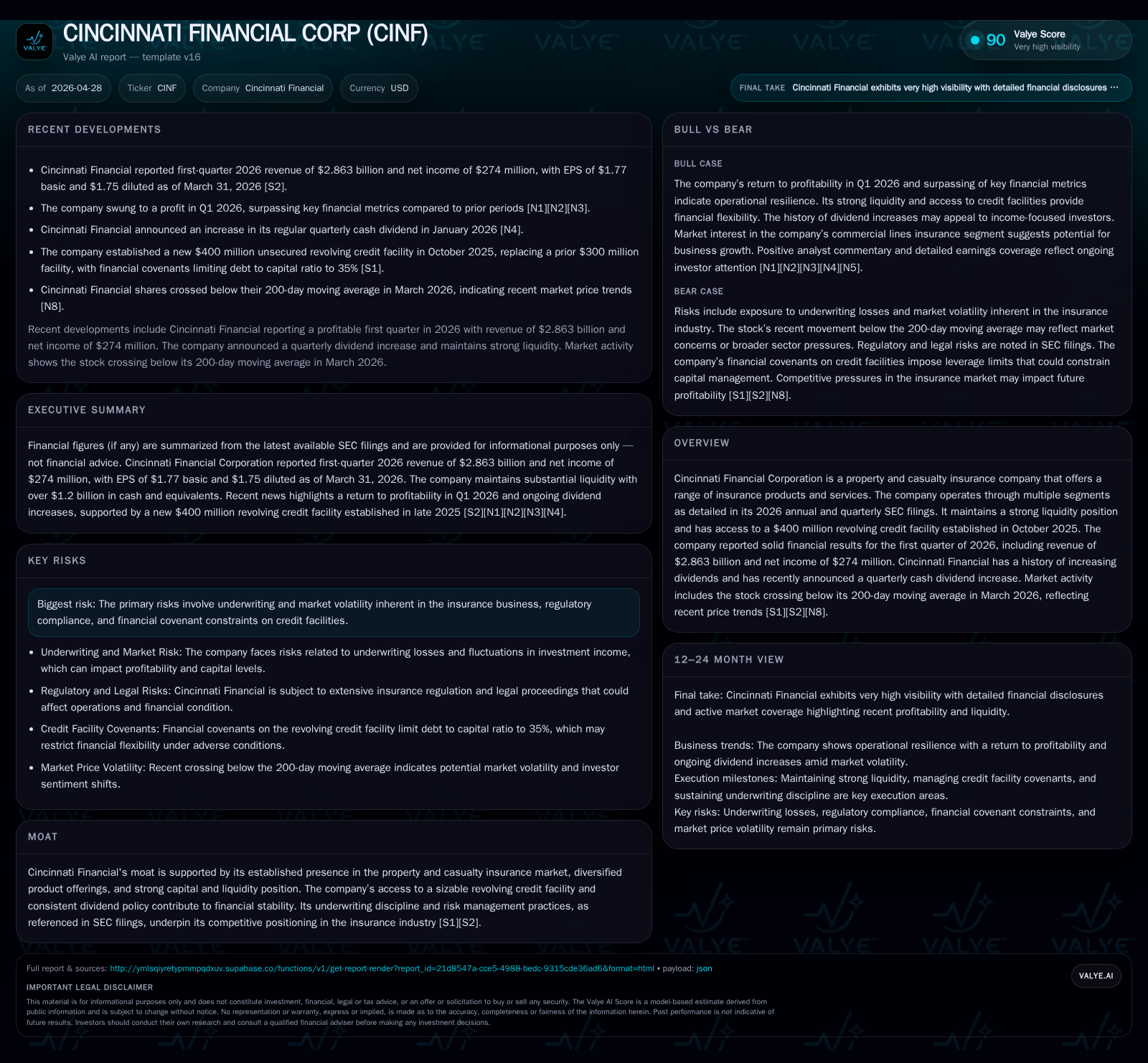
Cincinnati Financial Corporation reported strong first-quarter revenue of $2.863 billion and net income of $274 million, exceeding market expectations. The company’s legacy property and casualty insurance business continued to benefit from disciplined underwriting and effective risk management, supported by a stable balance sheet and a $400 million revolving credit facility established in late 2025. Despite challenging industry dynamics, Cincinnati Financial’s diversified product offerings and capital strength underpin its competitive moat, with dividend increases signaling confidence in ongoing operational resilience.
Q1 2026 Operating Update: Earnings and Revenue Highlights
In the latest quarterly filing dated April 27, 2026 [S2], Cincinnati Financial Corporation reported first-quarter revenue totaling approximately $2.863 billion alongside a net income of $274 million [S3][N1][N2]. This performance notably exceeded analyst consensus estimates for the period [N1], signaling operational resilience within its core property and casualty insurance business. Importantly, the company announced an increase in its regular quarterly cash dividend earlier in the year [S8], which underscores management's confidence in underlying earnings power and cash flow stability.
Market response to these results included the stock trading below its 200-day moving average earlier in March but showing stabilized activity around the earnings release date, reflecting cautious investor sentiment balanced by solid fundamentals [N8][N13]. The consistency of these quarterly results maintains momentum following a strong full-year 2025 performance documented in the prior annual report [S1].
Business Model and Product Offering Excellence in Property & Casualty Insurance
Cincinnati Financial generates revenue predominantly through diversified lines of property and casualty (P&C) insurance products offered across multiple segments as outlined in its 2026 annual filing [S1]. The company's operations are strategically segmented into agency operations providing insurance to individuals and businesses, insurance underwriting units managing risk selection and pricing discipline, as well as investment income generated from reserves.
Product quality is emphasized within specialized coverage sectors including commercial lines, personal lines, bond products, and specialty coverages [S1]. The firm’s enduring commitment to underwriting discipline serves as a moat driver by enabling selective risk acceptance which supports pricing power and mitigates loss frequency/severity variability. This agility fosters stable margin profiles even amid cyclical claims environments common in P&C markets.
Moreover, Cincinnati Financial leverages longstanding agency relationships to maintain customer retention rates that contribute to predictable premium flows and renewal stability [S1]. This distribution advantage creates switching costs that help sustain market share against peers.
Competitive Position and Industry Dynamics Shaping Cincinnati Financial
Within the broader P&C insurance industry landscape, Cincinnati Financial occupies a position supported by scale yet distinct due to its balanced focus between commercial and personal insurance lines [S1]. The sector is characterized by moderate supply-demand imbalance pressures as risk management sophistication grows among insured parties while evolving regulatory requirements impose compliance costs [S4].
Pricing power is preserved partly through Cincinnati’s proven track record of disciplined underwriting standards combined with calibrated capacity deployment. However, competitive pressure exists from larger multi-line insurers as well as emerging insurtech entrants leveraging data analytics for efficient pricing.
Claims environment volatility remains an industry constant influenced by weather patterns, economic conditions affecting loss frequency, and inflationary trends impacting claim settlement costs. Cincinnati’s risk management expertise facilitates prudent reserving practices that temper earnings shocks related to adverse development.
Regulatory landscapes necessitate continuous monitoring due to potential changes impacting capital adequacy requirements or consumer protection statutes [S4]. This dynamic compels insurers like Cincinnati to maintain conservative governance frameworks.
Key Growth Drivers: Market Penetration, Underwriting Discipline, and Capital Strategy
Growth catalysts for Cincinnati Financial hinge on several measurable factors. Geographic expansion of select insurance products via dedicated agency channels constitutes a structural opportunity for premium volume gain [N11]. Furthermore, tightening underwriting criteria contributes to margin enhancement by reducing loss ratios without sacrificing growth prospects [S2].
Capital strategy incorporates maintaining financial flexibility highlighted by access to a $400 million revolving credit facility initiated in October 2025 [S10]. This facility underpins tactical initiatives ranging from opportunistic acquisitions to bolstering working capital during claim surges. Its terms reflect modest borrowing costs tied to the company’s senior unsecured debt ratings.
Dividend policy remains a key signal of corporate health; sequential increases demonstrate management's assessment that cash generation can sustainably support shareholder returns while funding ongoing operations [S8]. Consistent dividend hikes typically correlate with favorable operating leverage realized through scale economies.
Overall demand is structurally driven given the essential nature of P&C insurance products for both commercial enterprises guarding assets and personal customers protecting property holdings. Given such cyclicality common across the P&C sector, ongoing vigilance around claims development trends is critical.
On the regulatory front, evolving compliance demands—particularly around solvency frameworks—require anticipatory adjustments that may impact capital allocation or product design flexibility [S4][S21]. Failure to adapt efficiently could handicap competitive positioning.
Moreover, any event default provisions related to timely payments or covenant breaches emphasize conservative financial stewardship as imperative going forward.
Upcoming Monitoring Points: Guidance, Milestones, and Execution Signals
Moving ahead into mid-2026 and beyond, key points warrant close observation by stakeholders including updated company guidance reflecting Q1 earnings drivers/remediations as per recent MD&A disclosures [S3]. Watchpoints include whether margin targets continue firming amid claims volatility or if emerging industry cost pressures necessitate pricing amendments.
Confirmation of segment-level growth trajectories—especially within commercial lines—and whether dividend increases persist represent tangible execution signals supporting confidence in operational strategy [N5][N7].
Additionally, any shifts in risk exposure based on claims severity assessments or structural changes in reinsurance arrangements could materially influence outlooks.
Finally, strategic utilization or expansions under the revolving credit facility framework will offer insights regarding capital deployment priorities relative to organic growth versus M&A activities.
Summary of Financial Liquidity and Profitability Snapshot
Cincinnati Financial closed Q1 2026 with a cash and equivalents balance of approximately $1.21 billion offsetting total debt outstanding near $859 million — effectively resulting in a net cash position of about $351 million as per latest balance sheet data [F1][S2]. This liquidity coupled with prudent leverage metrics buttresses the company's ability to support dividends while maintaining operational flexibility amidst market uncertainties.
Profitability evidenced by net income of $274 million demonstrates effective conversion of underwriting performance alongside investment income contributions aligned with corporate financial goals set forth last fiscal year [S2][F1]. Such capital strength underpins overall confidence in sustaining long-term shareholder value creation prospects without compromising prudent risk-taking thresholds.
This analysis synthesizes publicly available data as of April 27–28, 2026 from SEC filings including latest quarterly (10-Q), recent event filings (8-K), annual reports (10-K), supplemented by select market news coverage. It aims solely to provide a grounded business overview without expressing investment advice or projections.
Disclaimer: This is research-only, informational analysis and not investment advice. It may include AI-generated interpretation and general industry context. Always verify important details using primary sources.

Comments