
Easterly Government Properties Faces Profitability Pressure and Limited Liquidity in Q1 2026
Q1 results highlight narrowing net income and ongoing leverage challenges amid a specialized government property niche.
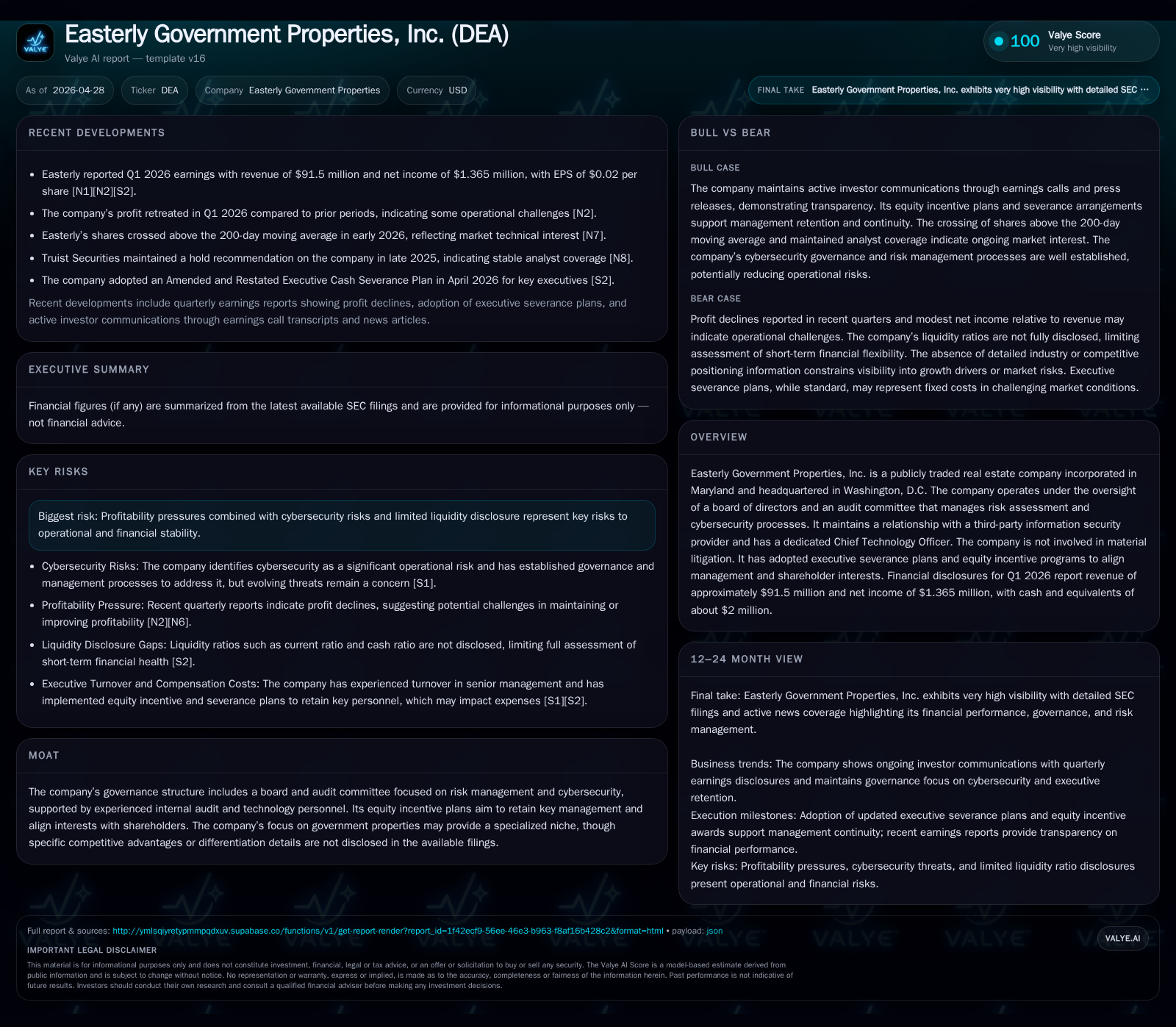
Easterly Government Properties reported $91.5 million in revenue but saw net income contract to approximately $1.4 million in Q1 2026, reflecting profitability pressures. The company maintains a portfolio focused on government real estate, leveraging specialized assets and long-term leases, yet faces liquidity constraints with cash of about $2 million versus significant debt nearing $1.7 billion. Corporate governance emphasizes risk management and cybersecurity, supported by equity incentives designed to align management and shareholder interests. Structural growth drivers center on the stable demand for government-leased properties, though growth may be limited by capital structure and tight liquidity.
Recent Operating Update
Easterly Government Properties filed its latest quarterly report on April 27, 2026 [S2], providing a clear window into its near-term operating landscape. The first quarter financials reveal approximately $91.5 million in revenue coupled with net income of only $1.365 million [N1][S3]. This margin compression suggests rising costs or other profitability pressures despite stable revenues. Cash and equivalents stood at approximately $2.0 million as of March 31, 2026, while total debt was reported at about $1.68 billion as of December 31, 2025 [F1]. Meanwhile, management moved to amend its executive severance plan in April 2026 [S2], signaling continued emphasis on leadership stability through incentive alignment.
This quarterly dynamic matters now because it underscores Easterly's ongoing challenge balancing its niche government leasing model with the realities of a leveraged capital structure amid a pressured macroeconomic environment.
Business Model Overview
Easterly Government Properties operates as a publicly traded real estate investment trust focused primarily on owning, acquiring, and managing commercial properties leased almost exclusively to U.S. government agencies [S1]. The core business model revolves around securing long-term leases with federal entities that provide relatively stable rental income compared to traditional commercial REIT peers exposed to variable market demand.
Revenue generation stems from rental payments under these government leases. However, margins can be compressed by operational expenses, interest costs from substantial indebtedness, and maintenance of specialized facilities meeting stringent federal criteria. Due to the nature of tenant profiles — primarily federal agencies — credit risk is mitigated but lease renewal cycles correspond closely to government budgetary cycles, which can be lumpy.
The company's recent amendments to expand equity incentive pools and revise severance terms demonstrate efforts to maintain experienced management capable of navigating this specialized segment [S2][S3]. Alongside this, the governance structure places strong emphasis on cybersecurity risk oversight due to growing digital threats impacting both real estate operations and associated tenant needs [S1].
Industry Structure and Competitive Position
Within the U.S. REIT landscape, Easterly occupies a distinctive niche focusing exclusively on properties leased to government entities primarily at federal installations – often referred to as 'government properties REITs.' This sub-sector benefits from structural demand driven by sustained government need for office space, labs, and data centers compliant with federal standards.
Competition exists from both broad-based office REITs that serve diverse tenants including government customers and specialist firms focusing solely on governmental leases. Easterly's competitive edge lies in its deep expertise managing compliance-heavy assets and maintaining strong tenant relationships within bureaucratic channels [S1]. However, this specialization also constrains scale diversification and exposes Easterly more directly to political/regulatory risk cycles impacting federal spending.
Furthermore, the industry contends with macroeconomic factors such as rising interest rates affecting borrowing costs and potential restrictions on capital deployments due to regulatory scrutiny over defense or intelligence-related real estate assets.
Growth Drivers and Constraints
Structurally, Easterly is positioned to benefit from enduring federal leasing demand — especially given limited new construction within secure or designated federal zones nationally. Backlog or renewal activity may provide organic expansion if managed effectively alongside prudent capital recycling.
The company's recent filing outlines no material litigation risk but highlights cybersecurity measures as critical risk components within operational strategy [S1]. Ensuring uninterrupted facility access aligned with tightening cybersecurity requirements can create entry barriers enhancing strategic differentiation.
On the constraint front, leverage levels are substantial relative to available liquidity—net debt approaches $1.67 billion while cash balances remain low [F1]. This tight financial profile restricts flexibility for opportunistic acquisitions or large-scale redevelopments without refinancing initiatives.
Management’s efforts to extend credit facilities, such as the 2018 Term Loan amendment extending maturity into 2028 with optional extensions backed by banks in August 2025 [S23], illustrate an attempt to mitigate refinancing risks amidst volatile credit markets.
Incremental equity compensation authorizations expanded in April 2026 [S26] may also shore up internal capabilities necessary for pursuing future growth pathways.
What to Watch Next
Investors should monitor key performance indicators including occupancy rates across the portfolio since these directly feed into rental revenue stability. Lease renewal terms will be informative regarding pricing power within government contract environments.
Additionally, updates stemming from regulatory developments affecting governmental lease mandates or cybersecurity compliance requirements could materially influence operational cost bases or tenant retention dynamics.
Easterly’s upcoming quarterly earnings calls and supplemental disclosures will provide incremental transparency on these execution points [N1].
Financial Profile Summary
The latest quarterly update confirms revenue near $91.5 million for Q1 2026 with trailing net income sharply reduced to around $1.365 million—a sign of margin pressure [F1][N3]. Cash reserves remain modest at approximately $2.0 million as of March 31, 2026, against total reported debt of about $1.68 billion as of December 31, 2025 [F1]. This financial profile indicates a leveraged position that may limit discretionary investment capacity absent new capital raises or refinancing arrangements.
Despite this leverage challenge, steady rent inflows tied to long-duration government leases provide some revenue predictability uncommon in other commercial real estate sectors.
Corporate governance efforts enhancing executive severance terms and expanding equity incentive programs reflect proactive management alignment strategies aimed at steering through current headwinds [S2][S26].
This report is provided for informational purposes only and does not constitute investment advice or recommendations regarding securities of Easterly Government Properties, Inc.
Disclaimer: This is research-only, informational analysis and not investment advice. It may include AI-generated interpretation and general industry context. Always verify important details using primary sources.

Comments