
Sanmina Advances Integrated Manufacturing with Q2 2026 Earnings Upside
Sanmina’s Q2 2026 results underscore growth momentum driven by robust demand in cloud infrastructure and industrial sectors amid sustained pricing pressures.
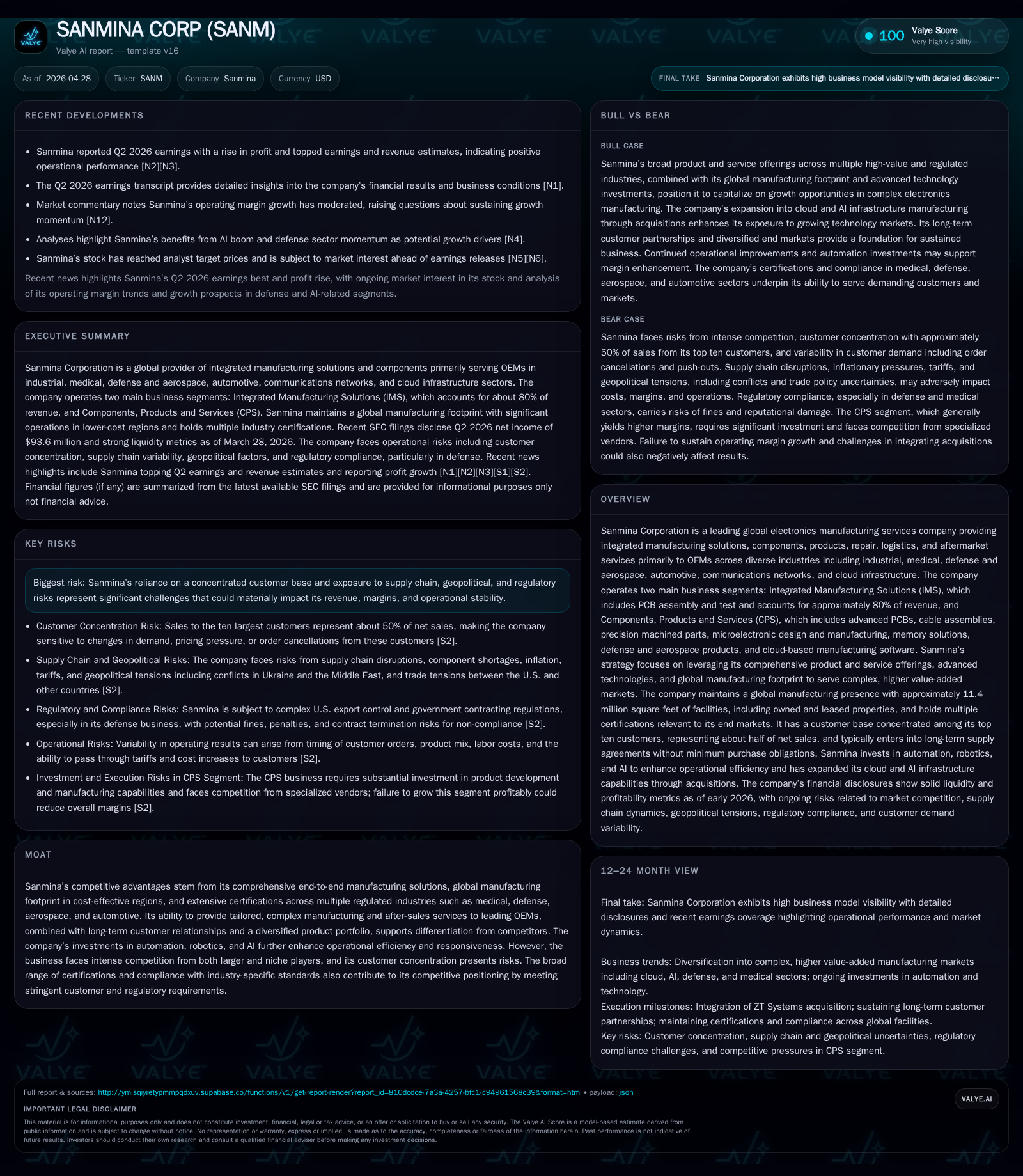
Sanmina Corporation reported stronger-than-expected Q2 2026 earnings driven by revenue growth in its core Integrated Manufacturing Solutions segment, supported by resilient demand for electronics manufacturing services in cloud infrastructure and industrial markets. The company leverages its end-to-end manufacturing capabilities, global footprint, and multi-sector certifications to maintain competitive differentiation, even as pricing pressures persist. Key growth drivers include investments in automation and robotics, expanding medical device manufacturing, and defense sector modernization, while risks stem from customer concentration, supply chain volatility, and regulatory complexities. Sanmina’s sound liquidity and manageable leverage support ongoing capital deployment toward technological upgrades.
Q2 2026 Operating Update: Revenue and Margin Highlights
Sanmina's latest quarterly filing dated April 27, 2026 ([S2]) reveals continuing operational momentum into the second fiscal quarter. The firm beat earnings expectations with revenue gains notably fueled by its core markets of cloud infrastructure build-out and industrial sectors where electronic manufacturing services are critical. Although pricing pressure remains acute among customers—particularly major cloud service providers—Sanmina managed to sustain margin expansion through disciplined cost controls and scaling benefits. The concurrent Form 8-K release ([S3]) confirms these highlights alongside management's transcript commentary ([N1], [N2]) stressing operational leverage gains helped by improved factory efficiencies and an uptick in higher value-add product mix.
Integrated Manufacturing Model and Service Quality Differentiation
Sanmina predominantly operates through two segments: Integrated Manufacturing Solutions (IMS), which accounts for approximately 80% of revenue, focusing on printed circuit board (PCB) assembly and testing; and Components, Products & Services (CPS), which encompasses advanced PCBs, cable assemblies, precision machined parts, microelectronics design/manufacturing, memory solutions, defense products, and manufacturing software ([S1]).
The company’s business model hinges on delivering end-to-end solutions tailored to original equipment manufacturers (OEMs) operating across industrial, medical, defense/aerospace, automotive/transportation, communications networks, and cloud infrastructure domains ([S1], [F1]). This approach benefits from deep customer collaboration embedding Sanmina early into product life-cycles.
Certification breadth is a formidable competitive moat: virtually all facilities carry ISO 9001:2015 accreditation; many hold TL 9000 certification crucial for telecommunications clients; centers of excellence in medical manufacturing maintain ISO 13485:2016 plus FDA/MDSAP compliance ([S1]). Such quality standards underpin trust with OEMs managing highly regulated environments. Additionally, Sanmina’s global footprint includes owned facilities totaling over nine million square feet complemented by leased spaces across Americas (dominantly Mexico), APAC (notably Malaysia), and EMEA regions ([S1], [S13]). This geographic diversity facilitates cost-effective manufacturing balancing labor cost savings with proximity to key customers.
Aftermarket repair services further enhance stickiness as OEMs seek partners capable of supporting complex lifecycle needs post-sale.
Competitive Dynamics in EMS Across Varied End Markets
The broader electronics manufacturing services space is marked by intense competition from both large EMS players like Flextronics and Jabil as well as niche specialists serving high-mix low-volume or heavily regulated segments ([S1], [N13]). Pricing remains especially pressured within Sanmina’s cloud infrastructure customer base due to buyer size concentration and their own competitive struggles ([S2]). However, Sanmina mitigates this somewhat through its diversified portfolio that includes robust defense/aerospace contracts requiring stringent regulatory compliance—a domain less susceptible to commoditization ([N14]).
Supply chain volatility continues to be a salient factor influencing operational execution; component shortages inject cost fluctuations requiring agile inventory management. These challenges have prompted Sanmina to accelerate investment in automation robotics integrated with AI capabilities to optimize factory throughput while maintaining quality controls ([N1], [S1]). These technological upgrades help defend unit economics against inflationary pressures.
Despite competitive intensity, long-standing OEM relationships supported by multi-industry certifications provide some insulation versus newer entrants lacking the depth or scale required for complex production mandates.
Key Growth Drivers: Technology Investments and Market Diversification
Capital expenditures directed toward automation including robotics enhanced by AI signal Sanmina’s commitment to driving future competitiveness ([N1], [S1]). This supports leaner operations amid labor market tightness globally. Moreover, increasing demand from medical device manufacturing—characterized by high technical complexity and regulatory scrutiny—offers structural growth as healthcare advancements expand product need ([S1]).
Cloud infrastructure buildup slated to continue underpins steady demand for communications network assembly expertise. Similarly, the defense sector’s modernization initiatives present longer-term tailwinds given higher barriers to entry attributable to export control regulations and compliance costs ([N14]).
Strategic diversification efforts targeting broader industrial applications help reduce exposure concentrations while capturing incremental demand streams driven by technology substitution trends like electric vehicles or renewable energy components.
Constraints on Growth: Customer Concentration and Supply Chain Risks
Notwithstanding growth areas, Sanmina faces notable constraints. Revenue remains significantly linked to a concentrated customer base where top ten clients contribute over half the sales ([S13]). This concentration imparts vulnerability if large OEMs cut orders due to price competition or capex pullbacks driven by macroeconomic uncertainties such as inflation or recession fears ([S2], [N7]).
Supply chain disruptions—including geopolitical tensions affecting chip sourcing—and rising component costs introduce risk around timing and margins on new program ramps ([S2], [N7]). Regulatory complexities inherent especially in defense production expose Sanmina to compliance risks that could impact contract continuance or generate fines if mishandled ([S11]). These factors collectively temper near-term visibility on steady margin improvement despite effective internal controls.
Monitoring Near-Term Milestones and Demand Indicators
Critical indicators for assessing Sanmina’s trajectory encompass new program wins poised to offset declines from end-of-life product cycles as discussed in management remarks during earnings calls ([N1], [N2], [S2]). Monitoring order flow patterns particularly from top-tier cloud infrastructure clients will reveal sustainability of recent revenue gains amid competitive pricing.
The pace of automation rollout within factories represents a key execution milestone tied directly to expected operating efficiency improvements. Supply chain continuity updates will further illuminate risk exposure levels. While explicit quarterly guidance was not detailed in filings examined here ([S2]), any updates referenced publicly remain important gauges for stakeholder assessment.
Financial Position Snapshot Supporting Operational Stability
As of March 28, 2026, Sanmina maintains robust liquidity with cash & equivalents totaling approximately $1.58 billion against total debt around $2.17 billion producing a net debt position near $600 million; combined with current assets of $7.61 billion vs current liabilities of $4.44 billion yields a healthy current ratio of about 1.71 conducive for meeting near-term obligations without stress ([F1]).
This financial flexibility enables continuation of strategic capital investments including automation enhancements while preserving balance sheet health against uneven macroeconomic backdrops. Absence of short-term borrowing draws under existing credit facilities also reflects manageable leverage levels supportive of sustainable operations ([F1]).
This analysis is based on the latest publicly available SEC filings including the April 27, 2026 Form 10-Q & Form 8-K as well as prior Form 10-K reports supplemented with recent earnings call transcripts and sector insights. It aims to provide a thorough business overview without investment recommendations.
Disclaimer: This is research-only, informational analysis and not investment advice. It may include AI-generated interpretation and general industry context. Always verify important details using primary sources.

Comments